 Back
ANP College Study Guide: Introduction to Anatomy & Physiology and Chemical Level of Organization
Study Guide - Smart Notes
 Tailored notes based on your materials, expanded with key definitions, examples, and context.
Anatomical Position and Terminology
Anatomical Position
The anatomical position is a standardized posture used as a reference in anatomy. The body stands upright, facing forward, with arms at the sides and palms facing forward. This position ensures consistency when describing locations and directions on the body.
Importance: Provides a universal frame of reference for anatomical descriptions.
Application: Used to describe the location of structures relative to one another.

Directional Terms
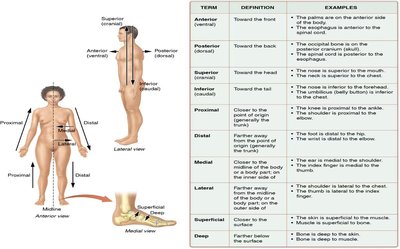
Directional terms are used to describe the locations of structures in relation to other structures or locations in the body.
Anterior (ventral): Toward the front of the body.
Posterior (dorsal): Toward the back of the body.
Superior: Toward the head.
Inferior: Toward the feet.
Proximal: Closer to the point of attachment.
Distal: Farther from the point of attachment.
Medial: Toward the midline.
Lateral: Away from the midline.
Superficial: Near the surface.
Deep: Farther from the surface.
Regional Terms
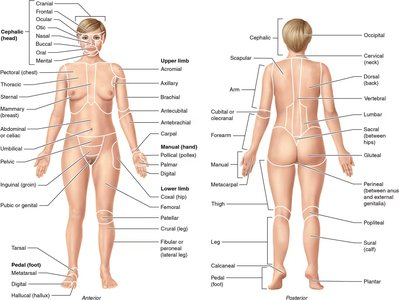
Regional terms specify distinct areas of the body, aiding in precise anatomical descriptions.
Cephalic: Head
Cervical: Neck
Thoracic: Chest
Abdominal: Abdomen
Pelvic: Pelvis
Brachial: Arm
Femoral: Thigh
Crural: Leg
Manual: Hand
Pedal: Foot
Body Planes and Sections
Planes of Section
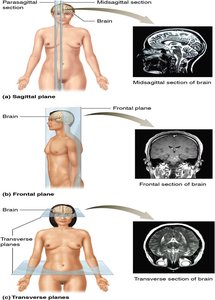
Body planes are imaginary lines used to divide the body into sections for anatomical study.
Sagittal Plane: Divides the body into left and right portions.
Frontal (Coronal) Plane: Divides the body into anterior and posterior portions.
Transverse Plane: Divides the body into superior and inferior portions.
Body Cavities
Major Body Cavities
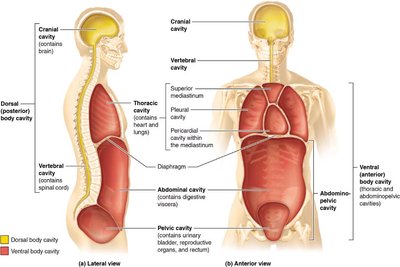
The body contains cavities that house and protect internal organs.
Dorsal Cavity: Contains the cranial and vertebral cavities (brain and spinal cord).
Ventral Cavity: Contains the thoracic and abdominopelvic cavities.
Thoracic Cavity: Contains heart and lungs.
Abdominopelvic Cavity: Contains digestive, reproductive, and urinary organs.
Abdominopelvic Quadrants and Regions
Abdominopelvic Quadrants
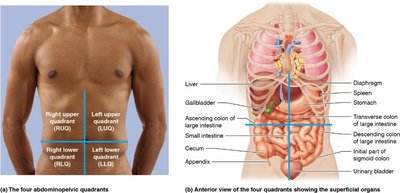
The abdominopelvic area is divided into four quadrants for clinical and anatomical reference.
Right Upper Quadrant (RUQ)
Left Upper Quadrant (LUQ)
Right Lower Quadrant (RLQ)
Left Lower Quadrant (LLQ)
Abdominopelvic Regions
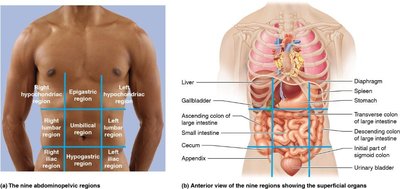
Nine regions provide more detailed localization of organs.
Right Hypochondriac
Epigastric
Left Hypochondriac
Right Lumbar
Umbilical
Left Lumbar
Right Iliac
Hypogastric
Left Iliac
Serous Membranes
Serous Membranes and Their Functions
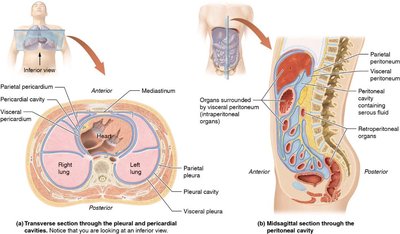
Serous membranes line body cavities and cover organs, reducing friction and providing protection.
Parietal Layer: Lines the cavity wall.
Visceral Layer: Covers the organ.
Examples: Pericardium (heart), Pleura (lungs), Peritoneum (abdominal organs).
Organ Systems Overview
Identifying Organ Systems
The human body is organized into organ systems, each with specific functions and major organs.
Circulatory System: Heart, blood vessels; transports blood and nutrients.
Integumentary System: Skin, hair, nails; protects against environmental hazards.
Lymphatic System: Lymph nodes, lymph vessels; defends against infection.
Muscular System: Muscles; movement and heat production.
Skeletal System: Bones, joints; support and protection.
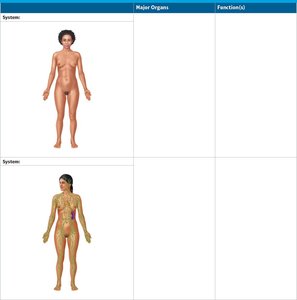

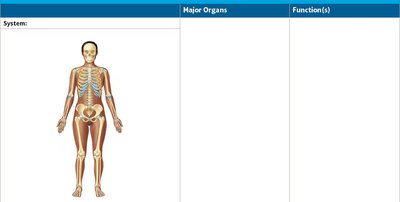
Major Organs and Functions Table
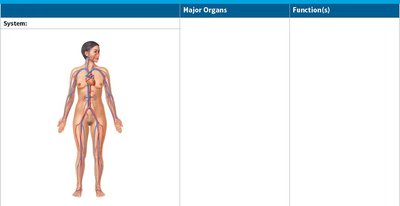
The following table summarizes the major organs and functions of key organ systems:
System | Major Organs | Function(s) |
|---|---|---|
Circulatory | Heart, blood vessels | Transport of blood, nutrients, gases |
Integumentary | Skin, hair, nails | Protection, temperature regulation |
Lymphatic | Lymph nodes, lymph vessels | Immunity, fluid balance |
Muscular | Muscles | Movement, heat production |
Skeletal | Bones, joints | Support, protection, movement |
Identifying Organs
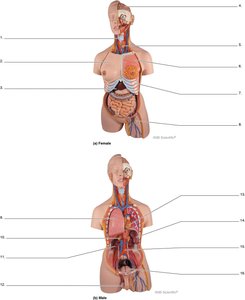
Examination of Internal Organs
Understanding the location and identification of internal organs is essential for anatomical study.
Key Organs: Heart, lungs, liver, stomach, intestines, kidneys, reproductive organs.
Application: Used in clinical diagnosis and surgical procedures.
Chemical Level of Organization
Atomic Structure and Properties
Atoms are the basic units of matter, composed of protons, neutrons, and electrons.
Atomic Symbol: One or two letters representing an element (e.g., H for hydrogen).
Atomic Number: Number of protons in the nucleus.
Atomic Mass: Sum of protons and neutrons.
Protons: Positively charged particles in the nucleus.
Neutrons: Neutral particles in the nucleus.
Electrons: Negatively charged particles orbiting the nucleus.
Acids, Bases, and pH
The pH scale measures the concentration of hydrogen ions in a solution, indicating its acidity or alkalinity.
Acid: Substance that releases hydrogen ions (H+).
Base: Substance that releases hydroxide ions (OH-).
Electrolytes: Substances that dissociate into ions in solution, conducting electricity.
Enzymes: Proteins that catalyze biochemical reactions.
pH Equation:
Organic Molecules
Organic molecules are essential for life and include carbohydrates, lipids, nucleic acids, and proteins.
Carbohydrates: Provide energy; examples include glucose and starch.
Lipids: Store energy and form cell membranes; examples include fats and oils.
Nucleic Acids: Store genetic information; examples include DNA and RNA.
Proteins: Perform structural and functional roles; examples include enzymes and antibodies.
Summary Table: Chemical Properties
Property | Description |
|---|---|
Atomic Symbol | Element abbreviation |
Atomic Number | Number of protons |
Atomic Mass | Protons + Neutrons |
pH | Measure of acidity/alkalinity |
Electrolytes | Conduct electricity in solution |
Enzymes | Catalyze reactions |
Additional info: Expanded explanations and tables were added for completeness and clarity based on standard ANP college curriculum.
