 Back
API Laboratory 1: Introduction to Anatomy & Physiology, Medical Terminology, Levels of Organization, Anatomical Landmarks and Directions
Study Guide - Smart Notes
 Tailored notes based on your materials, expanded with key definitions, examples, and context.
Introduction to Anatomy & Physiology
Overview of Anatomy and Physiology
Anatomy and physiology (A&P) are foundational sciences for understanding the structure and function of the human body. Anatomy focuses on the physical structures, while physiology explores how those structures operate and interact. - Anatomy: The study of body structure, including organs, tissues, and cells. - Physiology: The study of body function, including processes and mechanisms. - Medical terminology is essential for clear communication in healthcare and scientific contexts.
Medical Terminology: Root Words, Prefixes, and Suffixes
Medical terms are constructed from root words, prefixes, and suffixes, which convey specific meanings. Understanding these components aids in interpreting complex terminology. - Root word: The main part of a term, indicating the primary meaning (e.g., cardio- for heart). - Prefix: Appears at the beginning, modifies the root (e.g., hyper- means above or excessive). - Suffix: Appears at the end, often indicates a condition or process (e.g., -itis means inflammation). - Example: Hepatitis = hepat- (liver) + -itis (inflammation) = inflammation of the liver.
Common Medical Prefixes, Roots, and Suffixes
- anti/ant-: against - auto-: self - -blast: immature cell - brachi-: arm - carcin-: cancer - cardio-: heart - cephal-: head - cerebro-: brain - cervic-: neck - -clast: break - -cyte: cell - cranio-: skull - derm-: skin - endo-: within - epi-: upon - extra-: outside - gastro-: stomach - glyco-: sugar - hemo-: blood - hepato-: liver - hyper-: above - hypo-: below - inter-: between - intra-: within - -itis: inflammation - leuko-: white - myo-: muscle - necro-: death - onco-: tumor - osteo-: bone - -osis: condition - peri-: around - phago-: eat - -phil: loving - -phobia: fear - pulmo-: lung - sub-: under - super-: above
Levels of Organization in the Human Body
Hierarchical Structure of Life
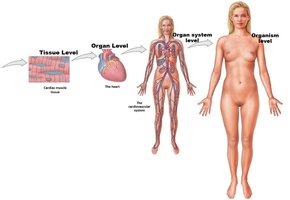
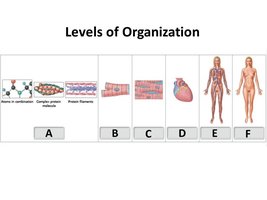
The human body is organized into a hierarchy, from the simplest chemical components to the complex organism. Each level builds upon the previous, allowing for specialization and integration. - Chemical Level: Atoms and molecules form the basis of all matter. - Cellular Level: Cells are the basic units of life, composed of organelles and molecules. 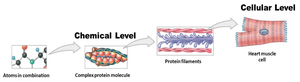 - Tissue Level: Groups of similar cells working together to perform a function. - Organ Level: Two or more tissues combine to form organs with specific functions. - Organ System Level: Organs work together in systems to accomplish complex tasks. - Organism Level: All organ systems function together to sustain life.
Summary Table: Levels of Organization
Level | Description | Example |
|---|---|---|
Chemical | Atoms and molecules | Proteins, carbohydrates |
Cellular | Basic unit of life | Heart muscle cell |
Tissue | Group of cells | Cardiac muscle tissue |
Organ | Two or more tissues | Heart |
Organ System | Group of organs | Cardiovascular system |
Organism | All systems together | Human body |
Organ Systems of the Human Body
Major Organ Systems
The human body contains several organ systems, each responsible for specific functions necessary for survival and health. - Integumentary: Protects the body, regulates temperature, and provides sensory information. - Skeletal: Supports and protects organs, stores minerals, produces blood cells. - Muscular: Produces movement, maintains posture, generates heat. - Nervous: Directs immediate responses to stimuli, coordinates activities. - Endocrine: Regulates long-term changes, controls metabolism. - Cardiovascular: Distributes blood, nutrients, and waste. - Lymphatic: Defends against infection, returns tissue fluids to bloodstream. - Respiratory: Delivers air, provides oxygen, removes carbon dioxide. - Digestive: Processes food, absorbs nutrients, eliminates waste. - Urinary: Eliminates excess water, salts, and waste. - Reproductive: Produces sex cells and hormones.
Anatomical Landmarks and Directions
Anatomical Position
The anatomical position is a standardized posture used to describe locations and directions on the body. - Standing erect, hands at sides, palms forward, toes pointing forward. - Provides a universal reference for anatomical descriptions. 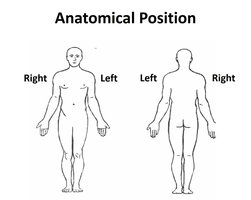
Anatomical Landmarks
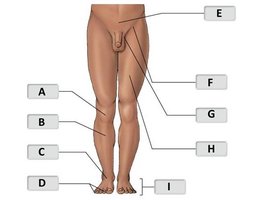
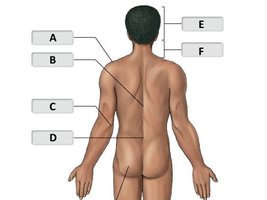
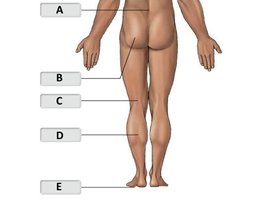
Anatomical landmarks are specific regions or points on the body used to identify locations and relationships. - Example: The femoral region refers to the upper leg; the femur is the bone in this region; the femoral artery supplies blood to this area. 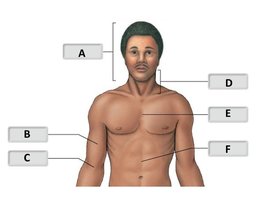
Directional References
Directional terms describe the location of one body part relative to another. - Supine: Lying face up - Prone: Lying face down - Proximal: Closer to the origin of attachment - Distal: Further from the origin of attachment - Cranial: Toward the head - Caudal: Toward the tail (tailbone) - Superior: Above - Inferior: Below - Medial: Toward the midline - Lateral: Away from the midline - Anterior: Front - Posterior: Back - Superficial: Near the surface - Deep: Farther from the surface 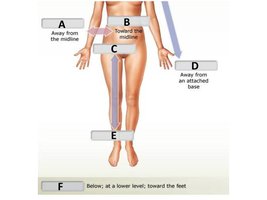
Examples of Directional References
- The wrist is distal to the elbow. - The shoulder is proximal to the elbow. - The clavicles are superior to the pelvis. - The umbilicus is inferior to the chin. - The sternum is medial to the ribs. - The shoulder is lateral to the sternum. - The epidermis is superficial to the dermis. - The heart is deep to the ribs.
Abdominopelvic Regions
Nine Abdominopelvic Regions
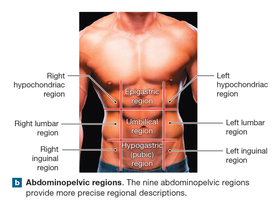
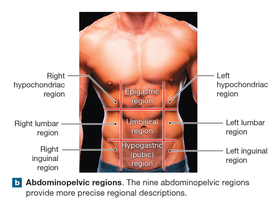
The abdominopelvic cavity is divided into nine regions for precise description of internal organ locations. - Right hypochondriac - Epigastric - Left hypochondriac - Right lumbar - Umbilical - Left lumbar - Right inguinal - Hypogastric (pubic) - Left inguinal 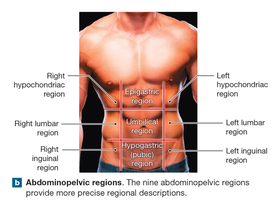
Examples:
- The umbilical region includes the navel. - The hypogastric region contains the urinary bladder. - The epigastric region contains most of the stomach and liver.
Sectional Anatomy: Planes and Sections
Planes and Sections
Anatomical planes are imaginary lines used to divide the body for study and visualization. - Plane: A three-dimensional axis. - Section: A slice parallel to a plane. - Used in radiological techniques such as MRI, PET, and CT scans.
Common Anatomical Planes
- Sagittal plane: Divides the body into left and right portions. - Frontal (coronal) plane: Divides the body into anterior and posterior portions. - Transverse plane: Divides the body into superior and inferior portions.
Summary
This study guide covers the foundational concepts of anatomy and physiology, including medical terminology, levels of organization, organ systems, anatomical landmarks, directional references, abdominopelvic regions, and sectional anatomy. Mastery of these topics is essential for further study in A&P and for effective communication in healthcare and scientific fields. Additional info: Academic context and expanded explanations were added to ensure completeness and clarity for college-level study.
