 Back
BackAppendicular Skeleton: Pectoral Girdle & Upper Limb
Study Guide - Smart Notes
 Tailored notes based on your materials, expanded with key definitions, examples, and context.
Appendicular Skeleton Overview
Definition and Components
The appendicular skeleton consists of the bones that facilitate movement and connect the limbs to the axial skeleton. It is divided into four main regions:
Pectoral girdle: Attaches the upper limb to the torso.
Upper extremity bones: Includes the arm, forearm, wrist, and hand.
Pelvic girdle: Attaches the lower limb to the torso.
Lower extremity bones: Includes the thigh, leg, ankle, and foot.
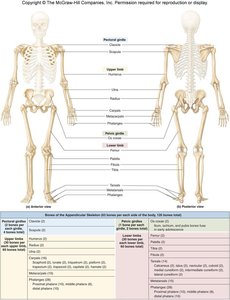
Pectoral Girdle
Bones and Functions
The pectoral girdle is composed of two bones on each side:
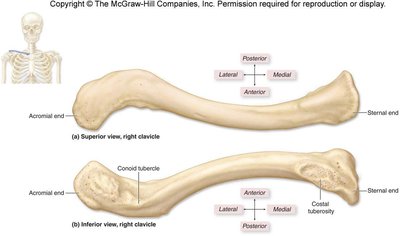
Clavicle (collarbone): S-shaped bone that connects the sternum (manubrium) to the scapula (acromion process). It acts as a strut to keep the upper limb away from the thorax, allowing for maximum mobility.
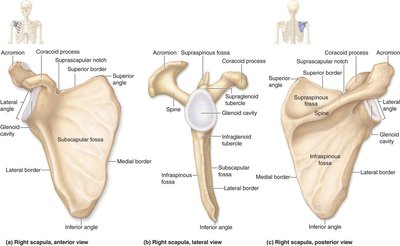
Scapula (shoulder blade): Flat, triangular bone located on the posterior thoracic wall. It provides attachment points for muscles and articulates with the humerus at the glenoid cavity.
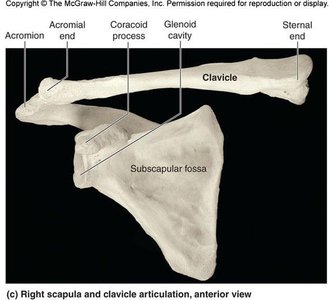
Clavicle: Structure and Features
Acromial end: Lateral, articulates with the acromion of the scapula.
Sternal end: Medial, articulates with the manubrium of the sternum.
Conoid tubercle: Inferior surface, attachment for ligaments.
Costal tuberosity: Attachment for costoclavicular ligament.
Scapula: Structure and Features
The scapula has several important anatomical landmarks:
Acromion: Lateral projection, articulates with clavicle.
Coracoid process: Anterior projection, attachment for muscles.
Glenoid cavity: Shallow socket for articulation with the humerus.
Spine: Prominent ridge on posterior surface.
Fossae: Subscapular, supraspinous, and infraspinous fossae serve as muscle attachment sites.
Bones of the Upper Limb
Overview
Each upper limb contains 30 bones, organized as follows:
Humerus: Single bone of the arm (brachium).
Radius and Ulna: Two bones of the forearm (antebrachium).
Carpals: Eight wrist bones.
Metacarpals: Five bones forming the palm.
Phalanges: Fourteen bones forming the fingers.
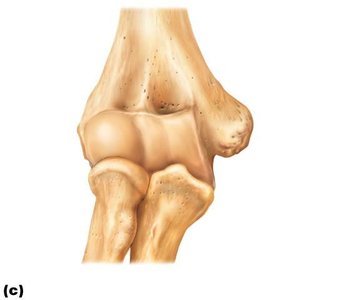
Humerus: Structure and Features
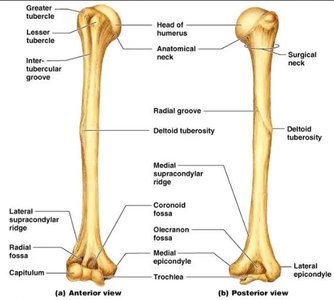
The humerus is the longest bone of the upper limb and articulates proximally with the scapula and distally with the radius and ulna.
Head: Articulates with the glenoid cavity of the scapula.
Anatomical neck: Slight constriction below the head.
Surgical neck: Common site of fractures.
Greater and lesser tubercles: Muscle attachment sites.
Deltoid tuberosity: Lateral surface, attachment for deltoid muscle.
Medial and lateral epicondyles: Muscle attachment sites.
Capitulum: Lateral condyle, articulates with radius.
Trochlea: Medial condyle, articulates with ulna.
Fossae: Radial, coronoid, and olecranon fossae accommodate forearm bones during movement.
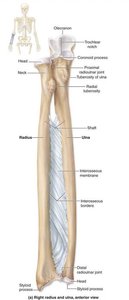
Forearm: Radius and Ulna
The radius and ulna are parallel bones of the forearm, connected by the interosseous membrane.
Radius: Lateral bone in anatomical position. Its head articulates with the capitulum of the humerus and the radial notch of the ulna. The distal end articulates with carpal bones, contributing to wrist movement.
Ulna: Medial bone. The trochlear notch articulates with the trochlea of the humerus, forming the elbow joint. The olecranon forms the elbow's "bump." The distal end is separated from the carpals by fibrocartilage and plays little role in hand movement.
Articulations of the Elbow
The elbow joint is a hinge joint formed by the humerus, radius, and ulna.
Trochlear notch of ulna: Articulates with the trochlea of humerus.
Olecranon process: Fits into the olecranon fossa of humerus during extension.
Coronoid process: Fits into the coronoid fossa during flexion.
Radial notch: Articulates with the head of the radius.
Hand: Carpals, Metacarpals, and Phalanges
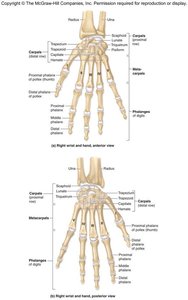
Carpals: Eight wrist bones arranged in two rows (proximal and distal). Mnemonic: "Sally Left The Party To Take Cathy Home" (Scaphoid, Lunate, Triquetrum, Pisiform, Trapezium, Trapezoid, Capitate, Hamate).
Metacarpals: Five bones forming the palm, numbered I-V from lateral (thumb) to medial (little finger).
Phalanges: Fourteen bones in the fingers. Each finger has three phalanges (proximal, middle, distal), except the thumb (pollex), which has two (proximal and distal).
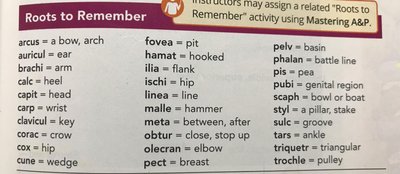
Root Words to Remember
Common Anatomical Roots
Understanding root words aids in learning anatomical terminology.
arcus: bow, arch
brachi: arm
carp: wrist
clavicul: key
cox: hip
fovea: pit
olecran: elbow
phalan: battle line
scaph: bowl or boat
trochle: pulley
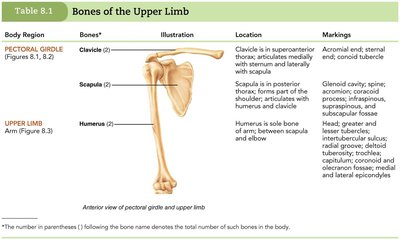
Summary Table: Bones of the Upper Limb
Classification and Markings
Body Region | Bones | Location | Markings |
|---|---|---|---|
Pectoral Girdle | Clavicle (2), Scapula (2) | Clavicle: superoanterior thorax; Scapula: posterior thorax | Clavicle: acromial end, sternal end, conoid tubercle; Scapula: glenoid cavity, spine, acromion, coracoid process, fossae |
Upper Limb (Arm) | Humerus (2) | Arm between scapula and elbow | Head, greater/lesser tubercles, deltoid tuberosity, epicondyles, capitulum, trochlea, fossae |
Upper Limb (Forearm) | Ulna (2), Radius (2) | Ulna: medial forearm; Radius: lateral forearm | Ulna: coronoid process, olecranon, trochlear notch, styloid process; Radius: head, radial tuberosity, styloid process |
Additional info:
Mnemonic for carpal bones is included for easier memorization.
Root words are provided to facilitate understanding of anatomical terminology.
