 Back
BackArticulations and Bone Joints: Structure, Function, and Classification
Study Guide - Smart Notes
 Tailored notes based on your materials, expanded with key definitions, examples, and context.
Articulations
Types of Joints
Articulations, or joints, are the connections between bones that allow for movement and provide mechanical support. Joints are classified based on their structure and function, which determines their range of motion and stability.
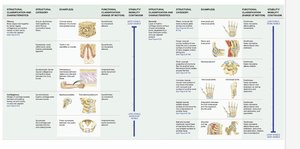
Fibrous Joints: Bones are joined by dense connective tissue, allowing little to no movement. Examples include sutures in the skull and syndesmoses between the radius and ulna.
Cartilaginous Joints: Bones are connected by cartilage, permitting limited movement. Examples include synchondroses (epiphyseal plates) and symphyses (pubic symphysis).
Synovial Joints: Most movable type of joint, characterized by a synovial cavity, articular cartilage, and a joint capsule. Examples include the shoulder, knee, and hip joints.
Classification of Synovial Joints
Synovial joints are further classified based on the shape of their articulating surfaces and the type of movement they allow:
Plane (Gliding) Joints: Allow sliding or gliding movements. Example: intercarpal joints.
Hinge Joints: Permit flexion and extension. Example: elbow joint.
Pivot Joints: Allow rotational movement. Example: atlantoaxial joint.
Condyloid (Ellipsoid) Joints: Permit movement in two planes. Example: wrist joint.
Saddle Joints: Allow movement in two planes, with greater freedom than condyloid joints. Example: thumb (carpometacarpal joint).
Ball-and-Socket Joints: Allow movement in multiple axes and planes. Example: shoulder and hip joints.
Functional Classification of Joints
Joints are also classified by their functional capacity:
Synarthrosis: Immovable joints (e.g., sutures).
Amphiarthrosis: Slightly movable joints (e.g., symphysis).
Diarthrosis: Freely movable joints (e.g., synovial joints).
Key Structures of Synovial Joints
Synovial joints contain several important anatomical features:
Articular Cartilage: Covers the ends of bones, reducing friction and absorbing shock.
Joint Capsule: Encloses the joint cavity, composed of fibrous and synovial layers.
Synovial Fluid: Lubricates the joint and nourishes the cartilage.
Ligaments: Connect bone to bone, providing stability.
Bursae: Fluid-filled sacs that reduce friction between tissues.
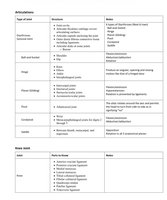
Table: Types of Joints and Their Characteristics
Type of Joint | Structure | Notes |
|---|---|---|
Fibrous (Synarthrosis) | Sutures, Syndesmoses, Gomphoses | Immovable, found in skull, teeth |
Cartilaginous (Amphiarthrosis) | Synchondroses, Symphyses | Slightly movable, found in vertebral column, pubic symphysis |
Synovial (Diarthrosis) | Plane, Hinge, Pivot, Condyloid, Saddle, Ball-and-Socket | Freely movable, found in limbs |
Bone Joints
Parts of Bone Joints
Bone joints are composed of several anatomical structures that contribute to their function and stability:
Articular Capsule: Encloses the joint cavity and maintains joint integrity.
Synovial Membrane: Produces synovial fluid for lubrication.
Articular Cartilage: Provides a smooth surface for movement.
Ligaments: Strengthen and stabilize the joint.
Bursae: Reduce friction between moving parts.
Menisci: Improve fit and absorb shock in certain joints (e.g., knee).
Table: Parts of Bone Joints
Joint | Parts of Bone Joints | Notes |
|---|---|---|
Synovial | Articular Capsule, Synovial Membrane, Articular Cartilage, Ligaments, Bursae, Menisci | Provides mobility and stability |
Additional info:
Synovial joints are the most common and versatile joints in the human body, allowing for a wide range of movements.
Ligaments and tendons play crucial roles in joint stability and movement.
Diseases such as arthritis can affect joint function and structure.
