 Back
Assisted Reproductive Technology and Contraception
Study Guide - Smart Notes
 Tailored notes based on your materials, expanded with key definitions, examples, and context.
Assisted Reproductive Technology (ART)
Overview of ART
Assisted reproductive technology (ART) encompasses medical procedures used to address infertility and help couples conceive. These techniques involve manipulating eggs, sperm, or embryos outside the body to increase the chances of pregnancy.
Hormone Therapy: Used to stimulate increased production of sperm or eggs in cases of low gamete count.
Surgical Intervention: Can correct anatomical blockages, such as blocked uterine tubes.
Artificial Insemination: Sperm is concentrated and placed directly into the female reproductive tract, bypassing cervical mucus and increasing the likelihood of fertilization.
Major ART Procedures
In Vitro Fertilization (IVF): Oocytes are surgically removed after hormone stimulation, fertilized with sperm in the laboratory (in vitro), and incubated overnight. Embryos that reach the four- to eight-cell stage or blastocyst stage are transferred to the uterus for implantation.
Zygote Intrafallopian Transfer (ZIFT): Oocytes are fertilized in vitro, then transferred to the uterine tube within 24 hours, allowing further development and natural implantation in the uterus.
Gamete Intrafallopian Transfer (GIFT): Sperm and oocytes are collected and transferred together into the uterine tubes, where fertilization is expected to occur naturally.
Cryopreservation: Unused oocytes, sperm, and embryos can be frozen for future attempts at pregnancy.
Example: IVF is the most common ART technique, widely used for couples with various infertility issues.
Contraception: Methods and Mechanisms
Introduction to Contraception
Contraception, or birth control, refers to methods used to prevent pregnancy. Effective contraception is essential for family planning and reproductive health. Methods are categorized based on their mechanism of action: behavioral, barrier, hormonal, and permanent (sterilization).
Behavioral Methods
Coitus Interruptus: Withdrawal of the penis before ejaculation. Unreliable due to lack of control over ejaculation.
Rhythm Method: Avoiding intercourse during fertile periods, determined by tracking basal body temperature. Requires accurate recordkeeping and has a moderate failure rate.
Abstinence: Complete avoidance of sexual intercourse; the only method that is 100% effective.
Barrier Methods
Diaphragms and Cervical Caps: Devices placed over the cervix to block sperm entry.
Male and Female Condoms: Prevent sperm from entering the female reproductive tract; also protect against sexually transmitted infections (STIs).
Spermicides and Gels: Chemicals that immobilize or kill sperm. Newer gels (e.g., Phexxi®) maintain vaginal acidity to inhibit sperm motility.
Hormonal Methods
Oral Contraceptives (The Pill): Contain estrogens and progestins, which inhibit ovulation by mimicking pregnancy hormones. Highly effective with perfect use, but real-world failure rates are higher due to inconsistent use.
Vaginal Rings and Skin Patches: Deliver hormones steadily; similar efficacy and side effects as oral contraceptives.
Progestin-Only Methods: Include implants (e.g., Nexplanon®) and injectables (e.g., Depo-Provera®). These thicken cervical mucus, reduce ovulation frequency, and alter the endometrium to prevent implantation.
Emergency Contraceptives (Morning-After Pills): High-dose progestins taken within 72 hours of unprotected intercourse to prevent fertilization or implantation.
Intrauterine Devices (IUDs)
Hormonal IUDs: Release synthetic progesterone locally, thickening cervical mucus and inhibiting sperm entry.
Copper IUDs: Release copper ions, which are toxic to sperm and make the uterus inhospitable for implantation.
Sterilization
Tubal Ligation: Surgical cutting or cauterization of the uterine tubes in females, preventing egg transport.
Vasectomy: Surgical cutting or cauterization of the ductus deferens in males, preventing sperm release.
These methods are considered permanent and are chosen by couples who do not wish to have more children.
Mechanisms of Contraceptive Action
Contraceptive methods act at various stages of the reproductive process, including gamete production, transport, fertilization, and implantation. The following table summarizes the main techniques, their targets, and mechanisms for both males and females:
Technique | Event (Male) | Event (Female) | Mechanism/Notes |
|---|---|---|---|
Vasectomy | Blocks sperm transport | — | Prevents sperm release |
Abstinence | Prevents sperm deposition | Prevents oocyte capture | No intercourse |
Condom | Blocks sperm deposition | Blocks sperm entry | Physical barrier |
Coitus interruptus | Prevents sperm deposition | — | Withdrawal before ejaculation (high failure rate) |
Combination hormonal methods (pill, patch, ring, IUD) | — | Prevents ovulation | Suppresses hypothalamic-pituitary-gonadal axis |
Tubal ligation | — | Blocks oocyte transport | Prevents egg from reaching uterus |
Spermicides, diaphragm, cervical cap | — | Blocks sperm entry | Chemical/physical barrier |
Morning-after pill | — | Prevents fertilization/implantation | Emergency contraception |
Progestin-only (implant, injection, IUD) | — | Thickens cervical mucus, inhibits ovulation | Long-acting hormonal methods |
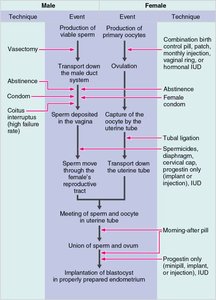
Additional info: The table and flowchart visually summarize how different contraceptive methods act at various stages of the reproductive process, reinforcing the mechanisms described above.
