 Back
BackAtoms and the Chemistry of Life: Study Notes for Anatomy & Physiology
Study Guide - Smart Notes
 Tailored notes based on your materials, expanded with key definitions, examples, and context.
Chapter 2: The Chemistry of Life
Atoms: The Building Blocks of Matter
Atoms are the fundamental units of matter, forming the basis for all chemical substances in the body. Understanding atomic structure is essential for grasping the chemical processes that underpin anatomy and physiology.
Atoms consist of a nucleus containing protons and neutrons, surrounded by electrons in orbitals.
Protons are positively charged particles found in the nucleus.
Neutrons are neutral particles also located in the nucleus.
Electrons are negatively charged particles that orbit the nucleus.
The number of protons determines the element, while different numbers of neutrons create isotopes.
Example: Carbon-12 and Carbon-14 are isotopes of carbon, differing in their number of neutrons.
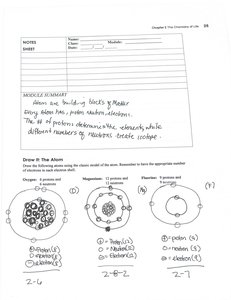
Atomic Structure and Electron Arrangement
The arrangement of electrons in shells or energy levels influences how atoms interact and bond with each other. The first shell holds up to 2 electrons, the second up to 8, and so on.
Atoms are stable when their outermost electron shell is full.
Atoms with incomplete outer shells tend to form chemical bonds.
Example: Hydrogen (1 electron), Helium (2 electrons), and Lithium (3 electrons) demonstrate different electron arrangements and bonding behaviors.
Key Terms and Definitions
Important Chemical Terms
Understanding basic chemical terminology is crucial for studying the molecular basis of anatomy and physiology.
Term | Definition |
|---|---|
Atom | The smallest unit of matter, consisting of protons, neutrons, and electrons. |
Element | A substance made of only one type of atom. |
Molecule | Two or more atoms bonded together. |
Peptide | A short chain of amino acids linked by peptide bonds. |
Adenosine Triphosphate (ATP) | The main energy source for cellular processes. |
Metabolism | The sum of all chemical reactions in the body. |
Example: ATP is used by muscle cells to contract and by neurons to transmit signals.
Outline: Note Taking and Study Strategies
Effective Study Techniques for Chemistry of Life
Active learning strategies help students retain and understand complex concepts in anatomy and physiology.
Summarizing key points after reading each section.
Drawing diagrams of atomic structure and molecules.
Using flashcards for terms and definitions.
Applying concepts to physiological examples, such as how ions contribute to nerve impulses.
Example: Creating a chart comparing the properties of different elements found in the human body.
Additional info:
Some content was inferred from context and standard academic knowledge to ensure completeness and clarity. The diagrams and tables were recreated based on the handwritten notes and textbook structure.
