 Back
ATP Production in Muscle Fibers: Cellular Respiration and Fermentation
Study Guide - Smart Notes
 Tailored notes based on your materials, expanded with key definitions, examples, and context.
ATP Production in Muscle Fibers
Introduction to ATP and Muscle Metabolism
Muscle fibers require large amounts of adenosine triphosphate (ATP) to power contraction and relaxation. ATP is produced by breaking down nutrients, primarily carbohydrates, through a series of metabolic pathways. The continuous cycle of ATP production and utilization is essential for muscle function and overall cellular activity.
ATP is the universal energy currency of the cell.
Muscle contraction, calcium ion transport, and ion balance restoration all require ATP.
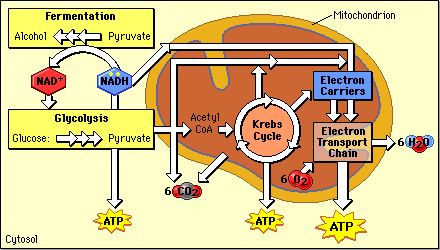
ATP is generated from the breakdown of biomolecules, producing waste products such as CO2 and H2O.
ATP Utilization in Muscle Contraction
Roles of ATP in Muscle Fibers
ATP is essential for several key processes during muscle contraction and relaxation:
Cross-bridge cycling: ATP is required to move and detach myosin heads from actin filaments.
Calcium reuptake: ATP powers the active transport of Ca2+ back into the sarcoplasmic reticulum (SR).
Ion balance: ATP is used to pump Na+ out and K+ into the cell after excitation-contraction coupling.
The ATP-ADP Cycle
ATP consists of adenosine and three phosphate groups. The bond between the second and third phosphate is a high-energy bond. When ATP is hydrolyzed, it forms ADP (adenosine diphosphate) and inorganic phosphate (Pi), releasing energy for cellular work.
ATP → ADP + Pi + energy
ADP + Pi + energy → ATP (regeneration)
Mechanisms of ATP Production
Substrate-Level (Direct) Phosphorylation
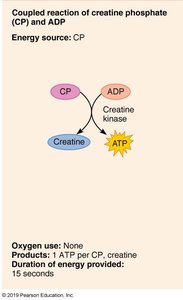
Muscle cells can rapidly generate a small amount of ATP through direct phosphorylation using creatine phosphate (CP). This process is catalyzed by the enzyme creatine kinase and does not require oxygen.
Creatine phosphate (CP) donates a phosphate to ADP, forming ATP and creatine.
This pathway provides energy for short bursts (about 15 seconds) of intense activity.
Cellular Respiration
Cellular respiration is the primary process for ATP production in muscle fibers. It involves the breakdown of glucose in the presence of oxygen to produce ATP, carbon dioxide, and water.
Overall equation:
Glucose is obtained from food; oxygen is supplied by the circulatory system.
CO2 is exhaled; H2O is produced as a byproduct.
Key Definitions
Oxidation: Loss of electrons or hydrogen atoms (OIL: Oxidation Is Loss).
Reduction: Gain of electrons or hydrogen atoms (RIG: Reduction Is Gain).
Coenzymes in Cellular Respiration
NAD+ (Nicotinamide adenine dinucleotide): Oxidized form; accepts electrons.
NADH: Reduced form; carries electrons.
FAD (Flavin adenine dinucleotide): Oxidized form; accepts electrons.
FADH2: Reduced form; carries electrons.
These coenzymes shuttle electrons during cellular respiration, facilitating ATP production.
Stages of Cellular Respiration
Overview of the Three Main Stages
Glycolysis (cytoplasm; anaerobic)
Citric Acid Cycle (Krebs Cycle) (mitochondrial matrix; aerobic)
Oxidative Phosphorylation (mitochondrial inner membrane; aerobic)
Citric acid cycle and oxidative phosphorylation require oxygen and yield the majority of ATP (~34-36 ATP per glucose).
Stage 1: Glycolysis
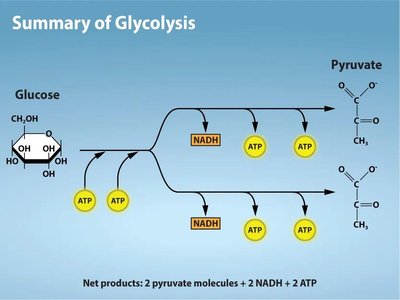
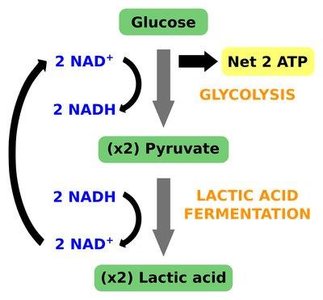
Glycolysis is the anaerobic breakdown of glucose (6 carbons) into two molecules of pyruvate (3 carbons each). It occurs in the cytoplasm and does not require oxygen.
Net products per glucose: 2 ATP, 2 NADH, 2 pyruvate
2 ATP are used, 4 ATP are produced (net gain: 2 ATP)
NAD+ is reduced to NADH
Mitochondria: The Powerhouse of the Cell
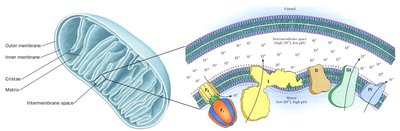
The remaining steps of cellular respiration occur in the mitochondria, which is specialized for efficient ATP production.
Structure includes outer membrane, inner membrane, intermembrane space, and matrix.
Preparatory Step: Conversion of Pyruvate to Acetyl CoA
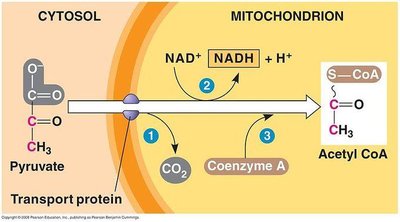
Before entering the citric acid cycle, pyruvate is converted to acetyl CoA in the mitochondrial membrane. This step requires oxygen and coenzyme A.
Products (per 2 pyruvate): 2 acetyl CoA, 2 NADH, 2 CO2
Stage 2: Citric Acid Cycle (Krebs Cycle)
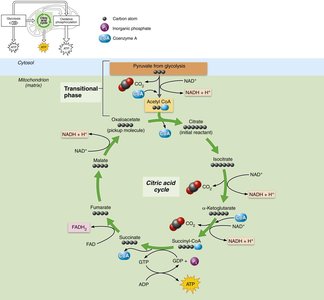
The citric acid cycle is an aerobic process that occurs in the mitochondrial matrix. Each acetyl CoA is broken down, releasing energy captured as NADH, FADH2, and ATP.
Products per acetyl CoA: 2 CO2, 3 NADH, 1 FADH2, 1 ATP
For each glucose (2 acetyl CoA): 4 CO2, 6 NADH, 2 FADH2, 2 ATP
Stage 3: Electron Transport Chain (ETC) and Oxidative Phosphorylation
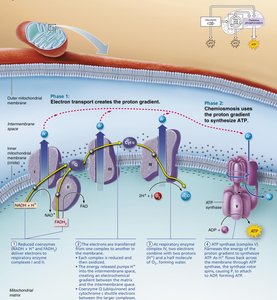
The ETC is located in the inner mitochondrial membrane. NADH and FADH2 donate electrons, which move through protein complexes, pumping H+ ions to create a gradient. ATP synthase uses this gradient to generate ATP in a process called chemiosmosis.
Oxygen is the final electron acceptor, forming water.
Produces ~34 ATP per glucose molecule.
Anaerobic ATP Production: Lactic Acid Fermentation
Fermentation in Muscle Cells
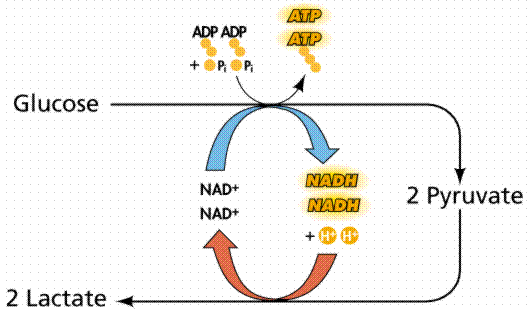
When oxygen is insufficient (anaerobic conditions), muscle cells switch to lactic acid fermentation to regenerate NAD+ for glycolysis. This process does not produce additional ATP beyond glycolysis.
Pyruvate + NADH → Lactic acid + NAD+
Lactic acid accumulation causes muscle fatigue and the sensation of "burn" during intense exercise.
Fermentation is essential for short-term energy needs when oxygen is limited.
Summary Table: ATP Yield from Glucose Metabolism
Pathway | Location | Oxygen Required? | ATP Yield (per glucose) | Key Products |
|---|---|---|---|---|
Glycolysis | Cytoplasm | No | 2 | 2 NADH, 2 pyruvate |
Citric Acid Cycle | Mitochondrial matrix | Yes | 2 | 6 NADH, 2 FADH2, 4 CO2 |
Oxidative Phosphorylation | Inner mitochondrial membrane | Yes | ~34 | H2O |
Lactic Acid Fermentation | Cytoplasm | No | 0 (beyond glycolysis) | Lactic acid, NAD+ |
Key Takeaways
Muscle fibers rely on multiple pathways for ATP production, switching between aerobic and anaerobic metabolism as needed.
Cellular respiration is highly efficient, while fermentation provides a rapid but limited supply of ATP.
Understanding these pathways is essential for comprehending muscle physiology and energy metabolism.
