 Back
BackAutonomic Nervous System (ANS): Receptors, Neurotransmitters, and Regulation
Study Guide - Smart Notes
 Tailored notes based on your materials, expanded with key definitions, examples, and context.
Autonomic Nervous System (ANS): Receptors, Neurotransmitters, and Regulation
Overview of the Autonomic Nervous System (ANS)
The Autonomic Nervous System (ANS) is a division of the peripheral nervous system that regulates involuntary physiological processes, including heart rate, blood pressure, respiration, digestion, and glandular activity. The ANS is divided into the sympathetic and parasympathetic divisions, each with distinct anatomical and functional characteristics.
Sympathetic Division: Prepares the body for 'fight or flight' responses.
Parasympathetic Division: Promotes 'rest and digest' activities.
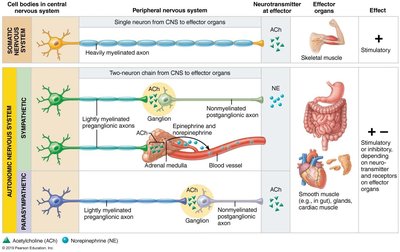
ANS Receptors
Receptors in the ANS are classified based on the neurotransmitter they bind. These receptors are critical for mediating the effects of the sympathetic and parasympathetic divisions on target organs.
Cholinergic Receptors: Bind acetylcholine (ACh).
Adrenergic Receptors: Bind norepinephrine (NE) and/or epinephrine (E).
Cholinergic Receptors
Nicotinic Receptors: Ionotropic receptors that open ion channels permeable to Na+ and K+ (more permeable to Na+), always producing an excitatory response. Located on the cell bodies of all ganglionic neurons.
Muscarinic Receptors: Metabotropic receptors that activate G-protein coupled pathways. Their activation can be excitatory or inhibitory, depending on the target cell. Found on all effector targets of the parasympathetic system.
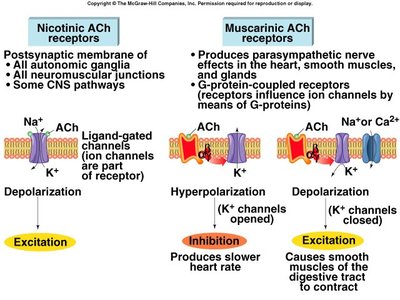
Adrenergic Receptors
Alpha (α) Receptors: Subdivided into α1 and α2 types.
Beta (β) Receptors: Subdivided into β1 and β2 types.
All adrenergic receptors are metabotropic and located on effector targets of the sympathetic system.
Adrenergic Receptor Subtypes and Effects
α1 Receptors: Excitatory; cause smooth muscle contraction (e.g., vasoconstriction in blood vessels, contraction of arrector pili muscles).
α2 Receptors: Inhibitory; found mainly in presynaptic terminals, decrease neurotransmitter release, and help prevent excessive sympathetic activity.
β1 Receptors: Excitatory; increase heart rate and contractility, stimulate renin release in the kidney via cAMP pathway.
β2 Receptors: Inhibitory; relax smooth muscle in bronchioles (bronchodilation), urinary bladder, digestive tract, and blood vessels supplying skeletal muscle and cardiac tissue (vasodilation).
Summary Table: Autonomic Receptors and Effects
Receptor Type | Main Neurotransmitter | Location | Effect |
|---|---|---|---|
Nicotinic (Cholinergic) | Acetylcholine (ACh) | All ganglionic neurons | Excitatory (depolarization) |
Muscarinic (Cholinergic) | Acetylcholine (ACh) | Parasympathetic effector organs | Excitatory or inhibitory (depending on target) |
α1 (Adrenergic) | Norepinephrine/Epinephrine | Most blood vessels, arrector pili | Excitatory (vasoconstriction, contraction) |
α2 (Adrenergic) | Norepinephrine/Epinephrine | Presynaptic terminals | Inhibitory (decreased neurotransmitter release) |
β1 (Adrenergic) | Norepinephrine/Epinephrine | Heart, kidney | Excitatory (increased heart rate, renin release) |
β2 (Adrenergic) | Norepinephrine/Epinephrine | Bronchioles, bladder, digestive tract, blood vessels to muscle | Inhibitory (relaxation, bronchodilation, vasodilation) |
Pharmacology of the ANS
Many drugs target ANS receptors to treat conditions such as hypertension, asthma, and cardiac arrhythmias. These drugs act as:
Antagonists: Block neurotransmitter binding to receptors.
Agonists: Mimic neurotransmitters by binding to receptors and activating them.
CNS Regulation and Coordination of the ANS
The activity of the ANS is regulated by specific regions of the central nervous system (CNS), ensuring homeostatic balance and appropriate physiological responses.
Hypothalamus: The primary integrative center for ANS activity; processes information and generates responses.
Reticular Formation (Brainstem): Receives commands from the hypothalamus and relays them to sympathetic and parasympathetic divisions.
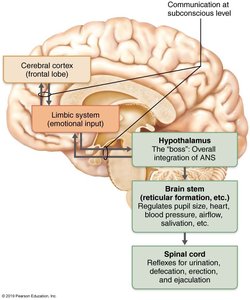
Autonomic Tone
Both the sympathetic and parasympathetic divisions of the ANS are continuously active, a phenomenon known as autonomic tone. This baseline activity allows for rapid adjustments in organ function as needed.
Tonic Parasympathetic Innervation: Example: The heart receives ongoing input from the parasympathetic system, maintaining a lower resting heart rate.
Tonic Sympathetic Innervation: Example: Blood vessels receive continuous sympathetic input, maintaining vascular tone and blood pressure.
Key Equations and Concepts
cAMP Second Messenger Pathway (β1 Receptors):
Ionotropic vs. Metabotropic Receptors:
Type | Mechanism | Example |
|---|---|---|
Ionotropic | Directly opens ion channels | Nicotinic ACh receptor |
Metabotropic | Activates G-protein coupled pathways | Muscarinic ACh, all adrenergic receptors |
Additional info: The ANS is essential for maintaining homeostasis and responding to internal and external stimuli. Understanding receptor types and their mechanisms is crucial for interpreting physiological responses and pharmacological interventions.
