 Back
BackAxonal Transport and Synaptic Physiology: Study Notes for ANP College Students
Study Guide - Smart Notes
 Tailored notes based on your materials, expanded with key definitions, examples, and context.
Axonal Transport
Overview of Axonal Transport
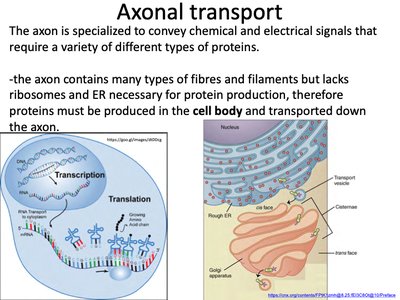
Axonal transport is a fundamental process in neurons, enabling the movement of proteins, organelles, and other substances between the cell body (soma) and the axon terminal. This transport is essential for neuronal function, maintenance, and communication.
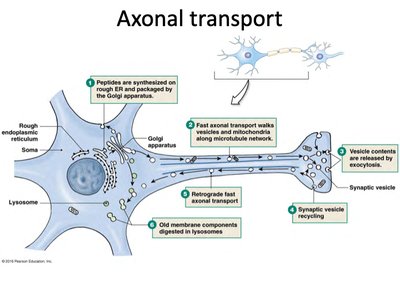
Axonal transport occurs in two main directions: anterograde (from soma to axon terminal) and retrograde (from axon terminal to soma).
It is mediated by specialized motor proteins that "walk" along microtubules using energy from ATP hydrolysis.
Axonal transport is crucial for delivering newly synthesized proteins and organelles, as well as recycling cellular components.
Fast vs Slow Axonal Transport
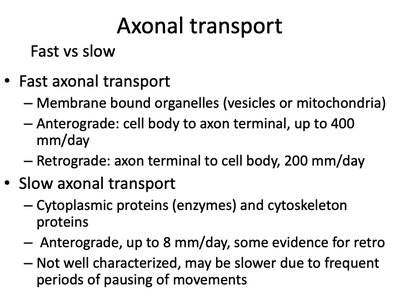
Axonal transport can be classified as fast or slow, depending on the speed and the type of cargo being moved.
Fast axonal transport moves membrane-bound organelles (such as vesicles and mitochondria) at rates up to 400 mm/day (anterograde) and 200 mm/day (retrograde).
Slow axonal transport carries cytoplasmic proteins (enzymes, cytoskeletal proteins) at rates up to 8 mm/day, with frequent pauses.
Both directions are necessary for neuronal health and function.
Molecular Mechanisms: Kinesins and Dyneins
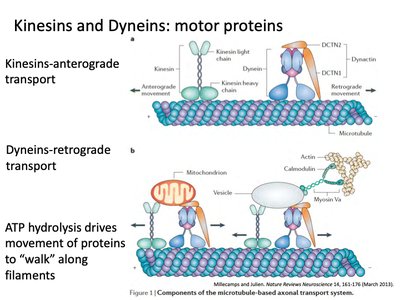
Motor proteins are responsible for the directional movement of cargo along microtubules.
Kinesins mediate anterograde transport, moving cargo toward the axon terminal.
Dyneins mediate retrograde transport, moving cargo back toward the soma.
ATP hydrolysis provides the energy for these proteins to "walk" along microtubules.
Kinesins may return to the soma by hitching a ride on dyneins or by diffusing in the cytoplasm.
Directionality is believed to be guided by microtubule charge gradients: positive at the terminal, negative at the soma.
Summary Table: Axonal Transport Types
Type | Cargo | Direction | Speed |
|---|---|---|---|
Fast Axonal Transport | Membrane-bound organelles | Anterograde & Retrograde | 400 mm/day (anterograde), 200 mm/day (retrograde) |
Slow Axonal Transport | Cytoplasmic proteins, cytoskeleton | Anterograde (some retrograde) | Up to 8 mm/day |
Synapses and Synaptic Physiology
Establishing Synapses
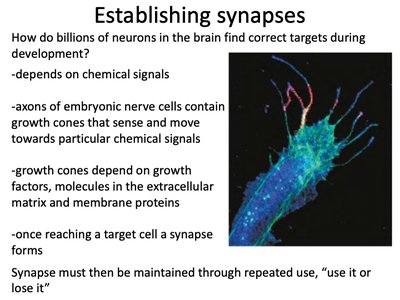
Synapse formation is a critical process during neural development, allowing neurons to connect with their correct targets.
Axons of embryonic nerve cells contain growth cones that sense and move toward chemical signals.
Growth cones respond to growth factors, extracellular matrix molecules, and membrane proteins.
Once a target is reached, a synapse forms, which must be maintained through repeated use (synaptic plasticity).
"Use it or lose it": Synapses not maintained may be eliminated.
Types of Synapses
Synapses are specialized junctions where neurons communicate with other neurons or target cells.
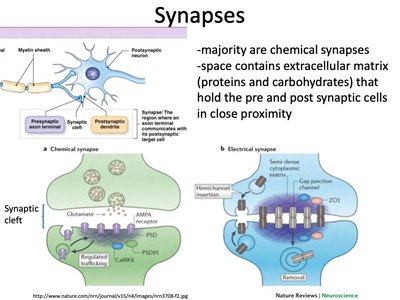
Chemical synapses are the most common, involving the release of neurotransmitters into the synaptic cleft.
Electrical synapses use gap junctions to allow direct passage of ions, enabling rapid communication.
The synaptic cleft contains extracellular matrix proteins and carbohydrates that hold pre- and post-synaptic cells in close proximity.
Synaptic Plasticity and Development
Synaptic plasticity refers to the ability of synapses to change in strength and structure over time.
Constant use and maintenance are required for synapses to persist.
Deprivation of sensory input in early development can lead to delayed neural development.
There is no evidence that excessive stimulation in infancy enhances intellectual development.
Key Terms and Concepts
Axonal transport: Movement of materials along the axon.
Anterograde transport: Movement from soma to axon terminal.
Retrograde transport: Movement from axon terminal to soma.
Kinesin: Motor protein for anterograde transport.
Dynein: Motor protein for retrograde transport.
Synapse: Junction between neurons or between a neuron and another cell.
Synaptic plasticity: Ability of synapses to change and adapt.
Relevant Equations
ATP Hydrolysis (energy for motor proteins):
Transport Rate:
Example Application
Damage to axonal transport mechanisms can lead to neurodegenerative diseases, such as Alzheimer's or ALS, due to impaired delivery and recycling of essential proteins and organelles.
Synaptic plasticity underlies learning and memory, as repeated use strengthens synaptic connections.
Additional info: Expanded explanations and context were added to clarify mechanisms and clinical relevance.
