 Back
BackBasic Chemistry: Inorganic Compounds in Anatomy & Physiology
Study Guide - Smart Notes
 Tailored notes based on your materials, expanded with key definitions, examples, and context.
Inorganic Compounds
Definition and Overview
Inorganic compounds are essential for life and play critical roles in the human body. Unlike organic compounds, they lack carbon and include substances such as water, salts, acids, and bases.
Inorganic compounds: Do not contain carbon atoms.
Examples: Water, salts, acids, bases.
Water: The Most Abundant Inorganic Compound
Vital Properties of Water
Water is the most abundant inorganic compound in the body and is vital for numerous physiological processes. Its unique properties make it indispensable for life.
High heat capacity: Water absorbs and releases large amounts of heat before its temperature changes appreciably. This prevents sudden changes in body temperature, helping maintain homeostasis.
Chemical reactivity: Water participates in chemical reactions such as hydrolysis (breaking down molecules by adding water) and dehydration synthesis (forming molecules by removing water).
Cushioning: Water provides protection by cushioning organs such as the brain, spinal cord, eyes, and fetus.
Cohesion: Water molecules are attracted to each other via hydrogen bonds.
Adhesion: Water molecules are attracted to other substances.
Polarity/solvent properties: Water is known as the "universal solvent" because it dissolves many substances, forming solutions.
Solvents are liquids or gases that contain smaller amounts of solutes. Solutes are solids, liquids, or gases dissolved or suspended by solvents.
Example: Water helps digest food by breaking down biological molecules through hydrolysis reactions.
Cushioning examples: Brain and spinal cord, intraocular components of the eye, fetus.
Salts
Properties and Functions
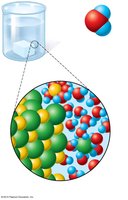
Salts are inorganic compounds that contain cations other than H+ and anions other than OH–. They are vital for many body functions and are classified as electrolytes because they conduct electrical currents.
Salts: Easily separate into their ions in water.
Electrolytes: Ions that conduct electrical currents.
Examples: Sodium and potassium ions are essential for nerve impulse transmission.
Key salts in the body:
Potassium: Key intracellular fluid (ICF) ion
Sodium: Key extracellular fluid (ECF) ion
Calcium: Found in blood and bone
Example: Sodium and potassium ions are crucial for nerve impulse transmission.
Salt | Location |
|---|---|
Potassium | Intracellular fluid (ICF) |
Sodium | Extracellular fluid (ECF) |
Calcium | Blood and bone |
Acids
Definition and Properties
Acids are substances that release hydrogen ions (H+) when dissolved in water. They are characterized by a pH below 7.
Strong acids: Ionize completely (100%) and liberate all their protons.
Weak acids: Ionize incompletely (~10%).
Example: Hydrochloric acid (HCl) dissociates into H+ and Cl–.
Equation:
Bases
Definition and Properties
Bases are substances that release hydroxyl ions (OH–) when dissolved in water. They are characterized by a pH above 7.
Strong bases: Seek and take up 100% of the H+ ions in a solution.
Example: Sodium hydroxide (NaOH) dissociates into Na+ and OH–.
Equation:
Neutralization Reaction
Acids and Bases Reacting
A neutralization reaction occurs when acids and bases react to form water and a salt. This is important for maintaining pH balance in the body.
Example: NaOH (base) + HCl (acid) → H2O + NaCl
Equation:

Additional info: The dissociation of salts and the neutralization reaction are fundamental to understanding electrolyte balance and acid-base homeostasis in human physiology.
