 Back
BackBIO 111-91 Anatomy & Physiology I Syllabus and Course Guide
Study Guide - Smart Notes
 Tailored notes based on your materials, expanded with key definitions, examples, and context.
Course Overview
BIO 111-91: Anatomy and Physiology I is an introductory college-level course that examines the organization of the human body at the tissue, organ, and system levels. The course emphasizes the structure and function of the integumentary, skeletal, muscular, and nervous systems, with a focus on homeostasis, the complementarity of structure and function, and the interrelationships among body systems.
Course Structure and Policies
Lecture Format: Lectures are delivered using PowerPoint slides, with active question and answer sessions to clarify concepts.
Participation: Students are encouraged to ask questions and participate actively to enhance understanding and performance.
Grading: The lecture portion is 70% of the final grade, and the laboratory portion is 30%. Components include homework (10%), attendance (5%), quizzes (30%), and a cumulative final exam (25%).
Attendance: Regular attendance is required. Missing three weeks results in automatic failure per college policy.
Homework: Assigned and submitted via the Pearson Mastering site, accessible through Blackboard. An access code is required.
Quizzes: Weekly quizzes on previously covered material, with the lowest quiz grade dropped.
Final Exam: Cumulative, covering all course material, scheduled for May 16, 2026.
Required Textbooks and Materials
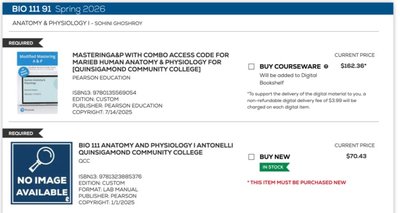
Mastering A&P with Combo Access Code for Marieb Human Anatomy & Physiology (Pearson Education)
BIO 111 Anatomy and Physiology | Antonelli (QCC Custom Lab Manual)
Technology and Computer Literacy
Students must have access to a computer with internet connectivity and be able to use Blackboard Learn and Pearson Mastering platforms.
Technical support is available through QCC IT.
Student Learning Outcomes
Recognize relationships among body systems.
Explain the importance of homeostasis in normal body function.
Apply the concept of complementarity to anatomy and physiology.
Discuss relationships between the integument, skeleton, and musculature.
Describe how the nervous system regulates and integrates body physiology.
Demonstrate competency in laboratory safety and equipment use.
Course Schedule (Key Topics)
Date | Topic | Chapter |
|---|---|---|
Jan 31 | Introduction to Anatomy and Physiology, Homeostasis | 1 |
Feb 7 | Tissues | 4 |
Feb 14 | Tissues (continued) | 4 |
Feb 21 | The Integumentary System | 5 |
Feb 28 | Bones and Skeletal Tissues | 6 |
March 7 | Bones and Skeletal Tissues (continued) | 6 |
March 14 | Joints; Muscles and Muscle Tissue | 8, 9 |
March 21 | Muscles and Muscle Tissue | 9 |
April 11 | The Nervous System and Nervous Tissue | 11 |
April 18 | Neurophysiology; Autonomic Nervous System | 11, 14 |
April 25 | Autonomic Nervous System; Central Nervous System | 14, 12 |
May 2 | Central Nervous System | 12 |
May 9 | Central Nervous System (continued) | 12 |
May 16 | Final Exam (Cumulative) | All |
Academic Integrity and Support Services
Academic Honesty: Plagiarism and cheating are strictly prohibited and may result in failure or expulsion.
Accessibility: Students requiring accommodations should contact Student Accessibility Services.
Tutoring: Academic support is available through the Math Center, Writing Center, and General Academic Areas Tutoring Center.
Diversity, Equity, and Inclusion
The School of Math, Science, & Engineering is committed to fostering a diverse, equitable, and inclusive learning environment, supporting all students regardless of background or identity.
Grading Scale
Grade | Score Range |
|---|---|
A | 95-100 |
A- | 90-94 |
B+ | 87-89 |
B | 83-86 |
B- | 80-82 |
C+ | 77-79 |
C | 73-76 |
C- | 70-72 |
D+ | 67-69 |
D | 63-66 |
D- | 60-62 |
F | Below 60 |
Key Study Strategies
Complete all assigned readings and homework on time.
Rewrite and review class notes regularly.
Participate actively in class and seek help when needed.
Utilize available tutoring and academic resources.
Take the VARK Learning Survey to identify your learning preferences and adapt your study strategies accordingly.
Major Course Topics (Mapped to Chapters)
Ch. 1: The Human Body: An Orientation
Ch. 4: Tissue: The Living Fabric
Ch. 5: The Integumentary System
Ch. 6: Bones and Skeletal Tissue
Ch. 8: Joints
Ch. 9: Muscles and Muscle Tissue
Ch. 11: Fundamentals of the Nervous System and Nervous Tissue
Ch. 12: The Central Nervous System
Ch. 14: The Autonomic Nervous System
Additional info: This syllabus covers foundational topics in human anatomy and physiology, directly matching the standard ANP college curriculum. Students are expected to master terminology, understand system interrelationships, and apply concepts of homeostasis and complementarity.
