 Back
BackBIO-168 Human Anatomy and Physiology I: Course Syllabus and Grading Overview
Study Guide - Smart Notes
 Tailored notes based on your materials, expanded with key definitions, examples, and context.
Course Overview
Introduction to Human Anatomy and Physiology I
This course, BIO-168 Human Anatomy and Physiology I, is the first in a two-semester sequence designed to provide a comprehensive survey of the structure and function of the human body. The curriculum begins at the cellular level and progresses through tissues and organ systems, focusing on the integumentary, skeletal, muscular, nervous, special senses, and endocrine systems. The course is delivered online and includes both theoretical and practical components, with assessments such as exams, lab assignments, discussions, and case studies.
Course Structure and Content
Main Topics Covered
The Human Body: An Orientation
Chemistry Comes Alive
Cells: The Living Units
Tissue: The Living Fabric
The Integumentary System
Bones and Skeletal Tissues
The Skeleton
Joints
Muscles and Muscle Tissue
The Muscular System
Fundamentals of the Nervous System and Nervous Tissue
The Central Nervous System
The Peripheral Nervous System and Reflex Activity
The Autonomic Nervous System
The Special Senses
The Endocrine System
These topics align with the standard curriculum for introductory anatomy and physiology courses and are assessed through four major exams, lab assignments, discussions, and case studies.
Student Learning Outcomes
Develop a vocabulary of appropriate terminology related to anatomy and physiology.
Recognize anatomical structures and explain physiological functions of body systems.
Describe interrelationships within and between anatomical and physiological systems.
Explain the principle of homeostasis and feedback loops in physiological regulation.
Apply critical thinking to evaluate scientific information and make informed decisions.
Assessment and Grading
Assessment Components
Exams: Four exams covering multiple chapters each.
Lab Assignments and Quizzes: Online labs and quizzes, including labeling artwork and answering questions.
Discussions and Case Studies: Participation in threaded discussions and analysis of case studies.
Mastering A&P Activities: Online homework and lab practicals via the Mastering platform.
Grading Scale
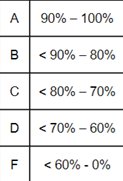
The grading scale for the course is as follows:
Grade | Percentage Range |
|---|---|
A | 90% – 100% |
B | < 90% – 80% |
C | < 80% – 70% |
D | < 70% – 60% |
F | < 60% – 0% |
Assignment Weighting
Assignment Type | Percentage of Overall Grade |
|---|---|
Syllabus Quiz | 1% |
Discussion Forums | 19% |
Case Study | 10% |
Lab Quizzes | 10% |
Mastering A&P | 30% |
Exams | 30% |
Course Policies and Expectations
Attendance and Participation
Regular online attendance and participation are required; this is not a self-paced course.
Assignments, quizzes, and exams must be completed by their due dates; late submissions generally receive a zero unless there is documented hardship.
Academic Integrity
Academic dishonesty, including plagiarism and cheating, will not be tolerated and may result in disciplinary action.
Proper citation and original work are expected in all assignments and discussions.
Technology Requirements
Students must have access to a computer with a webcam, microphone, and reliable internet connection.
Assignments must be submitted in formats compatible with Canvas LMS.
Support Services
Free tutoring is available through campus Success Centers and online platforms.
Disability accommodations are provided upon request and with appropriate documentation.
Additional resources include library services, counseling, career services, and support for military and veteran students.
Conclusion
BIO-168 Human Anatomy and Physiology I provides a foundational understanding of the human body’s structure and function, preparing students for advanced study in health sciences. Success in this course requires consistent participation, adherence to academic integrity, and utilization of available resources.
