 Back
BackBIO 169: The Endocrine System - Comprehensive Study Notes
Study Guide - Smart Notes
 Tailored notes based on your materials, expanded with key definitions, examples, and context.
Endocrine System Overview
Introduction to the Endocrine System
The endocrine system is one of the body's two major regulatory systems, alongside the nervous system. It synthesizes and secretes chemical messengers called hormones into the bloodstream, which bind to receptors on target tissues to elicit changes in cellular function. The endocrine system maintains fluid, electrolyte, and acid-base homeostasis, promotes growth, regulates metabolic reactions, and responds to stressors.
Hormones: Chemical messengers secreted by endocrine glands.
Target tissues: Cells with specific receptors for hormones.
Functions: Regulation of metabolism, growth, homeostasis, and response to stress.
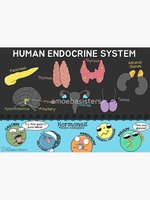
Endocrine vs. Exocrine Glands
Endocrine glands: Release hormones directly into the bloodstream.
Exocrine glands: Release substances into ducts (e.g., sweat, digestive enzymes).
Nervous System vs. Endocrine System
The nervous system acts rapidly via electrical impulses, while the endocrine system acts more slowly via hormones.
Nervous system: Fast, short-lived responses.
Endocrine system: Slow, long-lasting effects.
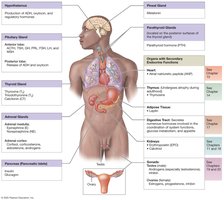
Anatomy of the Endocrine System
Primary, Secondary, and Neuroendocrine Organs
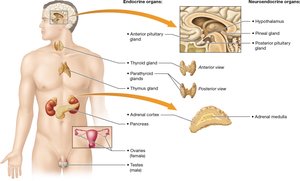
Primary organs: Pituitary, thyroid, parathyroid, adrenal glands, pancreas, gonads.
Secondary organs: Heart, kidneys, adipose tissue, thymus.
Neuroendocrine organs: Hypothalamus, pineal gland, adrenal medulla.
Classes of Hormones
Steroid vs. Non-Steroid Hormones
Hormones are classified based on their chemical structure and solubility.
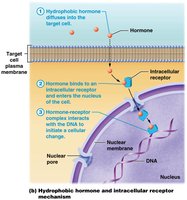
Steroid hormones: Derived from cholesterol, hydrophobic, require carrier proteins, can pass through cell membranes, bind to intracellular receptors.
Non-steroid hormones: Amino acid-based, hydrophilic, freely carried in blood, cannot pass through cell membranes, bind to extracellular receptors and use second messengers.
Hormone Mechanisms and Effects
Mechanism of Action
Hormones exert their effects by binding to specific receptors, which can be located on the cell surface or inside the cell.
Stimulate secretions from endocrine and exocrine cells
Activate or inhibit enzymes
Stimulate or inhibit mitosis/meiosis
Open/close ion channels, alter membrane potential
Activate or inhibit gene transcription/expression
Hormone Interactions
Synergists: Hormones that work together to amplify effects.
Antagonists: Hormones that oppose each other's actions.
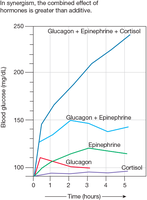
Regulation of Hormone Secretion
Feedback Mechanisms
Most hormone secretion is regulated by negative feedback, which maintains homeostasis by adjusting hormone levels in response to changes in the internal environment.
Negative feedback: Hormone release decreases as its effects are achieved.
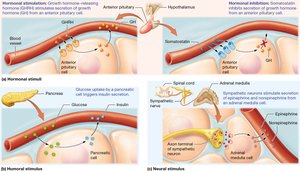
Endocrine Glands and Their Hormones
Hormone Chart
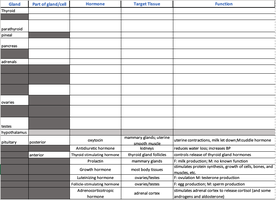
The following table summarizes the main glands, their hormones, target tissues, and functions.
Gland | Part of gland/cell | Hormone | Target Tissue | Function |
|---|---|---|---|---|
Thyroid | Follicles | T3/T4 | Most body tissues | Regulates metabolism, thermoregulation |
Thyroid | Parafollicular cells | Calcitonin | Osteoclasts | Decreases blood calcium |
Parathyroid | Chief cells | PTH | Osteoclasts, kidneys, intestines | Increases blood calcium |
Adrenals | Cortex | Aldosterone, cortisol, androgens | Kidneys, most tissues | Regulates BP, stress, sexual characteristics |
Adrenals | Medulla | Epinephrine, norepinephrine | Various organs | Fight-or-flight response |
Pancreas | Alpha cells | Glucagon | Liver, muscle, adipose | Raises blood glucose |
Pancreas | Beta cells | Insulin | Liver, muscle, brain | Lowers blood glucose |
Pineal | - | Melatonin | Brainstem | Regulates sleep/wake cycles |
Thymus | - | Thymosin, thymopoietin | Lymph organs | T cell maturation |
Testes | - | Testosterone | Reproductive organs | Male sex characteristics |
Ovaries | - | Estrogen, progesterone | Reproductive organs | Female sex characteristics, pregnancy |
Hypothalamus | - | Releasing/inhibiting hormones | Pituitary | Regulates pituitary hormones |
Pituitary | Anterior | TSH, PRL, GH, FSH, LH, ACTH | Various | Regulates other glands and growth |
Pituitary | Posterior | Oxytocin, ADH | Mammary glands, kidneys | Milk release, water retention |
Hypothalamus and Pituitary Gland
Anatomy and Function
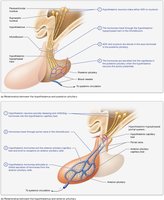
The hypothalamus and pituitary gland are part of the diencephalon and are connected by the infundibulum. The hypothalamic-hypophyseal portal system allows communication between these structures.
Anterior pituitary: Glandular epithelial tissue
Posterior pituitary: Nervous tissue
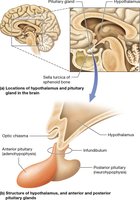
Posterior Pituitary Hormones
The posterior pituitary stores hormones made by the hypothalamus:
Oxytocin: Stimulates milk release and uterine contraction; known as the "cuddle hormone".
Antidiuretic hormone (ADH): Increases water retention by kidneys, affecting blood pressure.
Anterior Pituitary Hormones
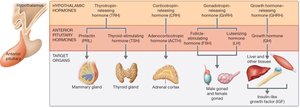
The hypothalamus secretes releasing and inhibiting hormones to regulate the anterior pituitary.
TSH: Stimulates thyroid hormone secretion
PRL: Milk production
GH: Growth and cell division
FSH: Egg and sperm production
LH: Ovulation and testosterone production
ACTH: Stimulates adrenal cortex
Thyroid and Parathyroid Glands
Thyroid Anatomy and Hormones
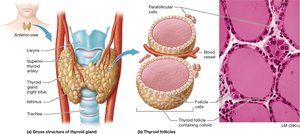
The thyroid is located in the anterior neck, superficial to the larynx. It consists of follicles (produce T3/T4) and parafollicular cells (produce calcitonin).
T3/T4: Regulate metabolic rate and thermoregulation
Calcitonin: Decreases blood calcium by inhibiting osteoclasts
Parathyroid Anatomy and Hormones
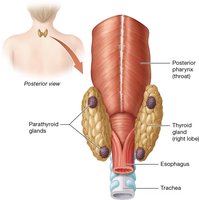
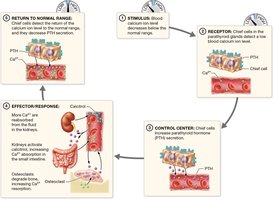
The parathyroid glands are located posterior to the thyroid. Chief cells produce parathyroid hormone (PTH), which increases blood calcium.
PTH: Increases osteoclast activity, Ca2+ reabsorption in kidneys and intestines
Thyroid Disorders
Hypothyroidism: Decreased metabolism, weight gain, cold intolerance, slow heart rate, low BP. Causes: iodine deficiency, Hashimoto thyroiditis.
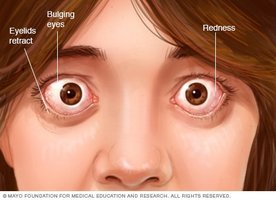
Hyperthyroidism: Increased metabolism, weight loss, heat intolerance, rapid heart rate, increased BP, exophthalmia. Cause: Graves disease.
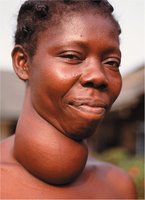
Goiter: Enlargement of the thyroid, can occur in both disorders.
Regulation of Thyroid Hormones
The TRH-TSH-Thyroid hormone pathway involves negative feedback to maintain metabolic balance. 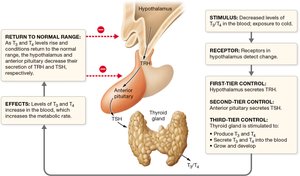
Thyroid and Parathyroid Summary Table
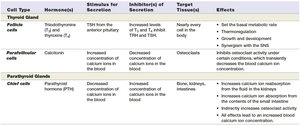
Cell Type | Hormones | Stimulus for Secretion | Inhibitor of Secretion | Target Tissues | Effects |
|---|---|---|---|---|---|
Follicle cells (Thyroid) | T3/T4 | TSH from anterior pituitary | High T3/T4 | Nearly every cell | Metabolic rate, thermoregulation, growth |
Parafollicular cells (Thyroid) | Calcitonin | Increased blood Ca2+ | Decreased blood Ca2+ | Osteoclasts | Inhibits osteoclasts, lowers blood Ca2+ |
Chief cells (Parathyroid) | PTH | Decreased blood Ca2+ | Increased blood Ca2+ | Bone, kidneys, intestines | Raises blood Ca2+ |
Adrenal Glands
Anatomy and Hormones
The adrenal glands consist of an outer cortex and inner medulla.
Zona glomerulosa: Mineralocorticoids (aldosterone)
Zona fasciculata: Glucocorticoids (cortisol)
Zona reticularis: Androgenic steroids
Medulla: Epinephrine/norepinephrine
Adrenal Hormone Functions
Aldosterone: Increases sodium and water reabsorption, raises BP
Cortisol: Stress hormone, increases blood glucose, reduces inflammation
Androgens: Secondary sexual characteristics
Epinephrine/norepinephrine: Fight-or-flight response
Adrenal Disorders
Hypercortisolism: Cushing disease/syndrome; muscle breakdown, weight gain, hyperglycemia, increased BP, weakened immunity
Addison disease: Adrenal insufficiency; hyposecretion of cortisol/aldosterone, fluid/electrolyte imbalance
Pancreas
Anatomy and Hormones
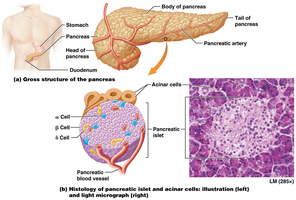
The pancreas is both an endocrine and exocrine gland.
Pancreatic islets: Alpha cells (glucagon), beta cells (insulin), delta cells (somatostatin)
Acinar cells: Secrete digestive enzymes
Glucagon and Insulin
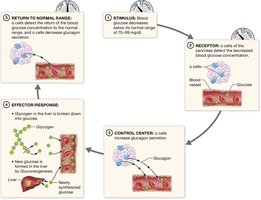
Glucagon: Raises blood glucose; targets liver, muscle, adipose tissue
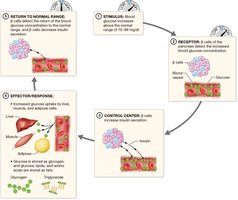
Insulin: Lowers blood glucose; targets liver, muscle, brain
Diabetes Mellitus
Type I: Autoimmune destruction of beta cells; decreased insulin production
Type II: Insulin resistance; cells do not recognize insulin
Symptoms: Glycosuria, polyuria, polydipsia, vascular damage, neuropathy, blindness, kidney failure
Blood Glucose Regulation
Other Endocrine Glands
Pineal Gland
Melatonin: Regulates sleep/wake cycles and mood; targets brainstem
Thymus
Thymosin, thymopoietin: T lymphocyte maturation; targets lymph organs
Gonads
Testes: Testosterone; male sex characteristics, spermatogenesis
Ovaries: Estrogen and progesterone; female sex characteristics, menstrual cycle, pregnancy
Hormones from Other Organs and Tissues
Adipose tissue: Leptin; regulates appetite
Heart: Atrial natriuretic peptide; lowers blood pressure
Kidneys: Erythropoietin; stimulates red blood cell production
Summary and Study Tips
Preview materials before class for better retention
Use spaced repetition and immediate review
Rewrite notes to enhance memory
Key Pathways and Feedback Mechanisms
TRH-TSH-Thyroid Hormone Pathway
Regulation of Blood Calcium
Control of Blood Glucose by Insulin & Glucagon
