 Back
BackBIO 211: Skin Structure, Burns, and Cancer Study Guidance
Study Guide - Smart Notes
 Tailored notes based on your materials, expanded with key definitions, examples, and context.
Q1. Sebaceous glands release: __________, while sudoriferous glands release __________
Background
Topic: Integumentary System – Glandular Secretions
This question tests your understanding of the different types of glands in the skin and what substances they secrete.
Key Terms:
Sebaceous glands: Associated with hair follicles, these glands secrete an oily substance.
Sudoriferous glands: Also known as sweat glands, these are responsible for another type of secretion.
Step-by-Step Guidance
Recall the function of sebaceous glands and what they produce to help lubricate and protect the skin and hair.
Think about the role of sudoriferous glands in thermoregulation and excretion, and what they release to the skin surface.
Try solving on your own before revealing the answer!
Q2. Why are 3rd degree burns more dangerous than first- or second-degree burns?
Background
Topic: Burns and Skin Damage
This question examines your understanding of the severity of burns and the physiological consequences of deeper tissue damage.
Key Concepts:
First-degree burns: Affect only the epidermis.
Second-degree burns: Affect the epidermis and part of the dermis.
Third-degree burns: Extend through the dermis and may affect underlying tissues.
Step-by-Step Guidance
Consider what layers of the skin are damaged in third-degree burns compared to first- and second-degree burns.
Think about the loss of protective functions (like barrier to infection and fluid retention) when deeper layers are destroyed.
Reflect on the complications that can arise from third-degree burns, such as infection and dehydration.
Try solving on your own before revealing the answer!
Q3. What are the 5 characteristics of skin cancer? Explain each one.
Background
Topic: Skin Cancer – ABCDEs of Melanoma
This question tests your knowledge of the warning signs of skin cancer, often summarized by the "ABCDE" rule.
Key Terms:
Asymmetry
Border
Color
Diameter
Evolving
Step-by-Step Guidance
List each characteristic (A, B, C, D, E) and write a brief explanation of what it means in the context of skin lesions.
For each, consider how it helps distinguish benign from malignant lesions.
Think about examples or descriptions for each characteristic.
Try solving on your own before revealing the answer!
Q4. List one bacterial skin infection and one fungal infection.
Background
Topic: Skin Infections
This question checks your ability to identify common infectious agents affecting the skin.
Key Concepts:
Bacterial infections: Often caused by Staphylococcus or Streptococcus species.
Fungal infections: Commonly caused by dermatophytes or yeast.
Step-by-Step Guidance
Recall examples of bacterial infections (e.g., impetigo, cellulitis) and fungal infections (e.g., ringworm, athlete's foot).
Choose one example for each and write them in the appropriate blanks.
Try solving on your own before revealing the answer!
Q5. What type of skin cancer is most likely aggressive and will metastasize?
Background
Topic: Types of Skin Cancer
This question tests your knowledge of the different types of skin cancer and their potential to spread (metastasize).
Key Terms:
Basal cell carcinoma
Squamous cell carcinoma
Melanoma
Step-by-Step Guidance
Recall which type of skin cancer is known for being the most aggressive and having the highest risk of spreading to other parts of the body.
Think about the origin of this cancer and its typical appearance.
Try solving on your own before revealing the answer!
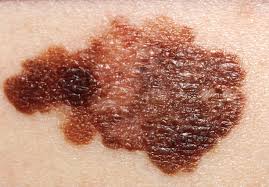
Q6. Identify this type of cancer:
Background
Topic: Skin Cancer Identification
This question asks you to visually identify a type of skin cancer based on its appearance.
Key Concepts:
Look for irregular borders, varied coloration, and asymmetry in the lesion.
Recall which type of skin cancer is most often associated with these features.
Step-by-Step Guidance
Observe the lesion's color, border, and symmetry.
Compare these features to the ABCDEs of skin cancer.
Recall which type of skin cancer typically presents with these characteristics.
Try solving on your own before revealing the answer!
Final Answers
Q1: Sebaceous glands release sebum, sudoriferous glands release sweat.
Q2: Third-degree burns are more dangerous because they destroy all layers of the skin, leading to loss of protective barrier, increased risk of infection, and severe fluid loss.
Q3: The 5 characteristics are:
Asymmetry: One half does not match the other.
Border: Edges are irregular or blurred.
Color: Multiple colors or uneven distribution.
Diameter: Greater than 6 mm (about the size of a pencil eraser).
Evolving: Changes in size, shape, or color over time.
Q4: Bacterial: Impetigo; Fungal: Ringworm (Tinea)
Q5: Melanoma is the most aggressive and likely to metastasize.
Q6: The image shows melanoma.
These answers are based on standard clinical and anatomical knowledge of the integumentary system.
