Back
BackBIO 231 Exam 3 Study Guide: Cell Cycle, Genetics, and Protein Synthesis
Study Guide - Smart Notes
 Tailored notes based on your materials, expanded with key definitions, examples, and context.
Q23. Define transcription. Where does this process occur? Which type of RNA is involved?
Background
Topic: Protein Synthesis (Transcription)
This question tests your understanding of how genetic information is copied from DNA to RNA, a key step in gene expression.
Key Terms and Concepts:
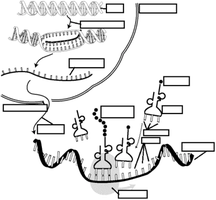
Transcription: The process of making a complementary RNA copy from a DNA template.
mRNA (messenger RNA): The RNA type produced during transcription, which carries genetic information from the nucleus to the ribosome.
Nucleus: The location where transcription occurs in eukaryotic cells.
Step-by-Step Guidance
Recall that transcription is the first step in protein synthesis, where a gene's DNA sequence is copied into mRNA.
Identify the cellular location: Transcription occurs inside the nucleus of eukaryotic cells.
Recognize the RNA type involved: mRNA is synthesized during transcription.
Understand that the enzyme RNA polymerase binds to the DNA and helps assemble the mRNA strand using complementary base pairing.
Try solving on your own before revealing the answer!
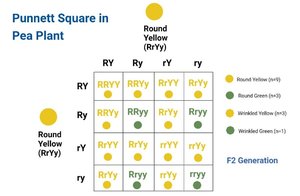
Q42. Use a Punnett square to predict the phenotypic and genotypic probabilities of crosses involving a single trait.
Background
Topic: Mendelian Genetics (Punnett Squares)
This question tests your ability to use Punnett squares to predict the possible genetic outcomes of a cross between two organisms for a single trait.
Key Terms and Concepts:
Punnett Square: A diagram used to predict the genotypes and phenotypes of offspring from a genetic cross.
Genotype: The genetic makeup (e.g., RR, Rr, rr).
Phenotype: The physical expression of the genotype (e.g., round or wrinkled peas).
Alleles: Different forms of a gene (e.g., R for round, r for wrinkled).
Step-by-Step Guidance
Identify the alleles for the trait and the genotypes of the parents (e.g., Rr × Rr).
Set up the Punnett square by writing the possible gametes from each parent along the top and side.
Fill in the squares by combining the alleles from each parent to show possible offspring genotypes.
Count the number of each genotype and determine the corresponding phenotypes.
Try solving on your own before revealing the answer!