 Back
Biochemistry Foundations for Human Anatomy & Physiology
Study Guide - Smart Notes
 Tailored notes based on your materials, expanded with key definitions, examples, and context.
Biochemistry: The Chemical Basis of Life
Introduction to Biochemistry
Biochemistry is the study of the chemical composition and reactions that occur within living organisms. It provides the foundational knowledge necessary to understand the structure and function of the human body at the molecular level. The chemicals in the body are broadly classified into inorganic and organic compounds.
Inorganic compounds: Do not contain carbon (e.g., water, salts, acids, and bases).
Organic compounds: Contain carbon, are usually large, and are covalently bonded (e.g., carbohydrates, lipids, proteins, nucleic acids).
Inorganic Compounds in the Body
Water in Living Organisms
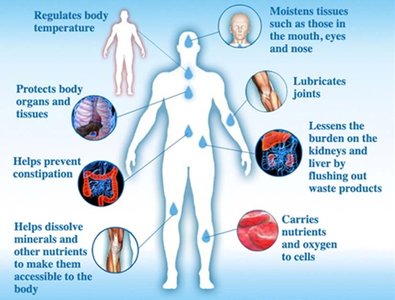
Water is the most abundant inorganic compound in living cells, making up 60-80% of cell volume. Its unique properties are essential for life:
High heat capacity: Absorbs and releases heat slowly, helping to maintain body temperature.
High heat of vaporization: Requires significant energy to change from liquid to gas, aiding in cooling mechanisms like sweating.
Polar solvent properties: Dissolves ionic substances, facilitating chemical reactions and transport of substances.
Reactivity: Involved in hydrolysis and dehydration reactions.
Cushioning and lubrication: Protects organs and lubricates joints.
Salts and Electrolytes
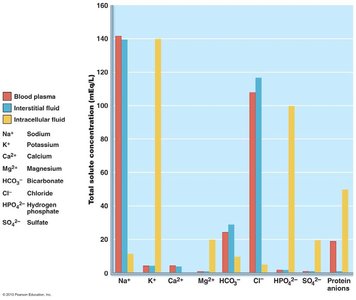
Salts are ionic compounds that dissociate into cations and anions in water, forming electrolytes. They are vital for body homeostasis and play specialized roles such as maintaining resting membrane potential, action potentials, and forming bone salts and hemoglobin.
Common salts: Sodium chloride, potassium chloride, calcium carbonate, calcium phosphates.
Acids and Bases
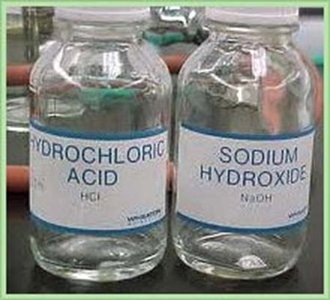
Acids and bases are electrolytes that ionize and dissociate in water. Acids are proton donors (release H+), while bases are proton acceptors (take up H+).
Important acids: Hydrochloric acid (HCl), carbonic acid (H2CO3), acetic acid (HC2H3O2).
Important bases: Bicarbonate ion (HCO3–), ammonia (NH3).
pH: Acid-Base Concentration and Neutralization
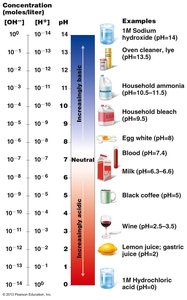
The pH scale measures the relative concentration of hydrogen ions [H+] in a solution, indicating its acidity or alkalinity. The scale ranges from 0 (most acidic) to 14 (most basic), with 7 being neutral.
Acidic: pH < 7
Neutral: pH = 7
Basic (alkaline): pH > 7
Neutralization: Mixing acids and bases forms water and a salt (e.g., HCl + NaOH → H2O + NaCl).
Acid-Base Homeostasis and Buffers
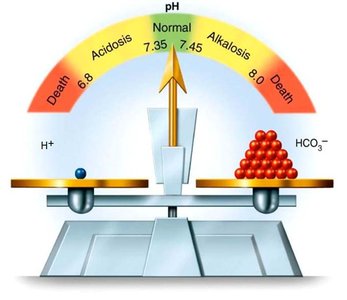
Maintaining a stable pH is critical for cellular function. The body uses chemical buffers, the lungs, and the kidneys to regulate pH. Buffers, such as the carbonic acid-bicarbonate system, resist abrupt changes in pH by releasing or binding H+ as needed.
Acidosis (low pH): Can cause nonresponsiveness in neurons and muscle cells.
Alkalosis (high pH): Can cause hyperactivity in neurons and muscle cells.
Organic Compounds in the Body
General Structure and Synthesis
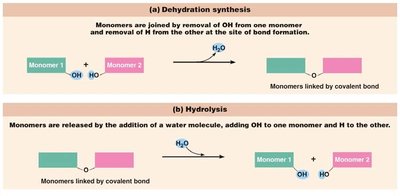
Organic compounds contain carbon (except CO2 and CO) and include carbohydrates, lipids, proteins, and nucleic acids. Many are polymers made of repeating monomers, synthesized by dehydration and broken down by hydrolysis.
Dehydration synthesis: Monomers join by removing water.
Hydrolysis: Polymers are broken down by adding water.
Carbohydrates
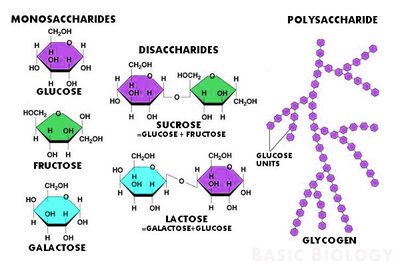
Carbohydrates are sugars containing carbon, hydrogen, and oxygen. They serve as a major source of cellular fuel and as structural molecules.
Monosaccharides: Single sugar units (e.g., glucose, fructose, galactose).
Disaccharides: Two monosaccharides joined together (e.g., sucrose, lactose, maltose).
Polysaccharides: Long chains of monosaccharides (e.g., starch, glycogen).
Lipids
Lipids are hydrophobic molecules containing carbon, hydrogen, and oxygen (less than carbohydrates), and sometimes phosphorus. They are insoluble in water and serve as energy storage, insulation, and protection.
Neutral fats (triglycerides): Three fatty acids bonded to one glycerol.
Phospholipids: Modified triglycerides with a polar head and non-polar tails, essential for cell membrane structure.
Steroids: Four interlocking hydrocarbon rings (e.g., cholesterol, vitamin D, sex hormones, bile salts).
Eicosanoids: Derived from arachidonic acid, involved in inflammation and other functions.
Proteins
Proteins are polymers of amino acids containing carbon, hydrogen, oxygen, nitrogen, and sometimes sulfur and phosphorus. They are essential for structure, function, and regulation of the body's tissues and organs.
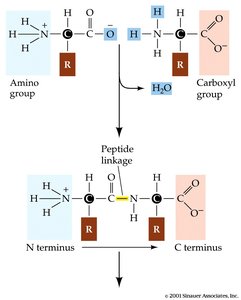
Amino acids: Building blocks of proteins, each with an amine group, acid group, and unique R group.
Peptide bonds: Link amino acids via dehydration synthesis.
Structural levels: Primary, secondary, tertiary, and quaternary structures determine protein function.
Fibrous proteins: Provide support and strength (e.g., collagen, keratin).
Globular proteins: Functional proteins (e.g., enzymes, antibodies, hormones).
Enzymes
Enzymes are globular proteins that act as biological catalysts, lowering the activation energy required for reactions and increasing reaction speed without being consumed.
Holoenzyme: Consists of an apoenzyme (protein) and a cofactor or coenzyme.
Specificity: Enzymes act on specific substrates via the "lock and key" model.
Nomenclature: Enzyme names often end in -ase (e.g., synthase, hydrolase).
Nucleic Acids
Nucleic acids include DNA and RNA, which store and transmit genetic information. They are polymers of nucleotides, each consisting of a nitrogen base, pentose sugar, and phosphate group.
DNA: Deoxyribonucleic acid, stores genetic information.
RNA: Ribonucleic acid, involved in protein synthesis.
Adenosine Triphosphate (ATP)
ATP is the energy currency of the cell, consisting of an adenine-containing RNA nucleotide with two additional phosphate groups. It stores and releases energy for cellular activities through phosphorylation.
ATP synthesis:
ATP hydrolysis:
Summary Table: Major Classes of Organic Compounds
Class | Monomer | Polymer | Main Functions |
|---|---|---|---|
Carbohydrates | Monosaccharide | Polysaccharide | Energy source, structure |
Lipids | Fatty acid, glycerol | Triglyceride, phospholipid | Energy storage, membranes, hormones |
Proteins | Amino acid | Polypeptide | Structure, enzymes, transport |
Nucleic Acids | Nucleotide | DNA, RNA | Genetic information, protein synthesis |
