 Back
Biochemistry: Organic Compounds and Biological Macromolecules
Study Guide - Smart Notes
 Tailored notes based on your materials, expanded with key definitions, examples, and context.
Organic Compounds in Living Systems
Introduction to Organic Compounds
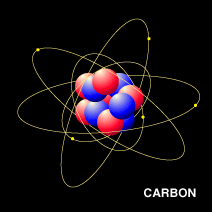
Organic compounds are molecules unique to living systems and are characterized by the presence of carbon. These compounds include carbohydrates, lipids, proteins, and nucleic acids. Carbon's four valence electrons allow it to form four covalent bonds, enabling the creation of diverse structures such as rings and chains.
Key Point: Carbon's bonding versatility is foundational for the complexity of biological molecules.
Key Point: Organic compounds are essential for structure and function in cells.
Building and Breaking Macromolecules
Polymerization: Dehydration Synthesis
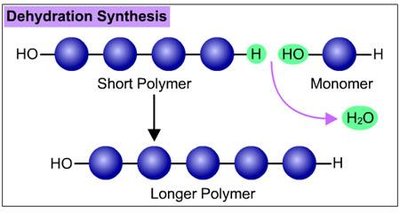
Macromolecules are formed by linking smaller units called monomers through covalent bonds. This process, known as dehydration synthesis, removes a water molecule for each bond formed, resulting in long chains called polymers.
Key Point: Dehydration synthesis is essential for building complex molecules from simpler ones.
Example: Formation of polysaccharides, proteins, and nucleic acids from their respective monomers.
Depolymerization: Hydrolysis
Polymers can be broken down into monomers by hydrolysis, a reaction that adds a water molecule to break covalent bonds. This process is crucial for digestion and cellular metabolism.
Key Point: Hydrolysis is the reverse of dehydration synthesis and is vital for nutrient breakdown.
Carbohydrates
Structure and Function
Carbohydrates are organic molecules with the general formula , where n is the number of carbon atoms. Their primary function is to provide energy and serve as structural components in cells.
Key Point: Carbohydrates are classified as monosaccharides, disaccharides, and polysaccharides based on the number of sugar units.
Monosaccharides
Monosaccharides are simple sugars and the building blocks of carbohydrates. Examples include glucose, fructose, galactose, deoxyribose, and ribose.
Disaccharides
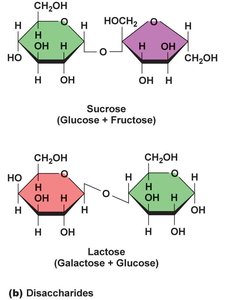
Disaccharides are formed by joining two monosaccharides via dehydration synthesis. Common examples include sucrose (glucose + fructose) and lactose (galactose + glucose).
Polysaccharides
Polysaccharides are long chains of monosaccharides and serve as energy storage or structural molecules. Starch (plants), glycogen (animals), and cellulose (plant cell walls) are key examples.
Starch: Storage form in plants, composed of glucose monomers.
Glycogen: Storage form in animals, highly branched glucose polymer.
Cellulose: Structural component in plant cell walls, not digestible by humans.
Lipids
Structure and Types
Lipids are hydrophobic molecules with a lower proportion of oxygen compared to carbohydrates. They are important for energy storage, membrane structure, and signaling. Major types include triglycerides, phospholipids, and steroids.
Triglycerides: Composed of glycerol and three fatty acids; main form of stored energy.
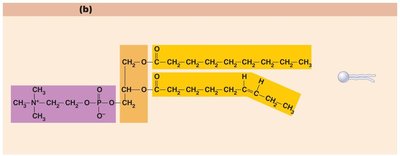
Phospholipids: Glycerol, two fatty acids, and a phosphate group; major component of cell membranes.
Steroids: Four fused carbon rings; includes cholesterol and hormones.
Saturated vs. Unsaturated Fatty Acids
Saturated fatty acids have only single bonds between carbon atoms and are solid at room temperature. Unsaturated fatty acids contain one or more double bonds, causing kinks and making them liquid at room temperature.
Phospholipids and Steroids
Phospholipids form the bilayer of cell membranes, with hydrophilic heads and hydrophobic tails. Steroids, such as cholesterol, are essential for membrane structure and hormone synthesis.
Proteins
Structure and Function
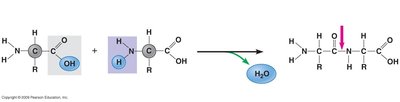
Proteins are polymers of amino acids linked by peptide bonds. They perform a vast array of functions, including catalysis (enzymes), structure, transport, and signaling.
Amino Acids: Each has a central carbon, amino group, carboxyl group, hydrogen, and variable R group.
Peptide Bond: Formed by dehydration synthesis between the amino group of one amino acid and the carboxyl group of another.
Levels of Protein Structure
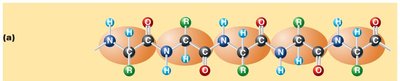
Primary: Sequence of amino acids.
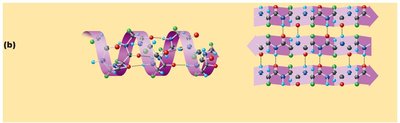
Secondary: Alpha helices and beta sheets formed by hydrogen bonding.
Tertiary: Three-dimensional folding due to R group interactions.
Quaternary: Association of multiple polypeptide chains.
Protein Denaturation
Proteins can lose their functional shape (denature) due to changes in pH or temperature. Denaturation is often irreversible and results in loss of function.
Molecular Chaperones
Molecular chaperones (chaperonins) assist in the proper folding of proteins, maintain folding integrity, and help transport proteins across membranes.
Fibrous vs. Globular Proteins
Fibrous Proteins: Structural, strand-like (e.g., collagen, keratin).
Globular Proteins: Functional, compact, spherical (e.g., enzymes, antibodies).
Enzymes
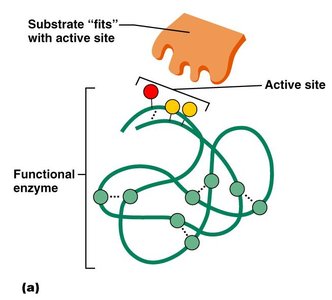
Enzymes are biological catalysts that speed up chemical reactions by lowering activation energy. They are highly specific and usually end with the suffix '-ase'.
Nucleic Acids
DNA and RNA Structure
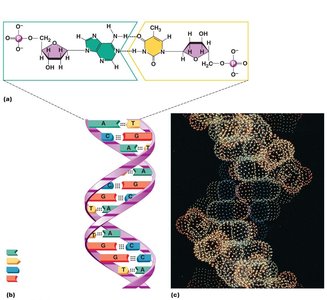
Nucleic acids are polymers of nucleotides, each consisting of a five-carbon sugar, a phosphate group, and a nitrogenous base. DNA contains deoxyribose, while RNA contains ribose.
DNA: Double-stranded helix, stores genetic information, bases are adenine (A), guanine (G), cytosine (C), and thymine (T).
RNA: Single-stranded, involved in protein synthesis, bases are adenine (A), guanine (G), cytosine (C), and uracil (U).
Base Pairing: In DNA, A pairs with T, and G pairs with C.
Adenosine Triphosphate (ATP)
ATP is an adenine-containing RNA nucleotide with three phosphate groups. It is the primary energy carrier in cells, providing immediately usable energy for cellular processes.
