 Back
Biochemistry: Organic Compounds in Human Anatomy & Physiology
Study Guide - Smart Notes
 Tailored notes based on your materials, expanded with key definitions, examples, and context.
Biochemistry: Organic Compounds
Overview of Organic Compounds
Organic compounds are molecules that contain carbon and are fundamental to living organisms. The four main types of organic compounds in human biology are carbohydrates, lipids, proteins, and nucleic acids. Each plays a distinct role in cellular structure and function.
Carbohydrates: Primary energy source, structural units, and energy reserves.
Lipids: Energy storage, membrane structure, insulation, and hormone production.
Proteins: Structural and functional molecules, including enzymes and hormones.
Nucleic Acids: Genetic material and regulation of cellular processes.
Carbohydrates
Classification and Structure
Carbohydrates are composed of carbon, hydrogen, and oxygen. They are hydrophilic, meaning they interact readily with water. Carbohydrates are classified based on their complexity:
Monosaccharides: Single sugar units (monomers).
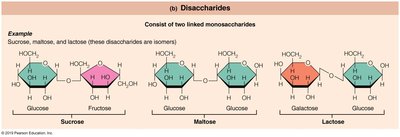
Disaccharides: Two monosaccharides linked together.
Polysaccharides: Long chains of monosaccharides (complex carbohydrates).
Monosaccharides
Monosaccharides are the simplest carbohydrates and serve as the building blocks for more complex sugars. Examples include glucose, fructose, and galactose (hexose sugars, six carbons), as well as ribose and deoxyribose (pentose sugars, five carbons). 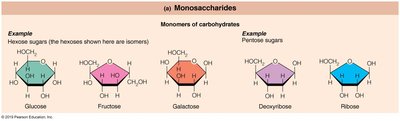
Disaccharides
Disaccharides are formed by joining two monosaccharides via a covalent bond. Examples include:
Sucrose: Glucose + Fructose
Maltose: Glucose + Glucose
Lactose: Galactose + Glucose
Polysaccharides
Polysaccharides are complex carbohydrates consisting of many monosaccharide units. Glycogen is the primary storage form in animals, while starch and cellulose are found in plants. Glycogen is stored in the liver and skeletal muscles. 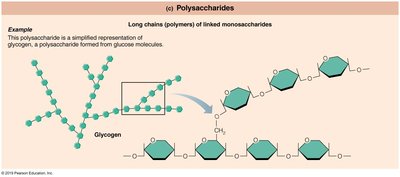
Dehydration Synthesis and Hydrolysis
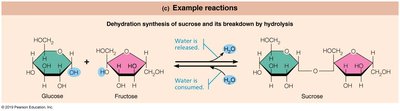
Dehydration synthesis is the process by which two monosaccharides are joined, releasing water. Hydrolysis is the reverse, breaking a bond by adding water.
Dehydration synthesis: Glucose + Fructose → Sucrose + H2O
Hydrolysis: Sucrose + H2O → Glucose + Fructose
Lipids
Classification and Structure
Lipids are hydrophobic molecules composed of carbon, hydrogen, and oxygen. They include triglycerides, phospholipids, steroids, and lipoproteins.
Triglycerides: Glycerol + 3 fatty acids; main energy reserve.
Phospholipids: Major component of cell membranes.
Steroids: Four interlocking carbon rings; includes cholesterol and hormones.
Triglycerides
Triglycerides are formed by dehydration synthesis between glycerol and three fatty acids. 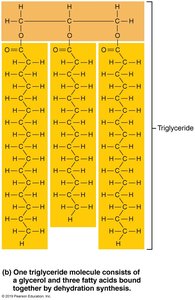
Saturated vs. Unsaturated Fats
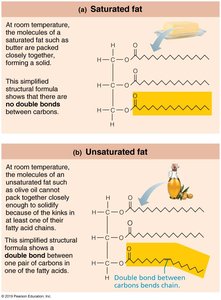
Saturated fats: No double bonds between carbons; solid at room temperature (e.g., butter).
Unsaturated fats: One or more double bonds; liquid at room temperature (e.g., olive oil).
Phospholipids
Phospholipids have a polar (hydrophilic) head and two nonpolar (hydrophobic) tails. They form the bilayer of cell membranes, with heads facing water and tails hidden. 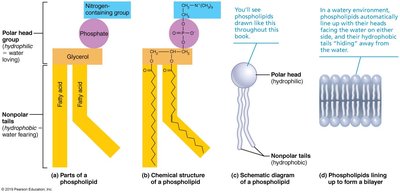
Steroids
Steroids are characterized by four interlocking hydrocarbon rings. Cholesterol is the basis for all steroids formed in the body. 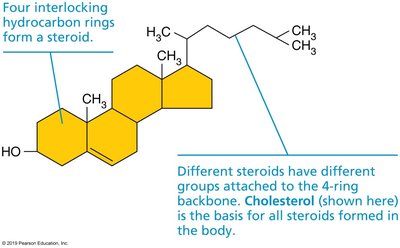
Proteins
Structure and Function
Proteins are composed of carbon, hydrogen, oxygen, and nitrogen. Their building blocks are amino acids, which are linked by peptide bonds. Proteins serve structural (e.g., muscle) and functional (e.g., enzymes, hormones) roles.
Amino Acids and Peptide Bonds
Amino acids have an amine group, an acid group, and a variable functional group (R). Peptide bonds are formed by dehydration synthesis and broken by hydrolysis. 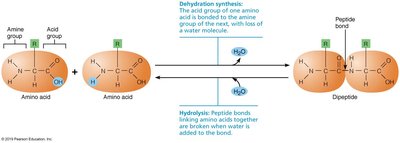
Levels of Protein Structure
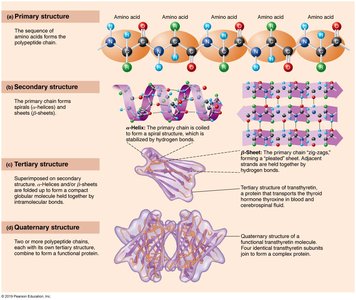
Primary: Sequence of amino acids.
Secondary: Hydrogen bonding forms alpha-helices and beta-pleated sheets.
Tertiary: Three-dimensional folding due to interactions among side chains.
Quaternary: Association of multiple polypeptide chains (e.g., hemoglobin).
Protein Denaturation
Protein function depends on structure. Denaturation (loss of structure) can occur due to changes in temperature, pH, or salinity, rendering the protein nonfunctional.
Nucleic Acids
Structure and Function
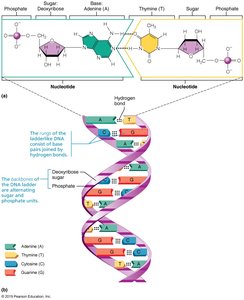
Nucleic acids include DNA and RNA. They are composed of carbon, hydrogen, oxygen, nitrogen, and phosphorus. The basic unit is the nucleotide, which consists of a phosphate group, pentose sugar, and nitrogenous base.
DNA: Double-stranded, contains deoxyribose, bases are adenine, thymine, guanine, cytosine.
RNA: Single-stranded, contains ribose, bases are adenine, uracil, guanine, cytosine.
Adenosine Triphosphate (ATP)
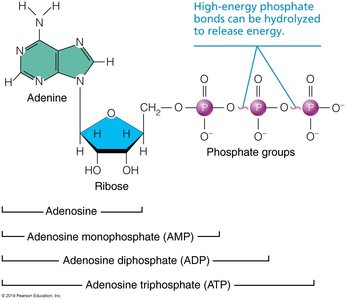
ATP is the cell's energy currency. It consists of adenine, ribose, and three phosphate groups. Energy is stored in the phosphate bonds and released when ATP is hydrolyzed.
ATP hydrolysis: ATP → ADP + Pi + energy
Summary Table: Organic Compounds
Compound | Elements | Monomer | Main Function |
|---|---|---|---|
Carbohydrates | C, H, O | Monosaccharide | Energy source, structure |
Lipids | C, H, O | Fatty acid, glycerol | Energy reserve, membranes, hormones |
Proteins | C, H, O, N | Amino acid | Structure, enzymes, hormones |
Nucleic Acids | C, H, O, N, P | Nucleotide | Genetic material, protein synthesis |
Key Concepts
Organic compounds are essential for life and cellular function.
Carbohydrates, lipids, proteins, and nucleic acids each have unique structures and roles.
Dehydration synthesis and hydrolysis are fundamental reactions in biochemistry.
ATP is the primary energy molecule for cellular work.
