 Back
Biomolecules: Structure, Function, and Importance in Anatomy & Physiology
Study Guide - Smart Notes
 Tailored notes based on your materials, expanded with key definitions, examples, and context.
Biomolecules: From Chemistry to Cells
What are Biomolecules?
Biomolecules are organic molecules (or ions) essential for life, forming the structural and functional basis of cells. Organic substances are characterized by carbon atoms bonded to hydrogen, allowing for diverse molecular structures.
Monomers: Small building blocks (e.g., amino acids, monosaccharides).
Polymers: Chains of repeating monomers (e.g., proteins, polysaccharides).
Dehydration synthesis: Process where two molecules bond by removing water.
Hydrolysis: Process where a molecule is split by adding water.
Four Main Categories of Biomolecules
Carbohydrates
Lipids
Proteins
Nucleic acids
Carbon: A Key Player
Carbon's Unique Properties
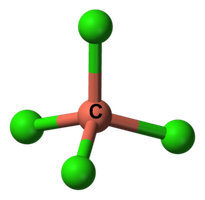
Carbon is fundamental to all biomolecules due to its ability to form four stable covalent bonds in various arrangements, making it the foundation of life's molecules. Functional groups attached to carbon give molecules specific chemical properties.
Common Functional Groups of Carbon
Amino group (-NH2): Found in amino acids.
Carboxyl group (-COOH): Found in amino acids and fatty acids.
Hydroxyl group (-OH): Found in carbohydrates, amino acids, fatty acids, alcohols.
Phosphate group (-PO42-): Found in nucleic acids, phospholipids, ATP.
Carbohydrates: Immediate and Stored Energy
Structure and Function
Carbohydrates contain carbon, hydrogen, and oxygen in a 1:2:1 ratio (e.g., glucose: C6H12O6). They serve as immediate energy sources and as stored energy in the form of polysaccharides.
Monosaccharides: Simple sugars (glucose, fructose, galactose).
Disaccharides: Two monosaccharides linked (maltose, sucrose, lactose).
Polysaccharides: Many monosaccharides linked (starch, glycogen, cellulose).
Glycosidic Bonds and Glycogen
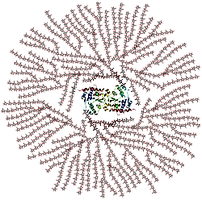
Glycosidic bonds link sugar molecules to form larger carbohydrates. Glycogen is a highly branched polysaccharide used for energy storage in liver and muscle cells.
Dehydration Synthesis and Hydrolysis
Dehydration synthesis: Joins sugar molecules by removing water (e.g., glucose + glucose → maltose).
Hydrolysis: Breaks glycosidic bonds by adding water (e.g., sucrose → glucose + fructose).
Lipids: Energy Storage, Insulation, Membranes, Hormones
Structure and Types
Lipids are mostly nonpolar (hydrophobic) molecules composed mainly of carbon and hydrogen. They serve as energy storage, insulation, membrane structure, and hormone precursors.
Fatty acids
Glycerides (mono-, di-, triglycerides)
Eicosanoids
Steroids
Phospholipids
Fatty Acids: Saturated vs. Unsaturated
Fatty acids are long hydrocarbon chains with a carboxyl group. Saturated fatty acids have no double bonds; unsaturated fatty acids have one or more double bonds.
Glycerides: Mono-, Di-, and Triglycerides
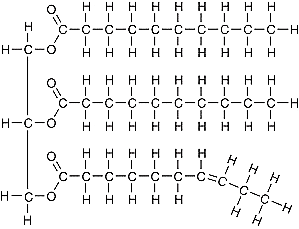
Glycerides are formed by attaching fatty acids to glycerol. Triglycerides are the main form of stored fat in adipocytes and must be hydrolyzed for energy use.
Phospholipids
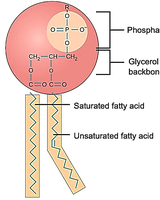
Phospholipids consist of a glycerol backbone, two fatty acid tails, and a phosphate group. They are amphipathic, forming the lipid bilayer of cell membranes.
Steroids
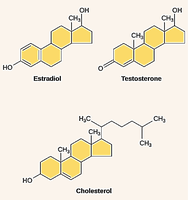
Steroids have a four-ring carbon structure and function as hormones and membrane components. Cholesterol is the most common steroid, serving as a precursor for steroid hormones.
Cholesterol in Cell Membranes
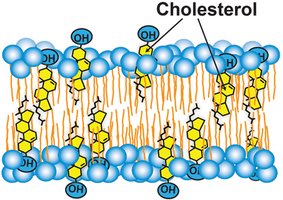
Cholesterol is a major component of plasma membranes, contributing to membrane fluidity and stability.
Proteins: Worker and Structural Supporter Molecules
Structure and Function
Proteins are long chains of amino acids linked by peptide bonds. Their structure determines their function, including enzymes, transporters, hormones, buffers, antibodies, and structural proteins (collagen, keratin).
20 different amino acids build all proteins.
Proteins can be thousands of amino acids long.
Levels of Protein Structure
Primary structure: Linear sequence of amino acids.
Secondary structure: Local folding (alpha helices, beta sheets) via hydrogen bonds.
Tertiary structure: Overall 3D shape stabilized by R group interactions.
Quaternary structure: Assembly of multiple polypeptide chains.
Enzymes: Specialized Proteins
Function and Specificity
Enzymes are proteins that act as biological catalysts, speeding up reactions by lowering activation energy. Their tertiary structure determines the specificity of their active sites.
Nucleic Acids: DNA and RNA
Structure and Function
Nucleic acids store and transmit genetic information. DNA contains the genetic code for protein synthesis; RNA helps read and carry instructions for building proteins.
DNA: Double-stranded, contains deoxyribose sugar.
RNA: Single-stranded, contains ribose sugar.
Nucleotides: Subunits of Nucleic Acids
Nucleotides consist of a pentose sugar, phosphate group, and nitrogenous base. The sequence of nitrogenous bases encodes genetic information.
Genetic Code: Sequence of Nitrogenous Bases
Purines: Adenine (A), Guanine (G) – double-ring structure.
Pyrimidines: Cytosine (C), Thymine (T, DNA), Uracil (U, RNA) – single-ring structure.
In DNA: A pairs with T, G pairs with C (complementary base pairs).
ATP: Stored Cell Energy
Role of ATP
ATP (adenosine triphosphate) is the cell’s energy currency, storing energy in its phosphate bonds. Energy is released when ATP is hydrolyzed to ADP and phosphate.
ATP is generated from ADP and phosphate using energy from organic molecules.
Cells use ATP for vital functions such as protein synthesis and muscle contraction.
ATP Hydrolysis Equation
ATP Synthesis Equation
