 Back
Blood: Structure, Function, and Components
Study Guide - Smart Notes
 Tailored notes based on your materials, expanded with key definitions, examples, and context.
Circulatory System Functions
Overview of Circulatory System Roles
The circulatory system is essential for maintaining homeostasis in the human body. It performs three primary functions: transport, protection, and regulation.
Transport: Moves respiratory gases (O2, CO2), nutrients, metabolic wastes, hormones, and stem cells throughout the body.
Protection: Prevents blood loss through clotting and defends against toxins and infections via inflammation, white blood cells, and antibodies.
Regulation: Maintains fluid balance, pH, and body temperature.
Components of Blood
Main Constituents of Blood
Blood is a specialized connective tissue composed of plasma and formed elements. Each component plays a distinct role in physiological processes.
Plasma: The clear, extracellular matrix of blood, making up about 55% of its volume.
Formed Elements: Includes cells and cell fragments such as erythrocytes (red blood cells), leukocytes (white blood cells), and platelets (thrombocytes).
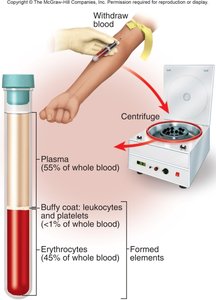
Separation of Blood Components
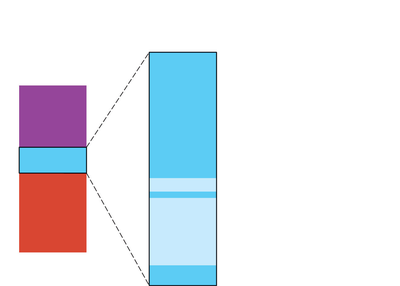
When blood is centrifuged, it separates into three layers:
Plasma: 55% of whole blood, least dense component.
Buffy Coat: Contains leukocytes and platelets, less than 1% of whole blood.
Erythrocytes: 45% of whole blood, most dense component.
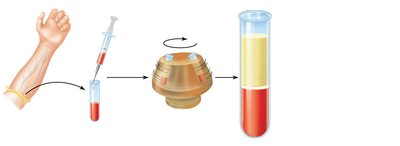
Blood Plasma
Composition and Function of Plasma
Plasma is the liquid portion of blood, consisting mostly of water and dissolved substances. It serves as the medium for transporting nutrients, hormones, and waste products.
Water: About 92% by weight.
Proteins: Albumins, globulins, fibrinogen, enzymes, and others.
Nutrients: Glucose, amino acids, lactic acid, lipids, etc.
Electrolytes: Salts of Na, K, Mg, Ca, Cl, etc.
Nitrogenous Wastes: Urea and others.
Hormones and Gases: Oxygen, carbon dioxide, nitrogen.
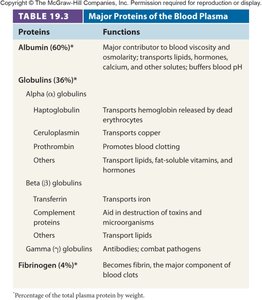
Major Plasma Proteins
Plasma proteins are crucial for maintaining osmotic pressure, transporting substances, and blood clotting.
Proteins | Functions |
|---|---|
Albumin (60%) | Major contributor to blood viscosity and osmolarity; transports lipids, hormones, calcium, and other solutes; buffers blood pH |
Globulins (36%) | Alpha: transports hemoglobin, copper, promotes clotting; Beta: transports iron, aids in destruction of toxins; Gamma: antibodies, combat pathogens |
Fibrinogen (4%) | Becomes fibrin, the major component of blood clots |
Formed Elements of Blood
Types of Formed Elements
The formed elements of blood include erythrocytes, leukocytes, and platelets, each with specialized functions.
Erythrocytes (Red Blood Cells): Transport oxygen and carbon dioxide.
Leukocytes (White Blood Cells): Defend against pathogens and foreign substances.
Platelets: Aid in blood clotting and vessel repair.
Erythrocytes (Red Blood Cells)
Structure and Function
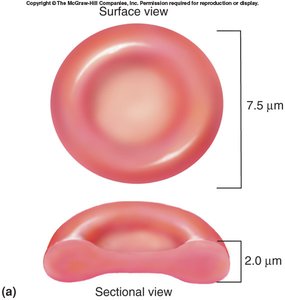
Erythrocytes are specialized for gas transport. Their unique shape and lack of organelles maximize their efficiency in carrying oxygen and carbon dioxide.
Shape: Biconcave disc, 7.5 μm in diameter, 2.0 μm thick.
Organelles: Lack nucleus and mitochondria, allowing more space for hemoglobin.
Membrane Molecules: Determine blood type.
Hemoglobin
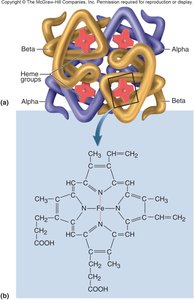
Hemoglobin is the iron-containing protein in erythrocytes responsible for oxygen transport.
Structure: Composed of four globin chains, each with a heme group containing a ferrous ion (Fe2+).
Function: Each heme binds one oxygen molecule; hemoglobin also transports some carbon dioxide.
Erythropoiesis (Red Blood Cell Formation)
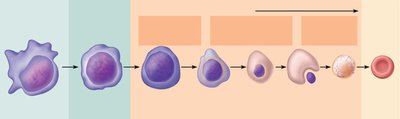
Erythropoiesis is the process of red blood cell production, occurring in the red bone marrow.
Stages: Hemocytoblast → Proerythroblast → Erythroblast (early and late) → Normoblast → Reticulocyte → Erythrocyte
Key Events: Ribosome synthesis, hemoglobin accumulation, ejection of nucleus.
Leukocytes (White Blood Cells)
Classification and Function
Leukocytes are the body's primary defense against infection. They are classified as granulocytes or agranulocytes based on the presence of cytoplasmic granules.
Granulocytes: Neutrophils, eosinophils, basophils.
Agranulocytes: Lymphocytes, monocytes.
Types of Leukocytes
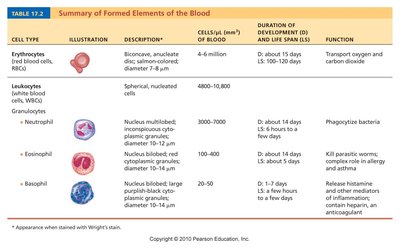
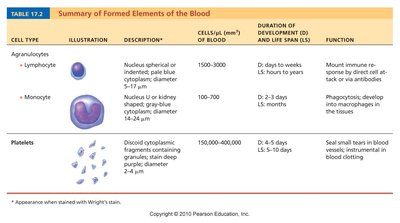
Each type of leukocyte has distinct morphological features and immune functions.
Cell Type | Description | Function |
|---|---|---|
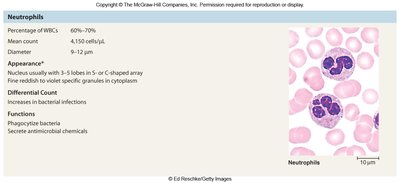
Neutrophil | Multilobed nucleus, pale granules | Phagocytizes bacteria |
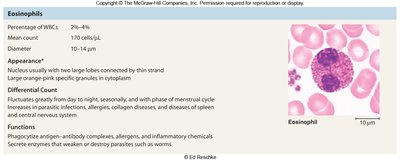
Eosinophil | Bilobed nucleus, orange-red granules | Kills parasites, modulates allergic responses |
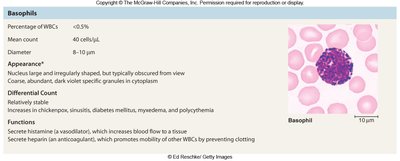
Basophil | Bilobed nucleus, dark granules | Releases histamine and heparin |
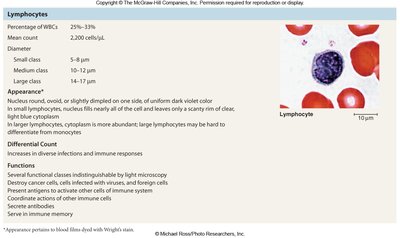
Lymphocyte | Large spherical nucleus | Mounts immune response |
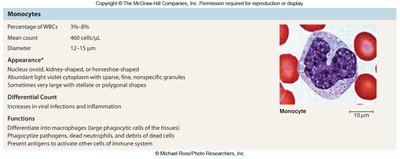
Monocyte | Kidney-shaped nucleus | Phagocytizes pathogens, becomes macrophage |
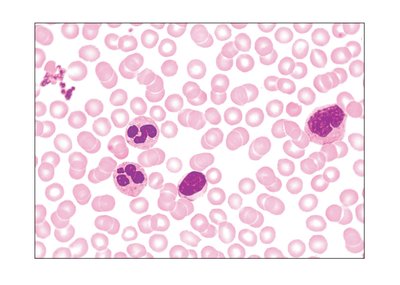
Microscopic Appearance of Leukocytes
Leukocytes can be identified in blood smears by their size, nuclear shape, and granule staining properties.
Neutrophils: 60–70% of WBCs, multilobed nucleus, fine granules.
Eosinophils: 2–4% of WBCs, bilobed nucleus, large orange granules.
Basophils: <0.5% of WBCs, large nucleus, dark granules.
Monocytes: 3–8% of WBCs, kidney-shaped nucleus, abundant cytoplasm.
Lymphocytes: 25–33% of WBCs, large round nucleus, thin rim of cytoplasm.
Platelets (Thrombocytes)
Structure and Function
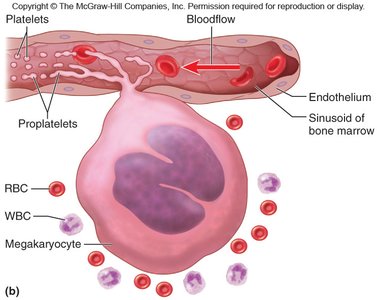
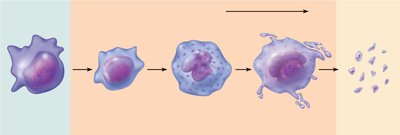
Platelets are small, anucleate cell fragments derived from megakaryocytes. They play a critical role in hemostasis (blood clotting) and tissue repair.
Origin: Fragments of megakaryocytes in bone marrow.
Functions: Form platelet plugs, secrete clotting factors, promote vessel repair, and attract white blood cells to sites of injury.
Platelet Production (Thrombopoiesis)
Platelets are produced through a process called thrombopoiesis, which involves the differentiation of hematopoietic stem cells into megakaryocytes and the subsequent release of platelets into the bloodstream.
Stages: Hemocytoblast → Megakaryoblast → Promegakaryocyte → Megakaryocyte → Platelets
Site: Occurs primarily in the red bone marrow.
Summary Table: Formed Elements of the Blood
The following tables summarize the main characteristics of erythrocytes, leukocytes, and platelets, including their appearance, abundance, and primary functions.
Cell Type | Description | Cells/μL | Life Span | Function |
|---|---|---|---|---|
Erythrocyte | Biconcave, anucleate | 4–6 million | 100–120 days | Transport O2 and CO2 |
Neutrophil | Multilobed nucleus, pale granules | 3,000–7,000 | 6 hours–few days | Phagocytize bacteria |
Eosinophil | Bilobed nucleus, orange granules | 100–400 | 8–12 days | Kill parasites, modulate allergy |
Basophil | Bilobed nucleus, dark granules | 20–50 | Few hours–few days | Release histamine, anticoagulant |
Lymphocyte | Large nucleus, thin cytoplasm | 1,500–3,000 | Days to years | Mount immune response |
Monocyte | Kidney-shaped nucleus | 100–700 | Months | Phagocytosis, become macrophages |
Platelets | Small cytoplasmic fragments | 150,000–400,000 | 5–10 days | Seal small blood vessels, clotting |
Additional info: These notes cover the essential aspects of blood as described in Chapter 17 and 18 of standard anatomy and physiology textbooks, including structure, function, and development of blood components.
