 Back
Blood: Structure, Function, and Formed Elements in the Cardiovascular System
Study Guide - Smart Notes
 Tailored notes based on your materials, expanded with key definitions, examples, and context.
Circulatory System Functions
Overview of Blood Functions
The circulatory system is essential for maintaining homeostasis and supporting life by transporting substances, protecting the body, and regulating internal conditions.
Transport: Moves respiratory gases (O2, CO2), nutrients, wastes, hormones, and stem cells throughout the body.
Protection: Blood clotting prevents loss of blood; white blood cells and antibodies defend against toxins and infections.
Regulation: Maintains fluid balance, pH, and temperature within the body.
Components of Blood
Blood Composition and Separation
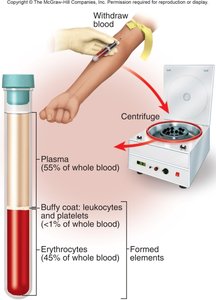
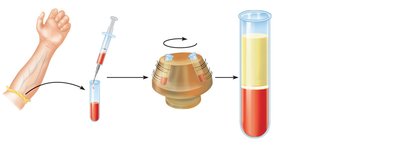
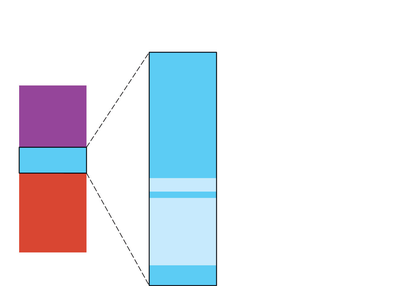
Blood consists of plasma and formed elements, which can be separated by centrifugation for analysis.
Plasma: The clear, extracellular fluid (matrix) that makes up about 55% of whole blood.
Formed Elements: Includes cells and cell fragments: erythrocytes (red blood cells), leukocytes (white blood cells), and platelets (fragments of bone marrow cells).
Distribution of Blood Components
Plasma: 55% of whole blood; least dense component.
Buffy coat: Contains leukocytes and platelets; less than 1% of whole blood.
Erythrocytes: 45% of whole blood; most dense component.
Blood Plasma
Composition of Plasma
Plasma is the liquid portion of blood, making up slightly more than half of its volume. It is primarily water, but also contains proteins, nutrients, electrolytes, wastes, hormones, and gases.
Serum: Plasma minus solids and clotting factors.
Water: 92% by weight.
Proteins: Albumins, globulins, fibrinogen, enzymes.
Nutrients: Glucose, amino acids, lactic acid, lipids.
Electrolytes: Salts of Na, K, Mg, Ca, Cl.
Nitrogenous wastes: Urea and others.
Hormones and gases: Oxygen, carbon dioxide, nitrogen.
Major Plasma Proteins
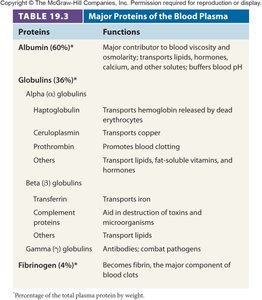
Plasma proteins serve various functions, including maintaining osmotic pressure, transporting substances, and aiding in clotting.
Proteins | Functions |
|---|---|
Albumin (60%) | Major contributor to blood viscosity and osmolarity; transports lipids, hormones, calcium; buffers blood pH |
Globulins (36%) | Transport hemoglobin, copper, lipids, fat-soluble vitamins, hormones; promote blood clotting; antibodies (gamma globulins) |
Fibrinogen (4%) | Becomes fibrin, the major component of blood clots |
Formed Elements of Blood
Types of Formed Elements
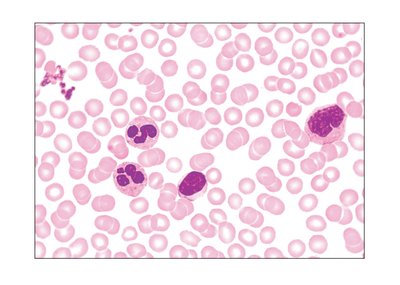
Formed elements include erythrocytes, leukocytes, and platelets, each with distinct functions and characteristics.
Erythrocytes (RBCs): Transport oxygen and carbon dioxide.
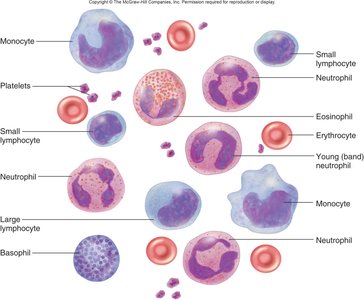
Leukocytes (WBCs): Protect against pathogens; divided into granulocytes and agranulocytes.
Platelets: Aid in blood clotting and other functions.
Erythrocytes (Red Blood Cells)
Structure and Function
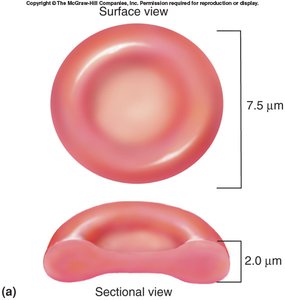
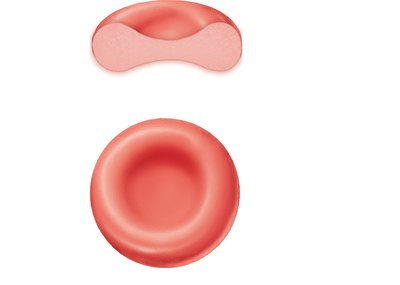
Erythrocytes are specialized for gas transport and have a unique discoid shape to maximize surface area for diffusion.
Shape: Biconcave disc, 7.5 µm diameter, 2.0 µm thick.
Organelles: Lack nucleus, mitochondria, and other organelles.
Hemoglobin: Each cell carries millions of hemoglobin molecules.
Blood type: Determined by molecules on cell membrane.
Quantity and Hematocrit
RBC count: Men: 4.6–6.2 million/µL; Women: 4.2–5.4 million/µL.
Hematocrit: Men: 45–52%; Women: 37–48%.
Hemoglobin Structure
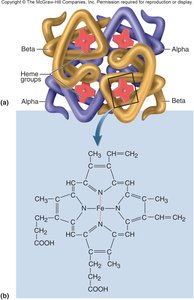
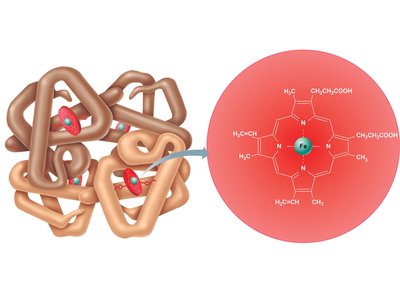
Hemoglobin is an iron-containing protein responsible for transporting oxygen. It consists of four globin chains, each with a heme group that binds oxygen.
Globin: Two alpha and two beta polypeptide chains.
Heme group: Contains a ferrous ion (Fe2+) at its center.
Erythropoiesis (RBC Formation)
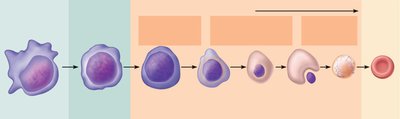
Erythropoiesis is the process of red blood cell formation, beginning with stem cells and progressing through several stages.
Stem cell: Hemocytoblast
Developmental pathway: Proerythroblast → Early erythroblast → Late erythroblast → Normoblast → Reticulocyte → Erythrocyte
Phases: Ribosome synthesis, hemoglobin accumulation, ejection of nucleus
Leukocytes (White Blood Cells)
Form and Function
Leukocytes are the body's defense cells, protecting against pathogens and migrating into tissues. They are the least abundant formed elements.
Agranulocytes: Lymphocytes and monocytes
Granulocytes: Neutrophils, eosinophils, basophils
Types of Leukocytes
Leukocytes are classified based on the presence of granules and their specific functions.
Cell Type | Description | Count (cells/µL) | Function |
|---|---|---|---|
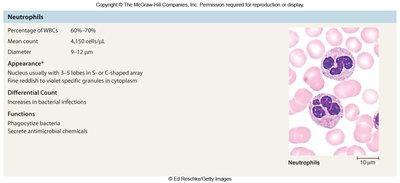
Neutrophil | Multilobed nucleus, pale granules | 3,000–7,000 | Phagocytize bacteria |
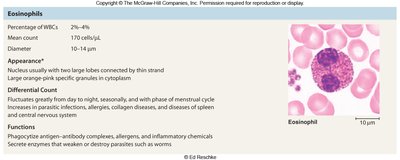
Eosinophil | Bilobed nucleus, orange granules | 100–400 | Kill parasitic worms, modulate allergy |
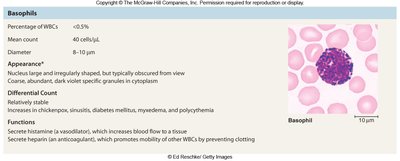
Basophil | Bilobed nucleus, dark granules | 20–50 | Release histamine, contain heparin |
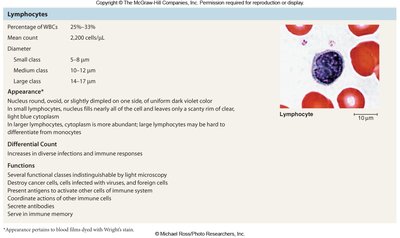
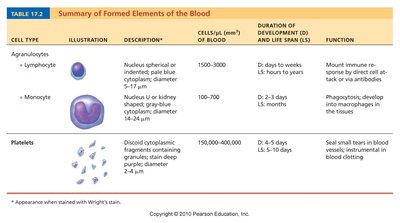
Lymphocyte | Spherical nucleus, thin rim of cytoplasm | 1,500–3,000 | Mount immune response |
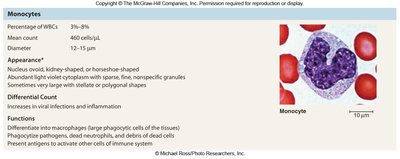
Monocyte | Kidney-shaped nucleus, abundant cytoplasm | 100–700 | Phagocytosis, develop into macrophages |
Platelets
Form and Function
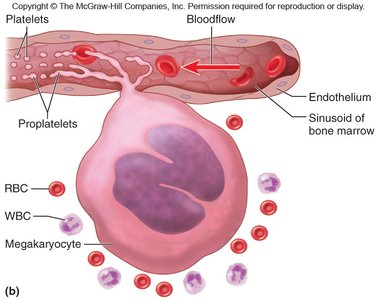
Platelets are small fragments of megakaryocytes that play a crucial role in blood clotting and other processes.
Structure: No nucleus, but contain organelles and an open canalicular system.
Functions: Clot formation, vasoconstriction, clot dissolving, WBC attraction, destruction of bacteria, stimulation of mitosis for healing.
Platelet Production (Thrombopoiesis)
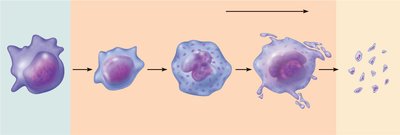
Platelets are produced from megakaryocytes in the bone marrow, which release proplatelet tendrils that break into platelets within lung capillaries.
Developmental Pathways of Blood Cells
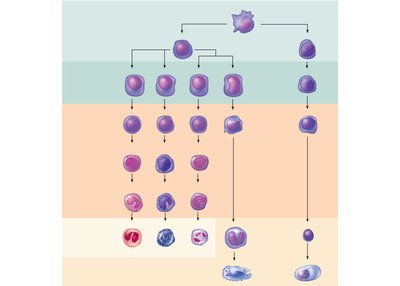
Blood cell formation involves differentiation from hematopoietic stem cells into various committed cell types, leading to the production of erythrocytes, leukocytes, and platelets.
Summary Table: Formed Elements of the Blood
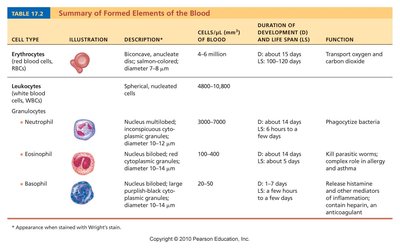
Cell Type | Description | Count (cells/µL) | Life Span | Function |
|---|---|---|---|---|
Erythrocyte | Biconcave, anucleate | 4–6 million | 100–120 days | Transport O2 and CO2 |
Neutrophil | Multilobed nucleus, pale granules | 3,000–7,000 | 6 hours–few days | Phagocytize bacteria |
Eosinophil | Bilobed nucleus, orange granules | 100–400 | ~5 days | Kill parasitic worms, allergy modulation |
Basophil | Bilobed nucleus, dark granules | 20–50 | ~few hours–few days | Release histamine, contain heparin |
Lymphocyte | Spherical nucleus, thin rim of cytoplasm | 1,500–3,000 | Days to years | Mount immune response |
Monocyte | Kidney-shaped nucleus | 100–700 | Months | Phagocytosis, develop into macrophages |
Platelets | Discoid cytoplasmic fragments | 150,000–400,000 | 5–10 days | Blood clotting |
Key Equations and Concepts
Hematocrit Calculation
Hematocrit is the percentage of blood volume occupied by erythrocytes.
Formula:
Osmotic Pressure
Osmotic pressure is largely determined by plasma proteins, especially albumin.
Formula:
Where is osmotic pressure, R is the gas constant, T is temperature, and is the concentration of solute i.
Additional info:
Blood cell development (hematopoiesis) occurs in the bone marrow and is regulated by growth factors and hormones.
Platelets are essential not only for clotting but also for tissue repair and immune responses.
