 Back
BackBlood Vessels and Hemodynamics: Structure, Function, and Regulation
Study Guide - Smart Notes
 Tailored notes based on your materials, expanded with key definitions, examples, and context.
Blood Vessels
Overview of Blood Vessels
Blood vessels are essential components of the circulatory system, responsible for transporting blood throughout the body. They deliver oxygen and nutrients to tissues and remove waste products. The main types of blood vessels include arteries, veins, and capillaries, each with distinct structural and functional characteristics.
Arteries: Carry blood away from the heart; typically muscular and elastic to withstand high pressure.
Veins: Return blood to the heart; have thinner walls and valves to prevent backflow.
Capillaries: Microscopic vessels where exchange of gases, nutrients, and waste occurs.
Structure of Blood Vessel Walls
Blood vessel walls are composed of three main layers (tunics), each with specific functions:
Tunica intima: Innermost layer; consists of endothelium (simple squamous epithelium) and a subendothelial layer of loose connective tissue. Reduces friction and allows smooth blood flow.
Tunica media: Middle layer; composed of smooth muscle and elastic fibers. Responsible for vasoconstriction and vasodilation, regulating blood vessel diameter and blood pressure.
Tunica externa (adventitia): Outermost layer; connective tissue that protects and anchors the vessel.
Types of Arteries
Conducting (elastic) arteries: Large arteries (e.g., aorta) that maintain blood pressure by stretching and recoiling.
Distributing (muscular) arteries: Medium-sized arteries that distribute blood to specific organs; more muscular and less elastic.
Resistance arteries (arterioles): Smallest arteries; regulate blood flow into capillary beds and are primary sites of vascular resistance.
Types of Veins
Venules: Smallest veins; collect blood from capillaries.
Medium veins: Contain valves to prevent backflow, especially in limbs.
Large veins: Include the superior and inferior vena cava; return blood directly to the heart.
Types of Capillaries
Continuous capillaries: Have tight junctions and intercellular clefts; found in most tissues.
Fenestrated capillaries: Contain small pores (fenestrations) for passage of larger molecules; found in kidneys and small intestine.
Sinusoidal capillaries: Large gaps between cells; found in liver, bone marrow, and spleen.
Special Circulatory Routes
Portal system: Blood passes through two consecutive capillary beds before returning to the heart (e.g., hepatic portal system in digestion).
Arteriovenous anastomosis: Direct connection between arteries and veins, bypassing capillaries.
Arterial anastomosis: Multiple arteries supply the same region, providing collateral circulation.
Common Blood Vessel Disorders
Varicose veins: Stretched, superficial veins due to valve failure (e.g., in obesity, hemorrhoids).
Aneurysm: Weak point in an artery wall; can occur in the brain or aorta and may rupture.
Hemodynamics: Blood Flow, Pressure, and Resistance
Basic Principles
Hemodynamics is the study of blood flow, pressure, and resistance in the circulatory system. Blood flows from areas of high pressure to low pressure, and the rate of flow is influenced by vessel diameter, blood viscosity, and vessel length.
Blood flow (F): Volume of blood moving through a vessel, organ, or tissue per unit time.
Blood pressure (BP): Force exerted by blood on vessel walls; highest in arteries, lowest in veins.
Resistance (R): Opposition to blood flow, mainly due to vessel diameter and blood viscosity.
Key Equation:
Where is flow, is the pressure gradient, and is resistance.
Factors Affecting Blood Flow and Pressure
Vessel diameter: Most adjustable factor; vasoconstriction decreases diameter and increases resistance, vasodilation increases diameter and decreases resistance.
Vessel length: Longer vessels increase resistance and decrease flow.
Blood viscosity: Thicker blood (e.g., polycythemia) increases resistance.
Arterial elasticity: Loss of elasticity (e.g., atherosclerosis) increases resistance and blood pressure.
Blood volume: Regulated by the kidneys; increased volume raises blood pressure.
Regulation of Blood Pressure and Flow
Local control: Vasoactive chemicals (e.g., histamine) cause vasodilation or vasoconstriction; angiogenesis forms new vessels in response to need.
Neural control: Baroreceptors (detect pressure changes) and chemoreceptors (detect pH, CO2, O2) regulate vessel diameter and heart rate.
Hormonal control: Renin-Angiotensin-Aldosterone System (RAAS) increases blood pressure via vasoconstriction and water retention; atrial natriuretic factor causes vasodilation and lowers blood pressure; antidiuretic hormone (ADH) increases water retention.
Capillary Exchange
Mechanisms of Exchange
Capillary exchange is the movement of substances between blood and interstitial fluid across capillary walls (one cell thick). The main mechanisms include:
Diffusion: Movement of oxygen, carbon dioxide, and nutrients down their concentration gradients.
Transcytosis: Transport of larger molecules across endothelial cells via vesicles.
Filtration: Movement of fluid out of capillaries due to hydrostatic pressure.
Reabsorption: Movement of fluid back into capillaries due to osmotic pressure.
Starling Forces
Fluid movement across capillaries is governed by the balance of hydrostatic and osmotic pressures (Starling forces):
Filtration occurs at the arterial end; reabsorption occurs at the venous end.
Major Arteries and Veins of the Body
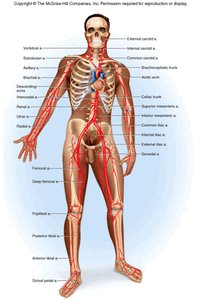
Major Arteries
Arteries are named based on the organs or regions they supply. For example, the renal artery supplies the kidneys, and the femoral artery supplies the thigh.
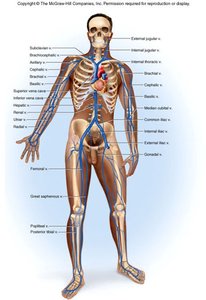
Major Veins
Veins are named based on the regions or organs they drain. For example, the renal vein drains blood from the kidneys, and the femoral vein drains blood from the thigh.
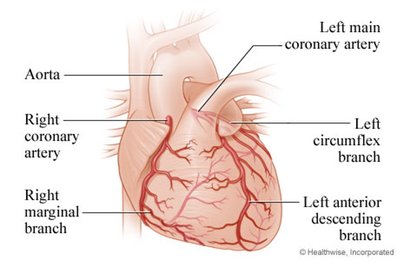
Coronary Circulation
The heart has its own blood supply via the coronary arteries and veins. The left main coronary artery branches into the left anterior descending and left circumflex arteries, while the right coronary artery gives rise to the right marginal branch.
Summary Table: Types of Blood Vessels
Vessel Type | Structure | Function |
|---|---|---|
Artery | Thick, muscular, elastic walls | Carry blood away from heart |
Vein | Thin walls, valves present | Return blood to heart |
Capillary | One cell thick | Exchange of gases, nutrients, waste |
Arteriole | Small, muscular | Regulate blood flow into capillaries |
Venule | Smallest veins | Drain blood from capillaries |
Additional info:
Blood pressure decreases as distance from the heart increases.
Perfusion is the rate of blood flow per given mass of tissue.
Vasomotion refers to changes in blood vessel radius, affecting blood flow and pressure.
Reactive hyperemia is increased blood flow following a period of restricted blood supply.
Angiogenesis is the formation of new blood vessels, important in healing and tumor growth.
