 Back
BackBody Cavities and Membranes: Organization of the Human Body
Study Guide - Smart Notes
 Tailored notes based on your materials, expanded with key definitions, examples, and context.
Body Cavities of the Human Body
Major Body Cavities
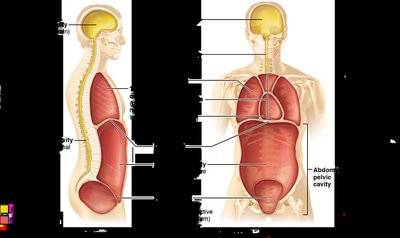
The human body contains several major cavities that house and protect vital organs. These cavities are primarily located in the axial region and are classified as dorsal or ventral, each with further subdivisions.
Dorsal Body Cavity: Located along the posterior (back) side of the body, it includes:
Cranial cavity: Encases the brain within the skull.
Vertebral (spinal) cavity: Encloses the spinal cord within the vertebral column.
Ventral Body Cavity: Located on the anterior (front) side, it is divided by the diaphragm into:
Thoracic cavity: Superior to the diaphragm; contains the heart and lungs, protected by the rib cage.
Abdominopelvic cavity: Inferior to the diaphragm; contains digestive, urinary, and reproductive organs. It is often subdivided into:
Abdominal cavity: Houses the stomach, intestines, liver, and other digestive organs.
Pelvic cavity: Contains the bladder, reproductive organs, and rectum.
Serous Membranes of the Ventral Body Cavity
Structure and Function of Serous Membranes
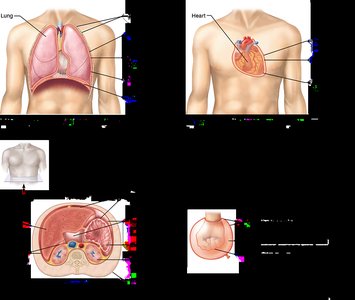
The organs within the ventral body cavity are covered by thin, double-layered membranes called serous membranes (serosae). These membranes serve to reduce friction and compartmentalize organs, preventing the spread of infection.
Parietal serosa: Lines the cavity walls.
Visceral serosa: Covers the external surfaces of organs within the cavity.
Serous fluid: Lubricating fluid produced by the membranes, allowing organs to slide smoothly against each other and the body wall.
Compartmentalization: Serous membranes help isolate organs, limiting the spread of infection.
The names of serous membranes are specific to the organs they surround:
Peritoneum: Surrounds abdominal organs.
Pleura: Surrounds the lungs.
Pericardium: Surrounds the heart.
Abdominopelvic Quadrants and Regions
Quadrant System
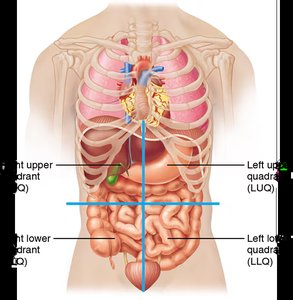
To facilitate the study and clinical examination of the abdominopelvic cavity, it is divided into four quadrants:
Right Upper Quadrant (RUQ)
Left Upper Quadrant (LUQ)
Right Lower Quadrant (RLQ)
Left Lower Quadrant (LLQ)
These quadrants are used by healthcare professionals to localize pain, injuries, or abnormalities.
Nine-Region System
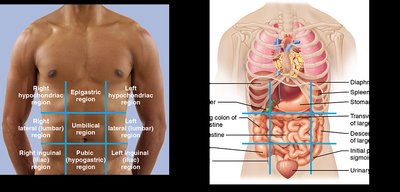
An alternative, more detailed division uses nine regions, delineated by four planes:
Umbilical region: Center, contains the navel.
Epigastric region: Superior to the umbilical region, overlies most of the stomach.
Pubic (hypogastric) region: Inferior to the umbilical region, encompasses the pubic area.
Right and Left Inguinal (iliac) regions: Lateral to the hypogastric region, overlying the hip bones.
Right and Left Lateral (lumbar) regions: Lateral to the umbilical region, between the ribs and hip bones.
Right and Left Hypochondriac regions: Flank the epigastric region, overlying the lower ribs.
This system is commonly used by anatomists for precise localization of organs and structures.
Other Body Cavities
Smaller Body Cavities
In addition to the major cavities, the body contains several smaller cavities, many of which are located in the head and open to the exterior:
Oral cavity (mouth): Contains the tongue and teeth; continuous with the digestive tract.
Nasal cavity: Located within and posterior to the nose; part of the respiratory system.
Orbital cavities (orbits): House the eyes in the skull.
Middle ear cavities: Medial to the eardrums; contain bones that transmit sound vibrations.
Synovial cavities: Found in freely movable joints (e.g., knee, hip, vertebrae); lined with membranes that secrete lubricating fluid to reduce friction.
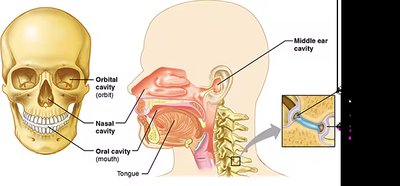
Summary Table: Major Body Cavities and Their Contents
Cavity | Location | Main Contents |
|---|---|---|
Dorsal (Cranial & Vertebral) | Posterior | Brain, Spinal Cord |
Ventral (Thoracic & Abdominopelvic) | Anterior | Heart, Lungs, Digestive Organs, Urinary & Reproductive Organs |
Oral | Head | Tongue, Teeth |
Nasal | Head | Nasal Passages |
Orbital | Head | Eyes |
Middle Ear | Head | Ear Ossicles |
Synovial | Joints | Synovial Fluid |
