 Back
BackBody Organization and Terminology: Foundational Concepts in Anatomy & Physiology
Study Guide - Smart Notes
 Tailored notes based on your materials, expanded with key definitions, examples, and context.
Body Organization and Terminology
Introduction to Body Organization
The study of anatomy and physiology begins with understanding how the human body is organized and the terminology used to describe its structures and positions. This foundational knowledge is essential for accurately describing locations, relationships, and functions of body parts.
Anatomical Position and Body Planes
Anatomical Position
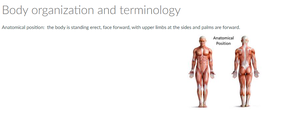
The anatomical position is the standard reference for describing the body. In this position, the body stands erect, facing forward, with upper limbs at the sides and palms facing forward. This orientation ensures consistency when referencing anatomical structures.
Body Planes
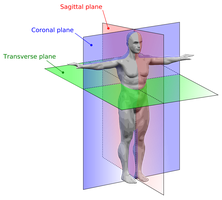
Body planes are imaginary lines used to divide the body into sections, aiding in anatomical study and medical imaging.
Sagittal Plane: Divides the body into right and left portions. The midsagittal (median) plane divides it into equal halves.
Coronal (Frontal) Plane: Divides the body into anterior (front) and posterior (back) portions.
Transverse (Horizontal) Plane: Divides the body into superior (upper) and inferior (lower) portions.
Directional Terminology
Key Directional Terms
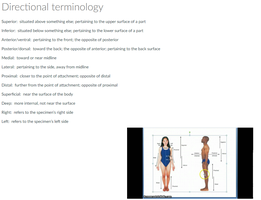
Directional terms are used to describe the locations of structures relative to other structures or locations in the body.
Superior: Above or toward the head of the body.
Inferior: Below or toward the lower part of the body.
Anterior (Ventral): Toward the front of the body.
Posterior (Dorsal): Toward the back of the body.
Medial: Toward the midline of the body.
Lateral: Away from the midline of the body.
Proximal: Closer to the point of attachment or origin.
Distal: Farther from the point of attachment or origin.
Superficial: Near the surface of the body.
Deep: Away from the surface, more internal.
Right/Left: Refers to the specimen's right or left side, not the observer's.
Body Cavities
Major Body Cavities
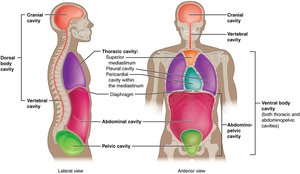
The human body contains several major cavities that house and protect vital organs. These cavities are divided into dorsal and ventral groups.
Dorsal Body Cavity: Includes the cranial cavity (encasing the brain) and vertebral cavity (encasing the spinal cord).
Ventral Body Cavity: Subdivided into the thoracic cavity (chest organs) and abdominopelvic cavity (abdominal and pelvic organs).
Thoracic Cavity Details
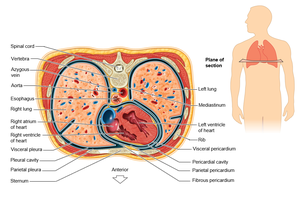
The thoracic cavity is further divided into smaller cavities:
Pleural Cavities: Each surrounds a lung.
Pericardial Cavity: Surrounds the heart, located within the mediastinum (central compartment of the thoracic cavity).
Abdominopelvic Cavity Details
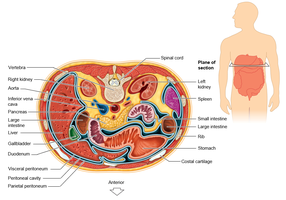
The abdominopelvic cavity contains digestive, urinary, and reproductive organs. It is divided into the abdominal cavity (digestive organs, kidneys) and pelvic cavity (bladder, reproductive organs).
Abdominal Regions and Quadrants
Abdominal Regions
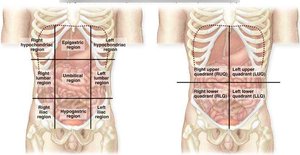
For clinical and anatomical purposes, the abdomen is divided into nine regions and four quadrants to help localize organs and describe pain or injury locations.
Nine Regions: Right hypochondriac, epigastric, left hypochondriac, right lumbar, umbilical, left lumbar, right iliac, hypogastric, left iliac.
Four Quadrants: Right upper (RUQ), left upper (LUQ), right lower (RLQ), left lower (LLQ).
Summary Table: Body Cavities and Major Organs
Body Cavity | Major Organs Contained |
|---|---|
Cranial | Brain |
Vertebral | Spinal cord |
Thoracic | Lungs, heart, esophagus, trachea |
Abdominal | Stomach, liver, intestines, kidneys, pancreas |
Pelvic | Bladder, reproductive organs, rectum |
Conclusion
Understanding body organization and terminology is essential for effective communication in anatomy and physiology. Mastery of these concepts provides a foundation for further study of the human body’s structure and function.
