 Back
BackBody Planes and Sections: Anatomical Orientation and Visualization
Study Guide - Smart Notes
 Tailored notes based on your materials, expanded with key definitions, examples, and context.
Body Planes and Sections
Introduction to Anatomical Planes
To study the internal structures of the human body, anatomists use imaginary lines called planes to make sections or cuts. These planes allow for consistent and clear descriptions of locations and directions within the body. Understanding these planes is essential for interpreting medical imaging and anatomical diagrams.
Main Anatomical Planes
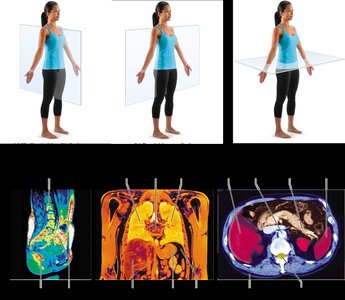
Sagittal Plane: Runs longitudinally and divides the body into right and left parts. If the division is exactly in the midline, it is called the median or midsagittal plane.
Frontal Plane (Coronal Plane): Also a longitudinal plane, it divides the body or an organ into anterior (front) and posterior (back) parts.
Transverse Plane: Runs horizontally, dividing the body into superior (upper) and inferior (lower) parts. Sections made along this plane are often called cross sections.
On microscope slides, longitudinal sections (sagittal or frontal) are abbreviated as l.s., while cross sections are abbreviated as x.s. or c.s..
Visualizing Sections: Application to Organs and Objects
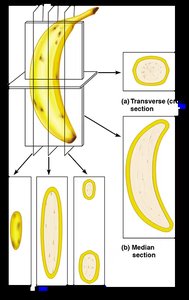
When an organ or object is sectioned along different planes, the resulting shapes can look very different. For example, a banana cut in the transverse, median, or frontal plane will yield distinct cross-sectional views. This principle is crucial in anatomy, as recognizing the plane of section helps in identifying structures in medical images and anatomical specimens.
Transverse (Cross) Section: Produces a circular or oval shape, depending on the object's geometry.
Median (Sagittal) Section: Produces a longitudinal view, often revealing the object's length and internal arrangement.
Frontal Section: Offers a different longitudinal perspective, dividing the object into front and back portions.
If a sectioned organ is not easily recognized, its original shape can often be reconstructed from a series of successive cuts.
Key Terms and Concepts
Section: A cut made along a plane to observe internal structures.
Plane: An imaginary flat surface passing through the body or an organ.
Longitudinal Section (l.s.): A cut along the length of an organ (sagittal or frontal).
Cross Section (x.s. or c.s.): A cut perpendicular to the length of an organ (transverse).
Examples and Applications
Medical Imaging: MRI and CT scans often display images in sagittal, frontal, or transverse planes, aiding in diagnosis and surgical planning.
Microscopy: Tissue samples are sectioned in specific planes to reveal different structural details under the microscope.
Additional info: Understanding anatomical planes is foundational for all health science students, as it underpins the interpretation of clinical images and anatomical diagrams throughout the study of human anatomy and physiology.
