 Back
BackBody Regions and Anatomical Terminology
Study Guide - Smart Notes
 Tailored notes based on your materials, expanded with key definitions, examples, and context.
Body Regions and Anatomical Terminology
Introduction to Anatomical Terminology
Anatomical terminology provides a standardized language for describing the locations and relationships of body parts. Understanding these terms is essential for clear communication in anatomy and physiology.
Body regions are specific areas of the body, each with a unique name used to describe location and orientation.
Terms are often derived from Latin or Greek roots and are used universally in medical and scientific contexts.
Major Anterior (Front) Body Regions
Frontal: Forehead region
Ocular (Orbital): Eye area
Nasal: Nose
Oral: Mouth
Buccal: Cheek
Mental: Chin
Cervical: Neck
Clavicular: Collarbone area (not listed but commonly referenced)
Sternal: Breastbone
Thoracic: Chest
Mammary: Breast
Axillary: Armpit
Brachial: Arm (upper arm)
Antecubital: Front of the elbow
Antebrachial: Forearm
Carpal: Wrist
Palmar: Palm of the hand
Digital (Manual): Fingers
Abdominal: Abdomen
Umbilical: Navel (not listed but commonly referenced)
Coxal: Hip
Inguinal: Groin
Pubic: Genital region
Femoral: Thigh
Patellar: Kneecap
Crural: Front of the leg (shin)
Tarsal: Ankle
Digital (Pedal): Toes
Major Posterior (Back) Body Regions
Occipital: Back of the head
Cervical: Neck
Vertebral: Spinal column
Dorsal: Back
Scapular: Shoulder blade area (not listed but commonly referenced)
Lumbar: Lower back (not listed but commonly referenced)
Sacral: Sacrum (base of the spine)
Gluteal: Buttocks
Perineal: Area between anus and genitals (not listed but commonly referenced)
Brachial: Arm
Olecranal: Back of the elbow (not listed but commonly referenced)
Antebrachial: Forearm
Manual: Hand
Femoral: Thigh
Popliteal: Back of the knee
Sural: Calf (back of the leg)
Calcaneal: Heel
Plantar: Sole of the foot
Examples and Applications
When describing the location of an injury, precise anatomical terms are used (e.g., "a laceration on the left antebrachial region").
Medical professionals use these terms to avoid confusion and ensure accurate communication.
Table: Selected Body Regions and Their Locations
Region | Location |
|---|---|
Frontal | Forehead |
Ocular (Orbital) | Eye |
Buccal | Cheek |
Mental | Chin |
Cervical | Neck |
Brachial | Arm |
Antebrachial | Forearm |
Carpal | Wrist |
Femoral | Thigh |
Patellar | Kneecap |
Crural | Front of the leg |
Popliteal | Back of the knee |
Sural | Calf |
Plantar | Sole of the foot |
Visual Reference: Anterior and Posterior Body Regions
The following image illustrates the major anterior and posterior body regions, providing a visual guide to the terminology described above.
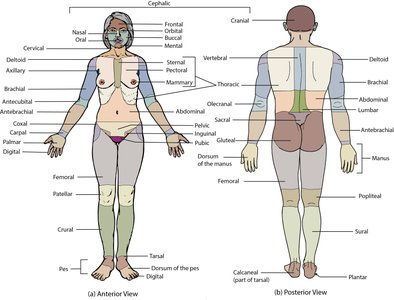
Additional info: Some terms (e.g., scapular, lumbar, perineal, olecranal) are commonly referenced in anatomy but were not listed in the provided materials. They are included here for completeness and academic context.
