 Back
Body Water: Distribution, Functions, and Fluid Balance
Study Guide - Smart Notes
 Tailored notes based on your materials, expanded with key definitions, examples, and context.
Distribution of Body Water
Overview of Body Water Content
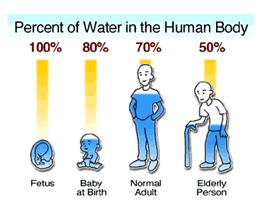
Water is the most abundant component of the human body, playing a critical role in physiological processes. The percentage of body water varies with age, sex, and body composition.
At birth: Approximately 75% of body weight is water.
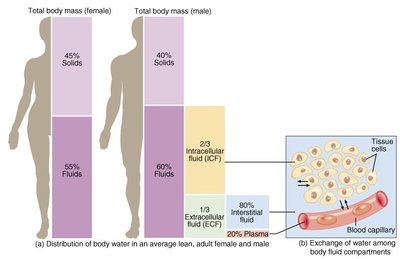
Young adult men: 55-60% of body weight is water.
Women: Slightly less than men due to higher fat content.
Obese/elderly: About 45% of body weight is water.
Functions of Body Water
Physiological Roles of Water
Water is essential for maintaining homeostasis and supporting life. It serves multiple functions in the body:
Solvent: Dissolves ions and molecules for biochemical reactions.
Transport medium: Carries nutrients, gases, and waste products.
Temperature regulation: Absorbs and distributes heat, enabling thermoregulation through sweating and respiration.
Lubrication and cushioning: Provides lubrication for joints and acts as a shock absorber for organs.
Chemical reactant: Participates directly in hydrolysis and other metabolic reactions.
Body Fluid Compartments
Major Compartments and Their Proportions
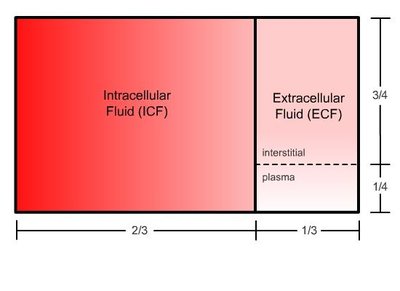
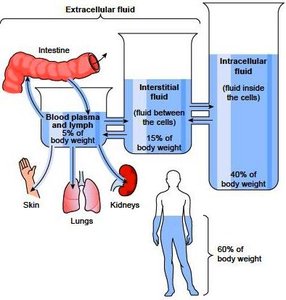
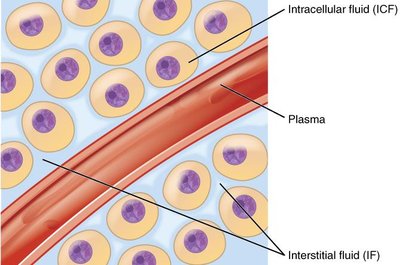
Body water is distributed between two main compartments: intracellular fluid (ICF) and extracellular fluid (ECF).
Intracellular Fluid (ICF): Fluid within cells, comprising about two-thirds of total body water.
Extracellular Fluid (ECF): Fluid outside cells, making up about one-third of total body water. ECF is further divided into:
Interstitial fluid: Surrounds tissue cells (about 80% of ECF).
Plasma: Fluid component of blood (about 20% of ECF).
Key Terminology
Definitions and Concepts
Osmosis: The movement of water across a selectively permeable membrane from an area of lower solute concentration to higher solute concentration.
Osmole: A unit that defines the number of solute particles in a solution, regardless of their mass.
Osmolality: Number of osmoles of solute per kilogram of solvent (Osm/kg).
Osmolarity: Number of osmoles of solute per liter of solution (Osm/L).
Tonicity: Describes the effect of a solution on cell volume (e.g., isotonic, hypertonic, hypotonic).
Osmosis and Osmotic Pressure
Mechanism and Importance
Osmosis is vital for maintaining fluid balance across cell membranes. The direction and rate of water movement depend on the concentration of solutes on either side of the membrane.
Osmotic pressure: The pressure required to prevent the net movement of water across a membrane. It can be calculated using the formula:
Where is osmotic pressure, is the van 't Hoff factor (number of particles per molecule), is molarity, is the gas constant, and is temperature in Kelvin.



Osmolarity and Tonicity
Comparing Solutions and Their Effects on Cells
Osmolarity and tonicity are related but distinct concepts. Osmolarity refers to the total concentration of solute particles in a solution, while tonicity describes the effect of a solution on cell volume.
Iso-osmotic: Solutions with the same osmolarity as plasma.
Hyper-osmotic: Solutions with higher osmolarity than plasma.
Hypo-osmotic: Solutions with lower osmolarity than plasma.
Isotonic: No net movement of water; cell volume remains unchanged.
Hypertonic: Water moves out of the cell; cell shrinks.
Hypotonic: Water moves into the cell; cell swells.

Fluid Exchange and Water Balance
Mechanisms of Fluid Movement
Water is continually exchanged between body compartments through capillary walls and plasma membranes, primarily by osmosis driven by osmotic gradients.
When tissue fluid osmolarity rises, water moves out of cells; when it falls, water moves into cells.
Osmosis between compartments is determined by the relative concentration of solutes.
Water Gain and Loss
Daily water gain: About 2500 mL/day (metabolic water: 200 mL, food: 700 mL, beverages: 1600 mL).
Daily water loss: Skin and lungs, urine, feces, insensible water loss (breath, cutaneous transpiration), obligatory water loss (expired air, sweat, fecal moisture, minimum urine output: 400 mL).
Regulation of Intake and Output
Intake: Governed mainly by thirst, regulated by the hypothalamic thirst center, which responds to angiotensin II, ADH, and osmoreceptor signals.
Output: Controlled by variations in urine volume, primarily regulated by ADH (antidiuretic hormone).
Disorders of Water Balance
Types and Causes
Fluid deficiency: Output exceeds intake over time.
Volume depletion (hypovolemia): Loss of water and sodium; osmolarity remains normal. Causes: hemorrhage, burns, vomiting, diarrhea, Addison's disease.
Dehydration (negative water balance): More water than sodium lost; ECF osmolarity increases. Causes: lack of water intake, diabetes mellitus, ADH deficiency, excessive sweating, diuretics.
Fluid excess: Less common due to effective renal compensation.
Volume excess: Both water and sodium retained; ECF isotonic. Causes: aldosterone hypersecretion, renal failure.
Hypotonic hydration (water intoxication): More water than sodium retained or ingested; ECF becomes hypotonic.
Fluid sequestration: Excess fluid accumulates in a specific location (e.g., edema, pleural effusion, hemorrhage).
Summary Table: Effects of Tonicity on Cells
Solution | Cell Behavior | Description |
|---|---|---|
Hypotonic | Cell swells | Lower solute concentration than cell |
Isotonic | No change | Equal solute concentration as cell |
Hypertonic | Cell shrinks | Higher solute concentration than cell |
