 Back
BackBone Biomechanics and Mechanical Properties: Study Notes for Anatomy & Physiology
Study Guide - Smart Notes
 Tailored notes based on your materials, expanded with key definitions, examples, and context.
Skeletal System and Bone Biomechanics
Bone Structure and Types
The skeletal system is composed of bones that provide structural support, protection, and facilitate movement. Bones are classified by their shape and function, and their internal structure is adapted to withstand various mechanical forces.
Key Point 1: Bones are hard, somewhat elastic, and fairly tough, allowing them to absorb energy and resist deformation.
Key Point 2: Bone structure includes compact (cortical) and spongy (trabecular) bone, each with distinct mechanical properties.
Example: The femur is a long bone designed to withstand compressive forces during walking and running.
Bone Mechanics: Stress and Strain
Bone mechanics describe how bones respond to applied forces. The concepts of stress and strain are fundamental to understanding bone behavior under load.
Stress: The force applied per unit area.
Strain: The extent of deformation relative to the original length.
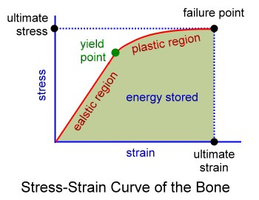
Young's Modulus: The slope of the stress-strain curve in the elastic region, representing stiffness.
Elastic Region: The area where bone returns to its original shape after force is removed.
Plastic Region: The area where bone undergoes permanent deformation.
Yield Point: The transition from elastic to plastic deformation.
Failure Point: The point at which bone fractures or buckles.
Mechanical Properties of Bone
Bones exhibit several mechanical properties that determine their response to forces:
Toughness: Ability to absorb energy before failure. High toughness means strong and ductile; low toughness means weak and brittle.
Stiffness: Resistance to deformation. Stiffer materials have a steeper slope in the stress-strain curve.
Flexibility: Readily deforms with applied force; more flexible materials have a flatter slope.
Brittle: Experiences little plastic deformation before failure (e.g., glass).
Ductile: Has a large plastic deformation region before failure (e.g., copper).
Strength: Ability to withstand applied load without failure or plastic deformation.
Hardness: Resistance to penetration by a harder body.
Elasticity: Ability to return to original shape after force is applied.
Plasticity: Propensity to undergo non-reversible deformation with applied force.
Stress-Strain Curve of Bone
The stress-strain curve illustrates the mechanical response of bone to loading, showing elastic and plastic regions, yield and failure points, and energy stored.
Hysteresis in Bone
Hysteresis describes the historical dependence of bone behavior. When a load is applied and removed, the bone's response depends on whether the load was within the elastic or plastic region.
Elastic Region: Bone returns to its original shape after load removal.
Plastic Region: Bone does not return to its original configuration after load removal.
Anisotropy of Bone
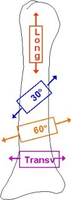
Anisotropy is the property of a material to exhibit different mechanical properties based on the direction of loading. For bone, Young’s Modulus and other properties depend on the load direction.
Directional Dependence: Bone is strongest, stiffest, and toughest along its long axis (longitudinal direction).
Transverse Loading: Bone is weaker and less stiff when loaded perpendicular to its long axis.
Fracture Patterns and Loading Modes
Fracture patterns in bone reflect the type and direction of applied forces. Common fracture types include transverse, oblique, butterfly, spiral, and crush, each associated with specific loading modes such as shear, twisting, bending, and compression.
Transverse Fracture: Caused by direct perpendicular force.
Oblique Fracture: Result of angled force.
Spiral Fracture: Caused by twisting forces.
Butterfly Fracture: Associated with bending and shear.
Crush Fracture: Result of compressive forces.
Viscoelasticity and Strain Rate Effects
Bones are viscoelastic, meaning their mechanical properties depend on the rate of loading. Viscoelastic materials show time-dependent strain effects, and bone toughness and stiffness vary with strain rate.
Viscosity: Resistance to flow; in bone, this affects how it responds to rapid or slow loading.
Strain Rate: At higher strain rates, bone exhibits greater toughness and stiffness.
Experiment: Altering strain rate and measuring stress reveals these properties.
Summary Table: Mechanical Properties of Bone
Property | Definition | Example |
|---|---|---|
Toughness | Energy absorbed before failure | Bone vs. glass |
Stiffness | Resistance to deformation | Bone vs. cartilage |
Strength | Withstand load without failure | Femur under compression |
Elasticity | Return to original shape | Bone in elastic region |
Plasticity | Permanent deformation | Bone in plastic region |
Anisotropy | Directional dependence | Long axis vs. transverse loading |
Viscoelasticity | Time-dependent strain | Bone under rapid loading |
Key Concepts
Bone exhibits hysteresis: historical differences in response.
Stress-strain curves describe bone mechanics.
Bone is hard, somewhat elastic, and fairly tough.
Once pulled past elastic region, bone enters plastic region.
Bone exhibits anisotropy: directional differences in response.
Fracture patterns reflect anisotropy.
Bone exhibits viscoelasticity: stress-rate responses.
Form fits function in bone structure.
