Back
BackBone Development, Growth, and Remodeling: Study Notes for ANP College Students
Study Guide - Smart Notes
 Tailored notes based on your materials, expanded with key definitions, examples, and context.
Bones and Skeletal Tissue: Bone Development and Growth
Ossification (Osteogenesis)
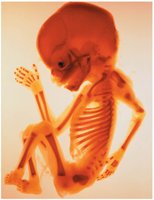
Ossification, also known as osteogenesis, is the process of bone formation. It begins in the second month of embryonic development and continues throughout life as bones grow and remodel in response to stress and repair.
Endochondral Ossification: Bone forms by replacing hyaline cartilage. This process forms most bones of the skeleton, especially long bones.
Intramembranous Ossification: Bone develops directly from mesenchymal tissue without a cartilage precursor. This process forms flat bones such as those of the skull and clavicle.
Remodeling and Repair: Bone is a dynamic tissue that undergoes continuous remodeling and repair throughout life.
Endochondral Ossification
Endochondral ossification is the process by which most bones are formed, replacing hyaline cartilage with bone tissue. It is essential for the formation of long bones and occurs in several stages:
Bone collar forms around the diaphysis of the hyaline cartilage model.
Cartilage in the center of the diaphysis calcifies and develops cavities.
The periosteal bud invades the internal cavities, and spongy bone forms.
The diaphysis elongates, and a medullary cavity forms. Secondary ossification centers appear in the epiphyses.
The epiphyses ossify. Hyaline cartilage remains only in the epiphyseal plates and articular cartilages.
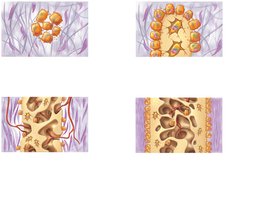
Key Structures: Primary and secondary ossification centers, epiphyseal plate, medullary cavity, articular cartilage.
Intramembranous Ossification
Intramembranous ossification forms flat bones of the skull, clavicle, and some facial bones. It involves the direct transformation of mesenchymal tissue into bone.
Ossification centers appear in the fibrous connective tissue membrane as mesenchymal cells differentiate into osteoblasts.
Osteoid is secreted and calcifies, trapping osteoblasts which become osteocytes.
Woven bone and periosteum form as osteoid accumulates between embryonic blood vessels.
Lamellar bone replaces woven bone, and red marrow appears within the spongy bone (diploë).
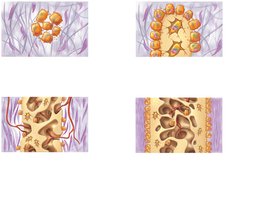
Key Bones Formed: Frontal, parietal, occipital, temporal bones, and clavicle.
Bone Growth: Postnatal Development
Interstitial Growth (Lengthening of Long Bones)
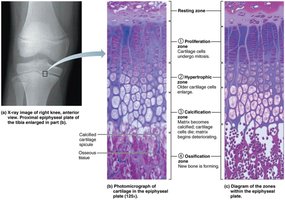
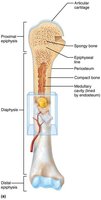
Long bones grow in length by interstitial growth at the epiphyseal plate, a layer of hyaline cartilage between the diaphysis and epiphysis. This process continues until adolescence, after which the epiphyseal plates close and are replaced by bone (epiphyseal line).
Zones of the Epiphyseal Plate: Resting, proliferation, hypertrophic, calcification, and ossification zones.
Closure Ages: Females (~18 years), Males (~21 years).
Appositional Growth (Bone Thickening)
Bones increase in thickness (diameter) through appositional growth. Osteoblasts in the periosteum secrete new bone matrix on the external surface, while osteoclasts in the endosteum remove bone from the internal surface, maintaining proper bone proportions.
Disorders of Bone Growth
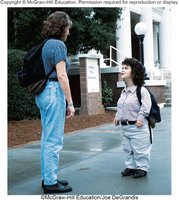
Achondroplastic Dwarfism: Failure of cartilage growth in the metaphysis due to a genetic mutation, resulting in short limbs but normal trunk size.
Pituitary Dwarfism: Lack of growth hormone leads to proportional but short stature.
Long Bone Growth and Remodeling During Youth
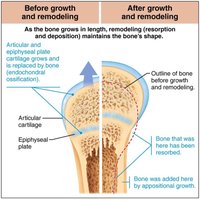
During growth, bones are remodeled to maintain their shape and adapt to mechanical stress. Remodeling involves both bone deposition by osteoblasts and bone resorption by osteoclasts.
Bone Remodeling and Homeostasis
Bone Remodeling
Bone remodeling is a continuous process where old bone is replaced by new bone tissue. About 5-7% of bone mass is recycled weekly. Spongy bone is replaced every 3-4 years, and compact bone every 10 years.
Bone Deposit: Osteoblasts secrete osteoid, which then calcifies.
Bone Resorption: Osteoclasts break down bone matrix, releasing minerals into the blood.
Calcium Homeostasis and Hormonal Control
Calcium levels in the blood are tightly regulated (9–11 mg/100 ml) by hormonal controls:
Parathyroid Hormone (PTH): Released in response to low blood calcium; stimulates osteoclasts to resorb bone and release calcium into the blood.
Calcitonin: Released by the thyroid gland in response to high blood calcium; stimulates osteoblasts to deposit calcium into bone.
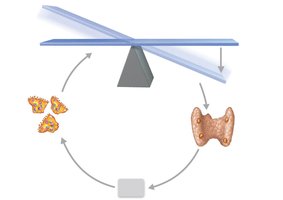
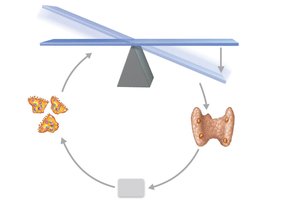
Homeostatic Imbalances:
Hypocalcemia: Low blood calcium causes hyperexcitability of nerves and muscles.
Hypercalcemia: High blood calcium leads to nonresponsiveness of nerves and muscles.
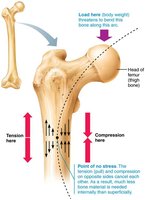
Mechanical Stress and Bone Remodeling (Wolff’s Law)
According to Wolff’s Law, bones grow and remodel in response to the mechanical stresses placed upon them. This explains differences in bone density and structure based on activity level and handedness.
Bones are thicker where muscles attach and in dominant limbs.
Weight lifters have denser bones; bedridden individuals lose bone mass.
Bone Fractures and Repair
Classification of Fractures
Fractures are classified by:
Position of bone ends: Nondisplaced (ends retain normal position) or displaced (ends out of alignment).
Completeness of break: Complete (broken through) or incomplete.
Whether skin is penetrated: Open (compound) or closed (simple).
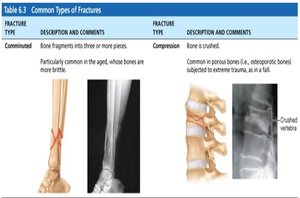
Common Types of Fractures
Type | Description |
|---|---|
Comminuted | Bone fragments into three or more pieces; common in aged, brittle bones. |
Compression | Bone is crushed; common in porous bones subjected to trauma. |
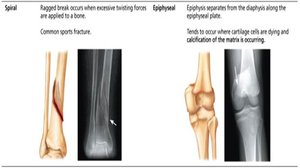
Spiral | Ragged break from excessive twisting; common sports fracture. |
Epiphyseal | Epiphysis separates from diaphysis along epiphyseal plate; occurs where cartilage cells are dying. |
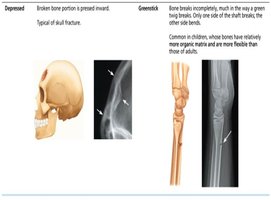
Depressed | Broken bone portion is pressed inward; typical of skull fracture. |
Greenstick | Bone breaks incompletely; common in children. |
Healing of Fractures
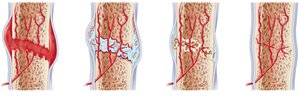
Bone repair occurs in four stages:
Hematoma formation: Blood clot forms at the fracture site.
Fibrocartilaginous callus formation: Soft callus of collagen and cartilage bridges the break.
Bony callus formation: New spongy bone replaces the soft callus.
Bone remodeling: Compact bone is laid down to reconstruct shaft walls.
Bone Disorders: Osteoporosis
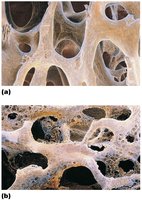
Osteoporosis is a condition characterized by severe loss of bone density, where bone resorption outpaces bone deposit. This leads to fragile bones and increased risk of fractures.
Risk Factors: Postmenopausal women, insufficient exercise, poor diet (low calcium/protein), smoking, genetics, hormone-related conditions, certain medications, and excessive alcohol consumption.
Prevalence: 30% of women aged 60-70, 70% by age 80.