Back
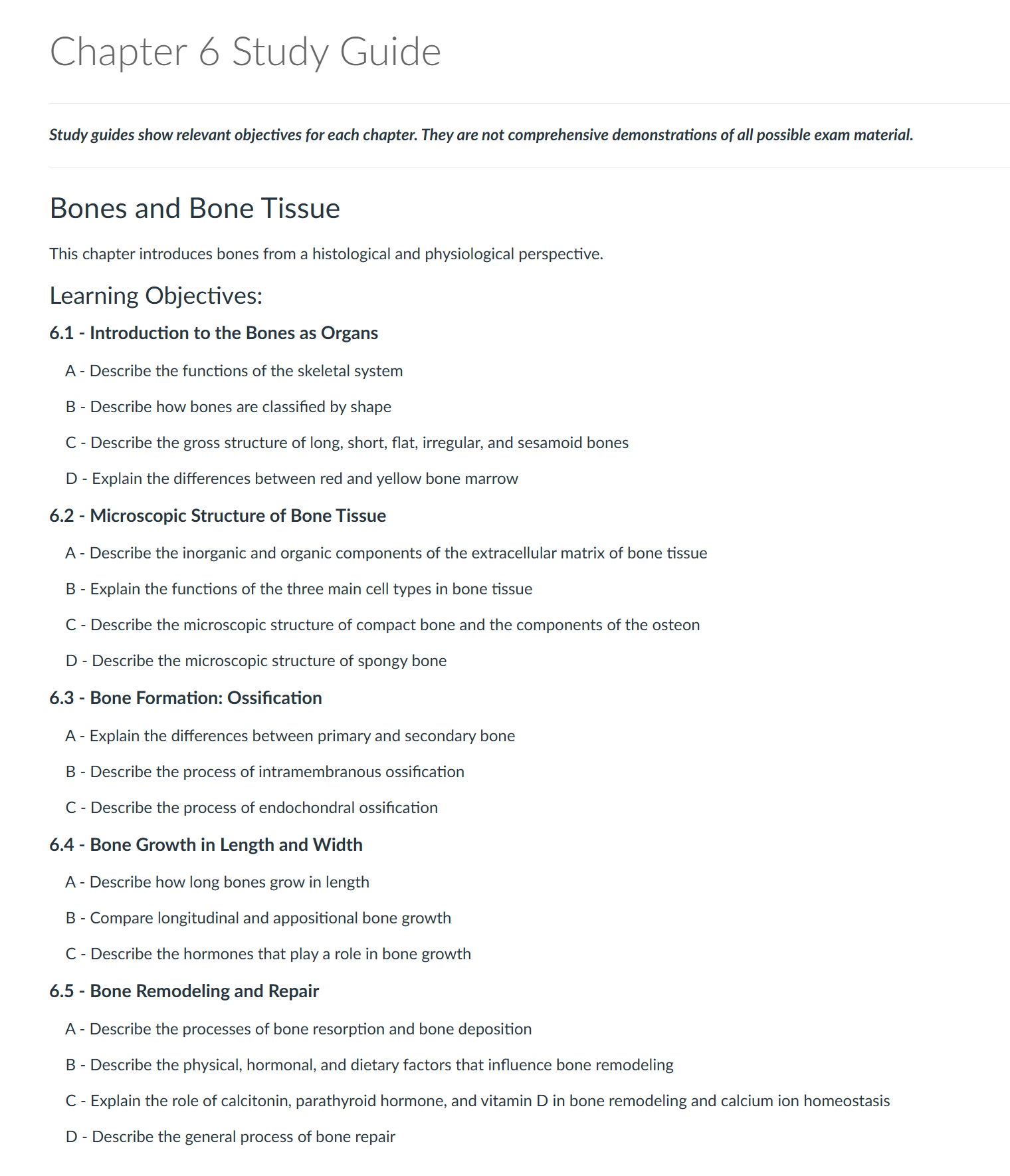
Bones and Bone Tissue: Chapter 6 Study Guide
Study Guide - Smart Notes
 Tailored notes based on your materials, expanded with key definitions, examples, and context.
Bones and Bone Tissue
This chapter provides an overview of bones from both histological and physiological perspectives, focusing on their structure, function, growth, and repair.
6.1 Introduction to the Bones as Organs
The skeletal system is a complex organ system that provides structural support, protection, and facilitates movement. Bones are classified by their shapes and contain specialized tissues such as bone marrow.
Functions of the Skeletal System: The skeletal system supports the body, protects internal organs, enables movement, stores minerals (such as calcium and phosphate), and houses bone marrow for blood cell production.
Classification of Bones by Shape: Bones are classified as long, short, flat, irregular, or sesamoid based on their morphology.
Gross Structure of Bones:
Long bones: e.g., femur; have a shaft (diaphysis) and two ends (epiphyses).
Short bones: e.g., carpals; roughly cube-shaped.
Flat bones: e.g., sternum; thin and often curved.
Irregular bones: e.g., vertebrae; complex shapes.
Sesamoid bones: e.g., patella; embedded within tendons.
Red vs. Yellow Bone Marrow:
Red marrow: Site of hematopoiesis (blood cell formation).
Yellow marrow: Primarily stores fat; can convert to red marrow under certain conditions.
6.2 Microscopic Structure of Bone Tissue
Bones are composed of a matrix containing both organic and inorganic components, and specialized cells that maintain bone health and structure.
Extracellular Matrix Components:
Inorganic: Hydroxyapatite (calcium phosphate crystals) provides hardness.
Organic: Collagen fibers and ground substance provide flexibility and tensile strength.
Main Cell Types in Bone Tissue:
Osteoblasts: Build new bone matrix.
Osteocytes: Mature bone cells that maintain bone tissue.
Osteoclasts: Break down bone matrix during resorption.
Microscopic Structure of Compact Bone: Compact bone is organized into osteons (Haversian systems), which consist of concentric lamellae surrounding a central canal containing blood vessels and nerves.
Microscopic Structure of Spongy Bone: Spongy bone (trabecular bone) is composed of a network of trabeculae, providing structural support and housing bone marrow.
6.3 Bone Formation: Ossification
Bone formation occurs through two main processes: intramembranous and endochondral ossification. Primary and secondary bone differ in structure and function.
Primary vs. Secondary Bone:
Primary bone: First formed during development; less organized.
Secondary bone: Mature bone; highly organized and stronger.
Intramembranous Ossification: Bone develops directly from mesenchymal tissue; forms flat bones like the skull.
Endochondral Ossification: Bone develops from a cartilage template; forms most bones, including long bones.
6.4 Bone Growth in Length and Width
Bones grow in length and width through distinct processes regulated by hormones and cellular activity.
Longitudinal Growth: Occurs at the epiphyseal plate (growth plate) through cartilage proliferation and ossification.
Appositional Growth: Bone grows in width by adding new bone tissue to the periosteum.
Hormones in Bone Growth: Growth hormone, thyroid hormone, and sex hormones (estrogen and testosterone) regulate bone growth and development.
6.5 Bone Remodeling and Repair
Bone remodeling is a continuous process involving bone resorption and deposition, influenced by physical activity, hormones, and nutrition. Bone repair restores structure after injury.
Bone Resorption and Deposition: Osteoclasts resorb bone, while osteoblasts deposit new bone matrix.
Factors Influencing Bone Remodeling: Physical activity, hormonal signals (e.g., parathyroid hormone, calcitonin), and dietary intake (calcium, vitamin D) affect bone remodeling.
Role of Calcitonin, Parathyroid Hormone, and Vitamin D:
Calcitonin: Lowers blood calcium by inhibiting osteoclast activity.
Parathyroid hormone (PTH): Raises blood calcium by stimulating osteoclasts.
Vitamin D: Enhances calcium absorption and bone mineralization.
Bone Repair Process: Involves hematoma formation, fibrocartilaginous callus formation, bony callus formation, and bone remodeling.
Additional info: The study guide outlines key objectives for understanding bone structure, function, growth, and repair, providing a foundation for further study in anatomy and physiology.