 Back
Bones and Skeletal Tissue: Structure, Classification, and Microscopic Anatomy
Study Guide - Smart Notes
 Tailored notes based on your materials, expanded with key definitions, examples, and context.
VA Bones and Skeletal Tissue
Introduction to Bones and Skeletal Tissue
The skeletal system forms the framework of the human body, providing support, protection, and facilitating movement. It is also essential for blood cell production and mineral storage.
Support and Protection: The skeleton supports the body and protects vital organs.
Movement: Bones act as levers for muscles, enabling movement.
Blood Cell Production: Bone marrow produces blood cells.
Mineral Storage: Bones store minerals such as calcium and phosphate.

Classification of Bones
Bone Tissue Types
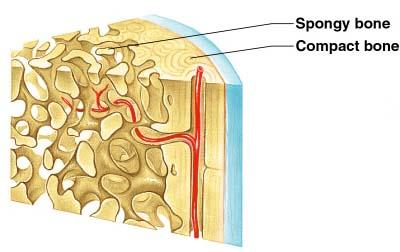
There are two main types of bone tissue: compact bone and spongy bone.
Compact Bone: Dense and forms the outer layer of bones, providing strength and protection.
Spongy Bone: Composed of trabeculae with many open spaces, reducing bone weight and housing bone marrow.
Bone Classification by Shape
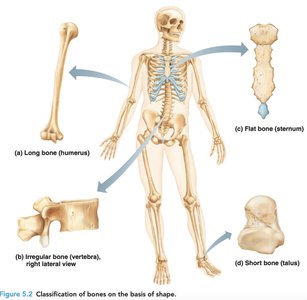
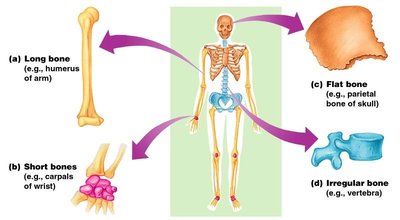
Bones are classified into several categories based on their shapes, each serving distinct functions in the body.
Long Bones: Longer than they are wide (e.g., femur, humerus). Crucial for leverage and movement.
Short Bones: Cube-shaped (e.g., carpals, tarsals). Provide stability and support with limited motion.
Flat Bones: Thin, flattened, and usually curved (e.g., skull, ribs, sternum). Protect organs and provide muscle attachment areas.
Irregular Bones: Complex shapes (e.g., vertebrae, hip bones). Protect and support while allowing complex articulations.
Sesamoid Bones: Embedded in tendons (e.g., patella). Protect tendons and improve joint function.
Gross Anatomy of Long Bones
Structure of a Long Bone
Long bones have a specialized structure that supports their function in movement and weight-bearing.
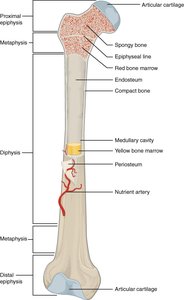
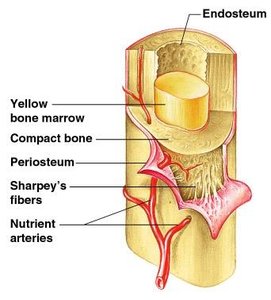
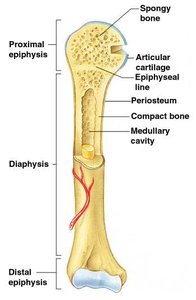
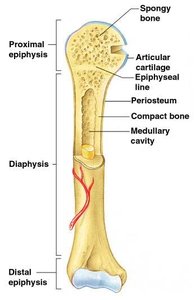
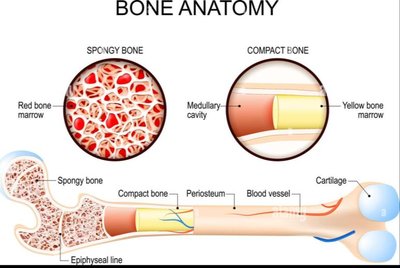
Diaphysis: The shaft, composed of compact bone, provides strength and length.
Epiphyses: The ends, composed of spongy bone covered by compact bone, articulate with other bones.
Metaphysis: The region between diaphysis and epiphysis, containing the epiphyseal (growth) plate in growing bones.
Medullary Cavity: Central cavity containing yellow marrow (fat storage) in adults and red marrow (blood cell formation) in infants.
Periosteum: Outer fibrous membrane covering the diaphysis, secured by Sharpey's fibers.
Endosteum: Thin membrane lining the medullary cavity and spaces within spongy bone.
Articular Cartilage: Hyaline cartilage covering epiphyses, reducing friction at joints.
Microscopic Anatomy of Bone
Compact Bone Structure
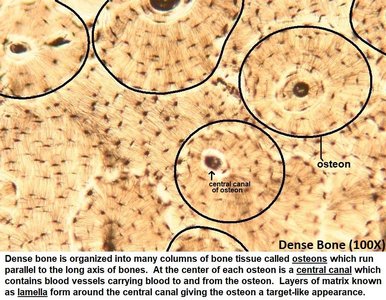
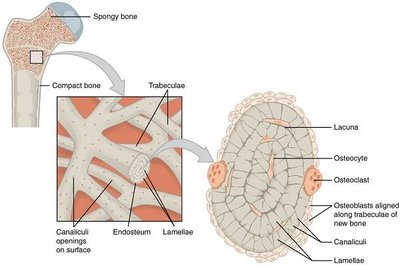
Compact bone is organized into structural units called osteons (Haversian systems), which provide strength and facilitate nutrient delivery.
Osteon: Cylindrical structure parallel to the long axis of bone, consisting of concentric lamellae.
Central (Haversian) Canal: Runs through the center of each osteon, containing blood vessels and nerves.
Lamellae: Rings of bone matrix around the central canal.
Lacunae: Small cavities housing osteocytes (mature bone cells).
Canaliculi: Tiny canals connecting lacunae, allowing communication and nutrient exchange between osteocytes.
Perforating (Volkmann's) Canals: Run perpendicular to central canals, connecting blood and nerve supply of periosteum to those in the central canal.


Spongy Bone Structure
Spongy bone consists of a network of trabeculae, which provide structural support and house bone marrow.
Trabeculae: Lattice-like structures that distribute stress and reduce bone weight.
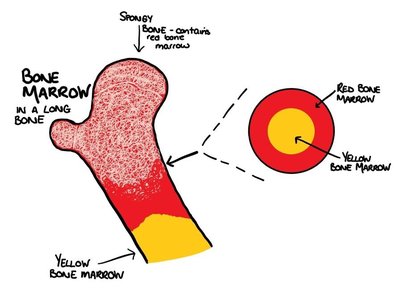
Bone Marrow: Fills spaces between trabeculae; red marrow is involved in hematopoiesis, while yellow marrow stores fat.
Bone Marrow
Types and Functions
Red Bone Marrow: Found in spongy bone and flat bones; responsible for hematopoiesis (production of blood cells).
Yellow Bone Marrow: Found in the medullary cavity of long bones; primarily stores fat and can convert to red marrow if needed.
Bone Cells
Types and Functions
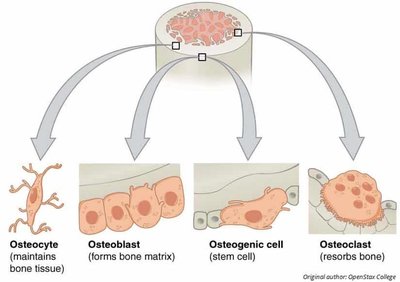
Osteoblasts: Bone-forming cells that secrete bone matrix (osteoid); responsible for bone deposition.
Osteocytes: Mature bone cells that maintain bone matrix and monitor stress, signaling for bone remodeling.
Osteoclasts: Bone-resorbing cells that break down bone matrix, important for bone remodeling and calcium release.
Bone Development and Growth
Ossification Processes
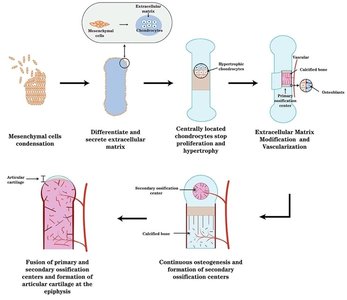
Endochondral Ossification: Bone develops by replacing hyaline cartilage; most bones, especially long bones, form this way.
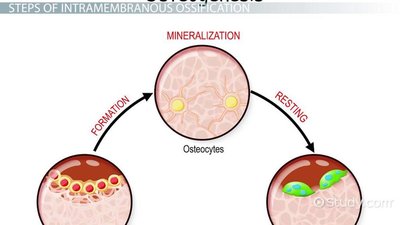
Intramembranous Ossification: Bone develops from a fibrous membrane; forms flat bones like the skull and clavicles.
Bone Growth and Remodeling
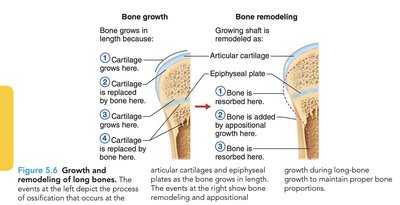
Epiphyseal Plates: Hyaline cartilage plates in the metaphysis of long bones; allow for bone lengthening during childhood and adolescence.
Appositional Growth: Bone increases in diameter by addition of bone matrix to the surface.
Bone Remodeling: Continuous process involving osteoblasts (deposition) and osteoclasts (resorption), regulated by hormones and mechanical stress.
Summary Table: Bone Types and Examples
Bone Type | Description | Example |
|---|---|---|
Long Bone | Longer than wide, shaft and two ends | Femur, humerus |
Short Bone | Cube-shaped | Carpals, tarsals |
Flat Bone | Thin, flattened, usually curved | Skull, ribs, sternum |
Irregular Bone | Complex shapes | Vertebrae, hip bones |
Sesamoid Bone | Embedded in tendons | Patella |
Additional info: This table summarizes the main bone types, their descriptions, and examples for quick reference.
