 Back
BackBSC 2086L Human Anatomy & Physiology II Lab Syllabus and Success Guide
Study Guide - Smart Notes
 Tailored notes based on your materials, expanded with key definitions, examples, and context.
Course Overview
BSC 2086L – Human Anatomy & Physiology II Lab is a college-level laboratory course designed to reinforce and expand upon the foundational concepts of human anatomy and physiology. This course covers advanced topics in the structure and function of the human body, with a focus on laboratory skills, physiological measurements, and clinical applications. The course is delivered asynchronously online, with required virtual engagement and proctored assessments.
Course Structure and Materials
Instructor: Taylor Kelsay
Textbook: Elaine Marieb, Katja Hoehn, Human Anatomy & Physiology, 12th Ed. (Access via Pearson/Canvas)
Prerequisites: BSC 2085, BSC 2085L
Co-requisite: BSC 2086
Course Delivery: Virtual, asynchronous
Learning Outcomes
Demonstrate proficient use of the compound light microscope.
Recognize and describe functions of blood components.
Identify anatomical features of the heart.
Evaluate physiological activity of the cardiovascular system (e.g., blood pressure, pulse rate, EKG).
Perform laboratory procedures illustrating the functions of the urinary, respiratory, and digestive systems.
Relate clinical measurements to human physiological activity.
Instructional Methods & Success Strategies
Thoroughly read and study each Lab Chapter Summary.
Review all questions and materials posted in Canvas.
Complete PhysioEx activities in Access Pearson.
Prepare for fill-in-the-blank style exams by practicing recall and correct spelling of terms.
Engage with all online modules and activities to maximize your engagement score.
Grading System
Lab Exams: 90% (Five cumulative exams, mostly fill-in-the-blank, proctored via Honorlock)
Student Engagement: 10% (Based on activity and participation in Canvas modules)
Letter grades are assigned as follows:
A: ≥ 90
B: ≥ 80 < 90
C: ≥ 70 < 80
D: ≥ 60 < 70
F: < 60
Student Engagement Scoring
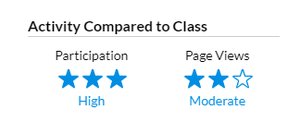
Engagement is tracked via Canvas and is reflected in a star-based system for both participation and page views. Consistently high activity earns full credit, moderate activity earns half credit, and low activity earns little to no credit.
Exam Policy and Academic Integrity
Exams are timed, proctored via Honorlock, and primarily fill-in-the-blank.
Honorlock requirements include webcam, microphone, room scan, and Chrome extension.
Strict adherence to academic integrity is required; violations result in a zero or course failure.
Make-up exams are only granted for documented emergencies.
AI tools may be used for brainstorming, but all final work must be original and properly cited.
Course Schedule (Tentative)
Week | Topics | Chapters |
|---|---|---|
May 18 | CNS & PNS Art-Labeling, Barany Test | 12-13 |
May 25 | Special Senses Anatomy & Histology, Weber/Rinne Tests, Disorders | 15 |
June 1 | Endocrine & Blood Histology, PhysioEx10 Activities | 16-17 |
June 8 | Lab Exam I (Ch. 12–16), Heart & Blood Vessel Anatomy, Cardiac Physiology | 18 |
June 15 | Heart, Cardiac Physiology, Blood Vessels, Vital Signs, Lymphoid Organs | 18-21 |
June 22 | Lab Exam II (Ch. 17–20) | 17-20 |
June 29 | Respiratory & Digestive System Anatomy, PhysioEx10 Activities | 22, 23 |
July 6 | Lab Exam III (Ch. 21–23) | 21-23 |
July 13 | ATP, Metabolic Pathways, Urinary System, PhysioEx10 Activities | 24-26 |
July 20 | Lab Exam IV (Ch. 24–26) | 24-26 |
July 27 | Reproductive System Anatomy & Physiology, Case Studies | 27-29 |
August 3 | Lab Exam V (Ch. 27–29) | 27-29 |
Important Policies and Resources
Religious Observances: Notify instructor in the first week for accommodations.
Disability Services: Contact the Office of Services for Students with Disabilities for accommodations as early as possible.
Safety & Security: Report concerns to campus Public Safety Office.
Title IX & Civil Rights: Policies and resources available on the college website.
College Seal

Summary of Success Tips
Stay engaged with all online materials and activities.
Practice recall and spelling for fill-in-the-blank exams.
Complete all PhysioEx and lab activities as assigned.
Follow all Honorlock and academic integrity requirements strictly.
Communicate proactively with your instructor regarding any issues or accommodations.
