Back
BackCardiovascular and Lymphatic Systems Mastery Guide
Study Guide - Smart Notes
 Tailored notes based on your materials, expanded with key definitions, examples, and context.
Cardiovascular and Lymphatic Systems Overview
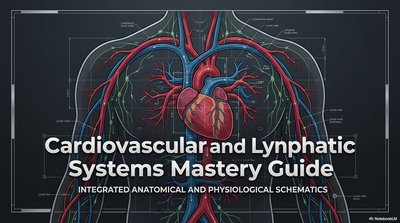
The cardiovascular and lymphatic systems function as integrated logistics and defense networks, ensuring the transport of nutrients, gases, and immune cells throughout the body. This guide provides a comprehensive overview of their anatomical structures, physiological functions, and clinical significance.
Blood: Composition and Function
Blood Components
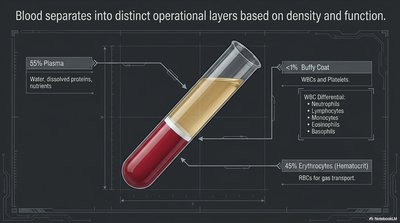
Blood is a specialized connective tissue with distinct layers, each serving unique physiological roles:
Plasma (55%): The liquid matrix containing water, dissolved proteins (e.g., albumin, globulins, fibrinogen), and nutrients.
Buffy Coat (<1%): Contains white blood cells (WBCs) and platelets. WBCs include neutrophils, lymphocytes, monocytes, eosinophils, and basophils.
Erythrocytes (45%): Red blood cells (RBCs) responsible for gas transport (oxygen and carbon dioxide).
Hemostasis and Blood Typing
Hemostasis
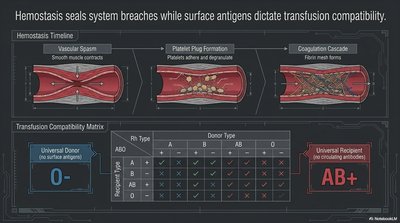
Hemostasis is the process by which the body seals vascular injuries to prevent blood loss:
Vascular Spasm: Smooth muscle contracts to reduce blood flow.
Platelet Plug Formation: Platelets adhere to the injury site and aggregate.
Coagulation Cascade: Fibrin mesh forms to stabilize the platelet plug.
Blood Typing and Transfusion Compatibility
Surface antigens on RBCs determine blood type and compatibility for transfusions. The ABO and Rh systems are most clinically significant.
Recipient Type | Universal Donor | Universal Recipient |
|---|---|---|
O- | Yes | No |
AB+ | No | Yes |
The Heart: Structure and Electrical Activity
Cardiac Cycle and ECG
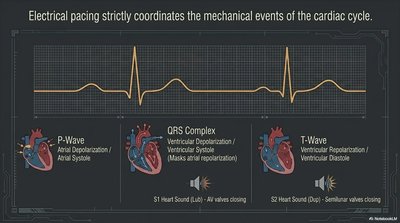
The heart's mechanical events are coordinated by electrical impulses, visualized as an electrocardiogram (ECG):
P-Wave: Atrial depolarization and contraction (systole).
QRS Complex: Ventricular depolarization and contraction; atrial repolarization occurs simultaneously.
T-Wave: Ventricular repolarization and relaxation (diastole).
Cardiac Output
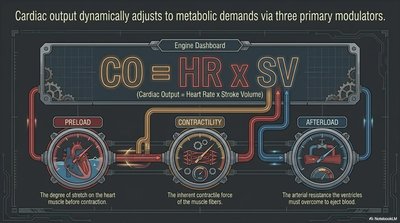
Cardiac output (CO) is the volume of blood pumped by the heart per minute and is determined by heart rate (HR) and stroke volume (SV):
Preload: Degree of stretch on the heart muscle before contraction.
Contractility: Inherent contractile force of the muscle fibers.
Afterload: Arterial resistance the ventricles must overcome to eject blood.
Formula:
Blood Vessels: Structure and Function
Vessel Types
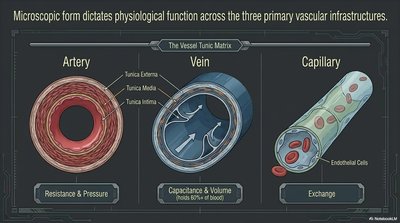
Blood vessels are classified based on their structure and function:
Arteries: Thick-walled, high-pressure vessels with three tunics (externa, media, intima).
Veins: Thinner walls, larger lumens, serve as blood reservoirs (hold ~60% of blood).
Capillaries: Single endothelial cell layer, site of exchange between blood and tissues.
Hemodynamics
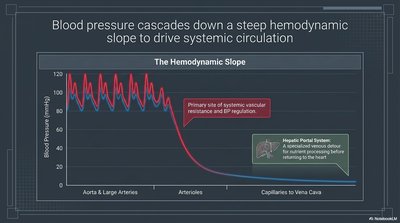
Blood pressure decreases as blood moves from arteries to veins, with the steepest drop in arterioles (primary site of resistance and regulation).
Capillary Exchange and Fluid Recovery
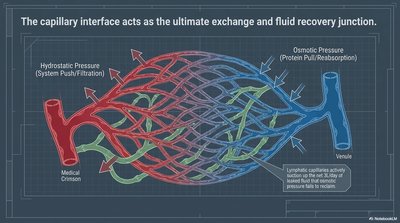
Capillaries facilitate the exchange of gases, nutrients, and waste products. Fluid movement is governed by hydrostatic pressure (pushes fluid out) and osmotic pressure (pulls fluid in). Lymphatic capillaries recover excess fluid not reabsorbed by blood capillaries.
Lymphatic and Immune Systems
Innate vs. Adaptive Immunity
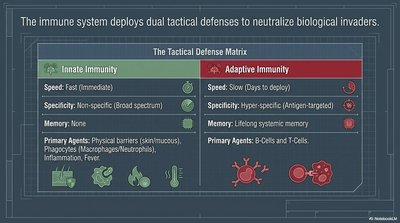
The immune system is divided into two main branches:
Feature | Innate Immunity | Adaptive Immunity |
|---|---|---|
Speed | Fast (Immediate) | Slow (Days to deploy) |
Specificity | Non-specific | Highly specific |
Memory | None | Lifelong systemic memory |
Primary Agents | Physical barriers, phagocytes | B-cells, T-cells |
Pathological Conditions
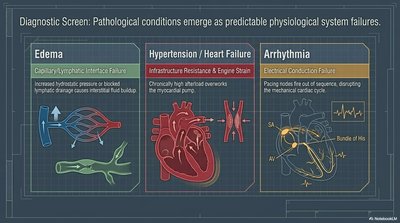
Disruptions in cardiovascular or lymphatic function can lead to predictable clinical conditions:
Edema: Failure of capillary/lymphatic interface, leading to fluid buildup.
Hypertension/Heart Failure: Increased vascular resistance or impaired cardiac function.
Arrhythmia: Abnormal electrical conduction affecting cardiac rhythm.
Physiological Baselines and Clinical Values
Maintaining homeostasis requires monitoring key physiological parameters:
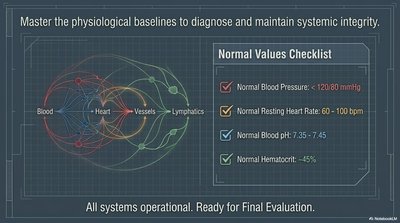
Normal Blood Pressure: < 120/80 mmHg
Normal Resting Heart Rate: 60–100 bpm
Normal Blood pH: 7.35–7.45
Normal Hematocrit: ~45%