 Back
BackCell Cycle and Mitosis: Structure and Phases
Study Guide - Smart Notes
 Tailored notes based on your materials, expanded with key definitions, examples, and context.
Cell Cycle and Mitosis
Overview of the Cell Cycle
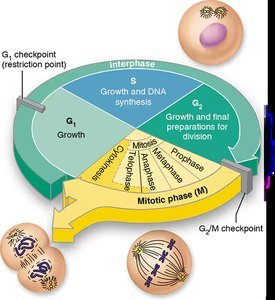
The cell cycle is the series of events that cells go through as they grow and divide. It consists of interphase (where the cell grows and DNA is replicated) and the mitotic phase (where the cell divides). Proper regulation of the cell cycle ensures healthy growth and development.
Interphase: The period of cell growth and DNA replication, divided into G1, S, and G2 phases.
Mitotic Phase (M): The phase where the cell divides into two daughter cells, including mitosis and cytokinesis.
Checkpoints: Critical control points (G1 checkpoint, G2/M checkpoint) ensure the cell is ready to proceed to the next stage.
Phases of Interphase
G1 Phase (Growth): The cell increases in size and synthesizes proteins and organelles.
S Phase (Synthesis): DNA is replicated, resulting in two complete sets of chromosomes.
G2 Phase (Growth and Final Preparations): The cell continues to grow and prepares for mitosis.
Mitosis: Division of the Nucleus
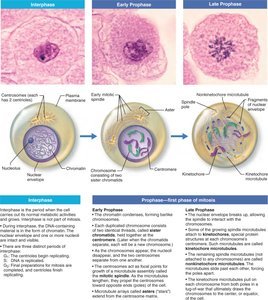
Mitosis is the process by which a eukaryotic cell separates its duplicated chromosomes into two identical sets, resulting in two nuclei. It is divided into several distinct phases:
Prophase
Early Prophase: Chromatin condenses into visible chromosomes; each chromosome consists of two sister chromatids joined at the centromere. The mitotic spindle begins to form.
Late Prophase (Prometaphase): The nuclear envelope breaks down, spindle fibers attach to kinetochores on chromosomes, and chromosomes begin moving toward the cell center.
Metaphase
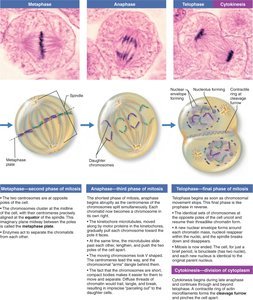
Chromosomes align at the metaphase plate (cell equator).
Spindle fibers from opposite poles attach to the centromeres of each chromosome.
Anaphase
Sister chromatids are separated and pulled toward opposite poles of the cell by the spindle fibers.
This ensures each new cell will receive an identical set of chromosomes.
Telophase
Chromosomes arrive at the poles and begin to decondense back into chromatin.
Nuclear envelopes reform around each set of chromosomes, resulting in two nuclei within the cell.
Cytokinesis
Division of the cytoplasm, resulting in two separate daughter cells.
In animal cells, a contractile ring forms a cleavage furrow that pinches the cell in two.
Summary Table: Phases of Mitosis
Phase | Main Events |
|---|---|
Prophase | Chromatin condenses, spindle forms, nuclear envelope breaks down |
Metaphase | Chromosomes align at metaphase plate |
Anaphase | Sister chromatids separate and move to opposite poles |
Telophase | Chromosomes decondense, nuclear envelopes reform |
Cytokinesis | Cytoplasm divides, forming two daughter cells |
Key Terms and Concepts
Chromatin: The complex of DNA and proteins found in the nucleus; condenses to form chromosomes during mitosis.
Centromere: The region where sister chromatids are joined and where spindle fibers attach.
Mitotic Spindle: Structure made of microtubules that separates chromosomes during mitosis.
Checkpoints: Regulatory points that ensure the cell is ready to proceed to the next phase.
Equations and Additional Information
DNA Replication: Each chromosome duplicates to form two sister chromatids:
Cell Division:
