 Back
Cell Membrane Transport: Active Processes and Cell Signaling
Study Guide - Smart Notes
 Tailored notes based on your materials, expanded with key definitions, examples, and context.
Membrane Transport: Active Processes
Overview of Active Transport
Active transport is a cellular process that moves substances across the plasma membrane against their concentration gradients, requiring energy input, typically from ATP. This process is essential for maintaining cellular homeostasis and involves specialized carrier proteins known as solute pumps.
Active Transport: Movement of solutes against their concentration gradient using energy.
Vesicular Transport: Movement of large particles or fluids via membranous sacs called vesicles.
Both processes require ATP because the transported substances are either too large, not lipid-soluble, or unable to move down their concentration gradient.
Types of Active Transport
Primary Active Transport: Direct use of ATP to transport molecules (e.g., Na+-K+ pump).
Secondary Active Transport: Indirect use of ATP; utilizes the energy stored in ionic gradients created by primary active transport.
Primary Active Transport: The Sodium-Potassium Pump
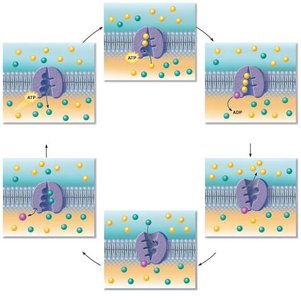
The sodium-potassium pump (Na+-K+ ATPase) is a well-studied example of primary active transport. It is present in all plasma membranes and is crucial for maintaining the electrochemical gradients necessary for muscle and nerve function.
Mechanism: The pump moves 3 Na+ ions out of the cell and 2 K+ ions into the cell against their respective gradients, using energy from ATP hydrolysis.
Importance: Maintains high intracellular K+ and high extracellular Na+ concentrations, essential for cell volume and electrical excitability.
Secondary Active Transport
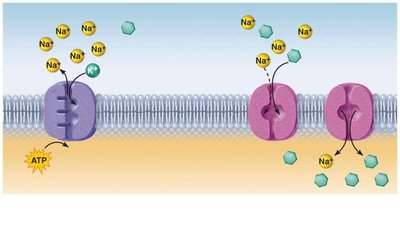
Secondary active transport relies on the ion gradients established by primary active transport. The energy stored in these gradients is used to drive the transport of other substances.
Cotransport (Symport): Two substances are transported in the same direction.
Antiport: Two substances are transported in opposite directions.
Example: The Na+-glucose symporter uses the Na+ gradient to drive glucose uptake into the cell.
Vesicular Transport
Vesicular transport moves large particles, macromolecules, and fluids across membranes in vesicles. This process is ATP-dependent and includes several subtypes:
Exocytosis: Transport out of the cell.
Endocytosis: Transport into the cell (includes phagocytosis, pinocytosis, and receptor-mediated endocytosis).
Transcytosis: Transport into, across, and out of the cell.
Vesicular Trafficking: Transport from one area or organelle to another within the cell.
Types of Endocytosis
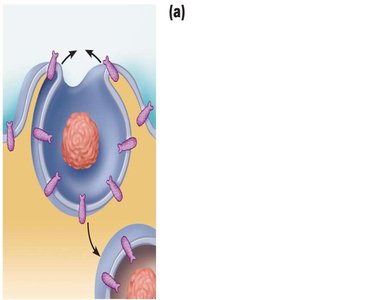
Phagocytosis: "Cell eating"; the cell engulfs large particles using pseudopods, forming a phagosome. Used by macrophages and some white blood cells.
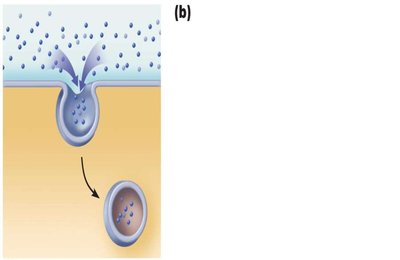
Pinocytosis: "Cell drinking"; the cell engulfs extracellular fluid and dissolved solutes in small vesicles. Non-specific process used by most cells.
Receptor-Mediated Endocytosis: Specific uptake of substances via receptor-ligand interactions, often involving clathrin-coated pits.
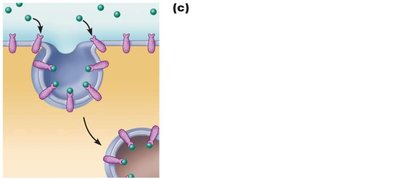
Exocytosis
Exocytosis is the process by which cells expel materials in vesicles. The vesicle membrane fuses with the plasma membrane, releasing its contents outside the cell. This process is crucial for hormone secretion, neurotransmitter release, and waste removal.
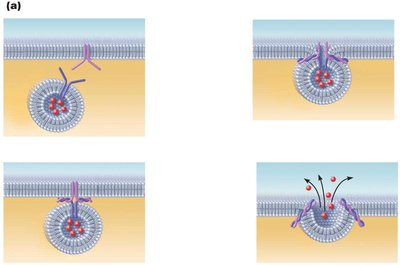
Summary Table: Active Membrane Transport Processes
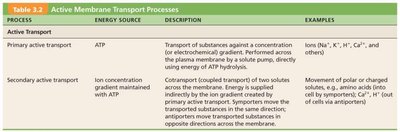
Process | Energy Source | Description | Examples |
|---|---|---|---|
Primary active transport | ATP | Transport of substances against a concentration (or electrochemical) gradient by a solute pump, directly using energy of ATP hydrolysis. | Ions (Na+, K+, H+, Ca2+) |
Secondary active transport | Ion gradient maintained with ATP | Cotransport of two solutes across the membrane. Energy supplied indirectly by the ion gradient created by primary active transport. | Movement of polar or charged solutes (e.g., amino acids, glucose, some ions) |
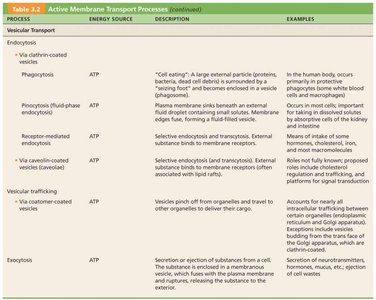
Phagocytosis | ATP | Cell engulfs large particles by forming pseudopods and enclosing them in a vesicle (phagosome). | Macrophages, neutrophils |
Pinocytosis | ATP | Cell "gulps" extracellular fluid into vesicles; non-specific process. | Most cells |
Receptor-mediated endocytosis | ATP | Selective endocytosis and transcytosis; external substances bind to membrane receptors. | Hormone, cholesterol, iron uptake |
Exocytosis | ATP | Secretion or ejection of substances from a cell by vesicle fusion with the plasma membrane. | Neurotransmitter, hormone, mucus secretion |
Generation of a Resting Membrane Potential (RMP)
Establishment of RMP
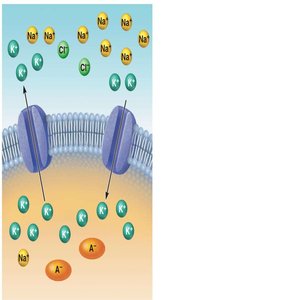
The resting membrane potential is the voltage difference across the plasma membrane in all cells, typically ranging from –50 to –100 mV. It is primarily established by the selective diffusion of potassium ions (K+) and maintained by the Na+-K+ pump.
Electrochemical Gradient: Combination of the chemical (concentration) and electrical (charge) gradients across the membrane.
K+ Diffusion: K+ leaks out of the cell, making the inside more negative, until the electrical gradient balances the chemical gradient.
Na+ Influence: Na+ entry slightly offsets the RMP, making it less negative (e.g., –70 mV in neurons).
Role of Active Transport in RMP
The Na+-K+ pump maintains the gradients by continuously ejecting 3 Na+ ions and importing 2 K+ ions for each ATP hydrolyzed.
This steady state is essential for nerve impulse transmission and muscle contraction.
Cell-Environment Interactions
Cell Adhesion Molecules (CAMs)
CAMs are proteins located on the cell surface involved in binding with other cells or with the extracellular matrix. They play roles in cell signaling, migration, and immune responses.
Anchor cells to the extracellular matrix or each other.
Assist in cell movement and attract immune cells to sites of injury.
Transmit signals to direct cell migration, proliferation, and specialization.
Plasma Membrane Receptors and Chemical Signaling
Plasma membrane receptors are proteins that bind ligands (such as hormones or neurotransmitters) and initiate cellular responses. Chemical signaling can alter cell activity through various mechanisms, including second messenger systems.
Contact Signaling: Direct cell-to-cell recognition and communication.
Chemical Signaling: Ligand binding triggers receptor-mediated changes, activating enzymes or ion channels.
G Protein–Linked Receptors: Ligand binding activates a G protein, which then triggers intracellular signaling cascades via second messengers (e.g., cyclic AMP, Ca2+).
Summary
Active transport and vesicular transport are essential for maintaining cellular homeostasis and communication.
Resting membrane potential is established by selective ion diffusion and maintained by active transport.
Cell-environment interactions are mediated by CAMs and membrane receptors, enabling cells to respond to external signals.
