 Back
Cell Structure and Function: ANP College Study Notes
Study Guide - Smart Notes
 Tailored notes based on your materials, expanded with key definitions, examples, and context.
Cell Theory and Overview
Fundamental Principles of Cell Theory
The cell theory is a cornerstone of biology, establishing the cell as the basic structural and functional unit of life. All living organisms are composed of cells, and the activities of an organism depend on the collective activities of its cells. The continuity of life is maintained through cellular reproduction.
Cell: The smallest unit of life, capable of performing all vital functions.
Organismal Activity: Determined by individual and collective cell activity.
Biochemical Activities: Dictated by subcellular structures (organelles).
Continuity of Life: Ensured by cellular reproduction.
Basic Parts of a Cell
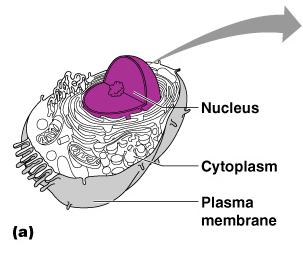
Every cell consists of three main components: the plasma membrane, cytoplasm, and nucleus. The cytoplasm is the material between the plasma membrane and the nucleus, containing cytosol (fluid) and cytoplasmic organelles (metabolic machinery).
Plasma Membrane: Boundary separating intracellular and extracellular environments.
Cytoplasm: Contains cytosol, organelles, and inclusions.
Nucleus: Genetic control center of the cell.
Plasma Membrane Structure and Function
Phospholipid Bilayer and Associated Proteins
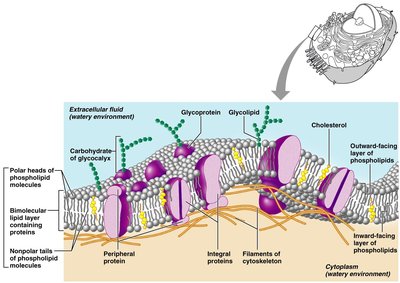
The plasma membrane is a dynamic structure, 7-10 nm thick, composed of a phospholipid bilayer with embedded proteins. It separates the cell's internal environment from the external environment and plays a crucial role in cellular activity.
Phospholipid Bilayer: Provides structural integrity and selective permeability.
Integral Proteins: Span the membrane; include transmembrane proteins.
Peripheral Proteins: Loosely attached to integral proteins.
Glycocalyx: Carbohydrate-rich area for cell recognition.
Glycolipids: Lipids with attached sugars, important for cell signaling.
Cholesterol: Stabilizes membrane fluidity.
Functions of Membrane Proteins
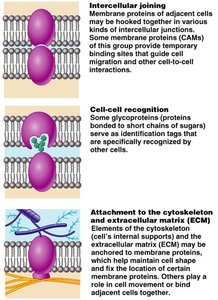
Membrane proteins are essential for various cellular functions, including transport, enzymatic activity, signal transduction, intercellular joining, cell-cell recognition, and attachment to the cytoskeleton and extracellular matrix.
Transport: Movement of substances across the membrane.
Enzymatic Activity: Catalysis of metabolic reactions.
Receptors: Signal transduction for cellular communication.
Intercellular Joining: Formation of junctions between cells.
Cell-Cell Recognition: Identification and interaction with other cells.
Attachment: Structural support via cytoskeleton and extracellular matrix.
Membrane Junctions
Types of Membrane Junctions
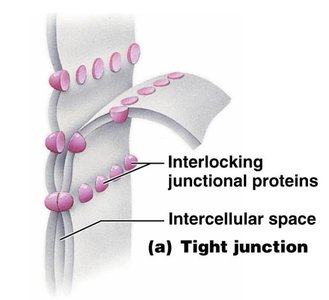
Cells use specialized junctions to maintain tissue integrity and facilitate communication. The three main types are tight junctions, desmosomes, and gap junctions.
Tight Junctions: Impermeable junctions encircling cells, preventing leakage (e.g., intestinal cells).
Desmosomes: Anchoring junctions distributing tension, preventing tearing (e.g., skin).
Gap Junctions: Channels allowing chemical communication and synchronization (e.g., cardiac muscle).
Transport Across the Plasma Membrane
Passive Transport Mechanisms
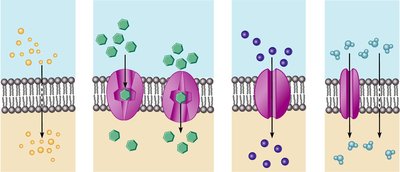
Passive transport does not require energy and includes diffusion, facilitated diffusion, osmosis, and filtration. Substances move down their concentration gradients.
Simple Diffusion: Movement of lipid-soluble substances directly through the bilayer.
Channel-Mediated Facilitated Diffusion: Movement of ions through channel proteins.
Carrier-Mediated Facilitated Diffusion: Specific transport via carrier proteins.
Osmosis: Diffusion of water through aquaporins or the bilayer.
Filtration: Movement driven by hydrostatic pressure (e.g., kidney).
Active Transport Mechanisms
Active transport requires energy (ATP) to move substances against their concentration gradients. It includes primary and secondary active transport, as well as vesicular transport.
Primary Active Transport: Direct use of ATP (e.g., sodium-potassium pump).
Secondary Active Transport: Uses energy from ionic gradients created by primary transport.
Symport System: Two substances move in the same direction.
Antiport System: Two substances move in opposite directions.
Vesicular Transport
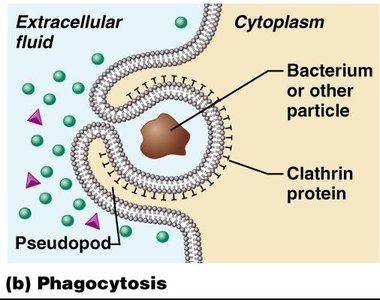
Vesicular transport moves large particles and macromolecules across the membrane using ATP. It includes endocytosis, exocytosis, and transcytosis.
Endocytosis: Uptake of substances into the cell.
Exocytosis: Release of substances from the cell.
Transcytosis: Transport across the cell.
Types of Endocytosis
Endocytosis can be classified into phagocytosis, pinocytosis, and receptor-mediated endocytosis.
Phagocytosis: Engulfment of solid particles by pseudopods.
Pinocytosis: Uptake of fluid and dissolved materials.
Receptor-Mediated Endocytosis: Specific uptake via clathrin-coated pits.
Cytoplasmic Organelles
Overview of Organelles
Organelles are specialized structures within the cytoplasm, each performing distinct functions. Some are membrane-bound, while others are not.
Membrane-bound Organelles: Allow compartmentalization of cellular processes.
Non-membrane Organelles: Include ribosomes, cytoskeleton, centrioles.
Mitochondria
Mitochondria are the powerhouses of the cell, generating ATP through aerobic cellular respiration. They have a double membrane with inner folds called cristae.
ATP Production: Occurs via aerobic respiration.
Structure: Double membrane, cristae, matrix.
Endoplasmic Reticulum (ER)
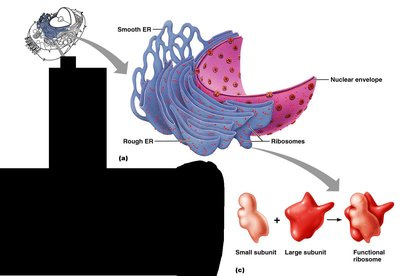
The ER is a network of membranes continuous with the nuclear envelope. It exists in two forms: rough ER (with ribosomes) and smooth ER (without ribosomes).
Rough ER: Synthesizes proteins and phospholipids.
Smooth ER: Catalyzes lipid metabolism, detoxification, and calcium storage.
Ribosomes
Ribosomes are granules composed of protein and rRNA, responsible for protein synthesis. They can be free in the cytoplasm or bound to the ER.
Free Ribosomes: Synthesize soluble proteins.
Membrane-bound Ribosomes: Synthesize proteins for membranes or secretion.
Golgi Apparatus
The Golgi apparatus consists of stacked, flattened membranous sacs. It modifies, concentrates, and packages proteins for secretion or use within the cell.
Protein Processing: Receives proteins from ER, processes, and sorts them.
Vesicle Formation: Forms secretory, membrane, and lysosomal vesicles.
Lysosomes and Peroxisomes
Lysosomes are membrane-bound sacs containing digestive enzymes, while peroxisomes contain oxidases and catalases for detoxification.
Lysosomes: Digest bacteria, viruses, toxins, and degrade organelles.
Peroxisomes: Neutralize free radicals and detoxify harmful substances.
Cytoskeleton
The cytoskeleton provides structural support, maintains cell shape, and facilitates movement. It consists of microfilaments, intermediate filaments, and microtubules.
Microfilaments: Strengthen cell surface.
Intermediate Filaments: Resist pulling forces.
Microtubules: Determine cell shape and organelle distribution.
Centrioles
Centrioles are barrel-shaped organelles located in the centrosome. They anchor microtubules and organize the mitotic spindle during cell division.
Structure: Pinwheel array of nine triplets of microtubules.
Function: Organize spindle fibers for mitosis.
Nucleus and Genetic Material
Nucleus Structure and Function
The nucleus contains the cell's genetic material and is surrounded by a nuclear envelope. The nucleolus within the nucleus is the site of ribosome synthesis.
Nuclear Envelope: Double membrane with pores for transport.
Nucleolus: Ribosome production site.
Chromatin and Chromosomes
Chromatin consists of DNA and histone proteins, forming nucleosomes. During cell division, chromatin condenses into chromosomes, which are joined at the centromere.
Chromatin: DNA-histone complex.
Chromosomes: Condensed chromatin for cell division.
Cell Cycle and Mitosis
Phases of the Cell Cycle
The cell cycle consists of interphase (G1, S, G2) and the mitotic phase (prophase, metaphase, anaphase, telophase, cytokinesis).
Interphase: Growth and DNA synthesis.
Mitotic Phase: Division of nucleus and cytoplasm.
Mitosis Steps
Mitosis ensures equal distribution of genetic material to daughter cells.
Prophase: Chromatin condenses, spindle forms.
Metaphase: Chromosomes align at metaphase plate.
Anaphase: Chromosomes pulled to opposite poles.
Telophase: Nuclear envelopes reform, chromosomes decondense.
Cytokinesis: Division of cytoplasm, formation of two daughter cells.
DNA Replication and Protein Synthesis
DNA Replication
DNA replication occurs during the S phase of interphase, ensuring each new cell receives a complete set of DNA. The process is semi-conservative, involving enzymes such as helicase, RNA primase, DNA polymerase, and DNA ligase.
Helicase: Unwinds DNA.
RNA Primase: Lays down RNA primer.
DNA Polymerase III: Adds nucleotides.
DNA Polymerase I: Replaces RNA primer with DNA.
DNA Ligase: Joins Okazaki fragments.
Central Dogma of Biology
The central dogma describes the flow of genetic information: DNA → RNA → protein. Genes are transcribed into mRNA, which is then translated into proteins.
Transcription: DNA is copied into mRNA.
Translation: mRNA is decoded at the ribosome to synthesize proteins.
Roles of RNA
mRNA: Carries genetic information from nucleus to ribosome.
tRNA: Brings amino acids to ribosome.
rRNA: Structural component of ribosomes.
Transcription and Translation
Transcription involves RNA polymerase binding to the promoter, unwinding DNA, and synthesizing mRNA. Translation occurs at the ribosome, where tRNA matches codons with amino acids, forming polypeptides.
Transcription Factor: Activates gene expression.
Promoter: Start site for transcription.
Termination Signal: Ends transcription.
Genetic Code
The genetic code is a set of rules by which mRNA codons specify amino acids. Each codon consists of three nucleotides.
Process | Key Enzyme | Function |
|---|---|---|
DNA Replication | DNA Polymerase | Synthesizes new DNA strand |
Transcription | RNA Polymerase | Synthesizes mRNA from DNA |
Translation | Ribosome | Assembles protein from mRNA |
Example: The codon AUG codes for the amino acid methionine, which is the start signal for translation.
Additional info: These notes cover the essential concepts of cell structure, membrane function, transport mechanisms, organelles, nucleus, cell cycle, and genetic information transfer, as outlined in Chapter 3: Cells: The Living Units of the ANP college course.
