 Back
BackCell Transport: Diffusion, Osmosis, and Membrane Dynamics
Study Guide - Smart Notes
 Tailored notes based on your materials, expanded with key definitions, examples, and context.
Cell Transport and Membrane Dynamics
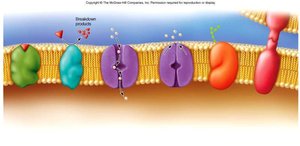
Membrane Protein Functions
The plasma membrane contains various proteins that perform essential functions for cellular activity and communication. These proteins are embedded within the phospholipid bilayer and contribute to the selective permeability of the membrane.
Receptors: Bind specific molecules (ligands) and initiate cellular responses.
Enzymes: Catalyze chemical reactions at the membrane surface.
Channel Proteins: Form pores or gates for selective passage of ions and molecules.
Pumps: Actively transport substances against their concentration gradient using ATP.
Cell-Identity Markers: Glycoproteins that help cells recognize each other.
Cell-Adhesion Molecules: Facilitate cell-to-cell attachment and communication.
Types of Membrane Transport
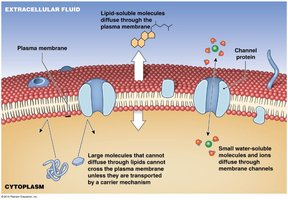
The cell membrane is selectively permeable, allowing certain substances to pass while restricting others. Transport mechanisms are classified as passive (no energy required) or active (energy required).
Passive Processes:
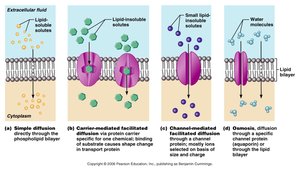
Simple Diffusion: Movement of hydrophobic substances (e.g., steroid hormones, O2, CO2) through the phospholipid bilayer.
Facilitated Diffusion: Movement of hydrophilic solutes (e.g., ions, water) via channel proteins.
Osmosis: Diffusion of water through a semipermeable membrane.
Active Processes:
Active Transport: Movement of substances against their concentration gradient using ATP (e.g., sodium-potassium pump).
Vesicular Transport: Movement of large particles or fluids via vesicles (endocytosis and exocytosis).
Diffusion
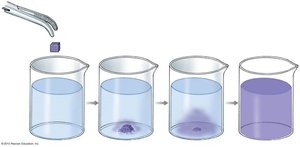
Diffusion is the net movement of particles from an area of high concentration to an area of low concentration, driven by the random motion of molecules. It is a fundamental process for the distribution of substances within and between cells.
Concentration Gradient: The difference in concentration across a membrane.
Simple Diffusion: Direct movement through the lipid bilayer.
Facilitated Diffusion: Movement through channel or carrier proteins.
Factors Affecting Diffusion Rate
Temperature: Higher temperature increases diffusion rate.
Molecular Weight: Smaller molecules diffuse faster.
Steepness of Concentration Gradient: Greater difference increases rate.
Membrane Surface Area: Larger area increases rate.
Membrane Permeability: More permeable membranes allow faster diffusion.
Electrical Forces: The charge inside the cell can influence movement of ions.
Osmosis
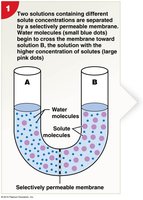
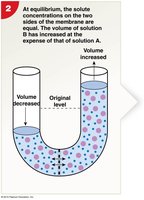
Osmosis is the diffusion of water across a semipermeable membrane from an area of higher water concentration (lower solute concentration) to an area of lower water concentration (higher solute concentration). Aquaporins are channel proteins that facilitate water movement.
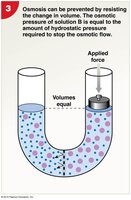
Osmotic Pressure: The force exerted by solutes that drives water movement. Water moves toward areas of higher osmotic pressure.
Hydrostatic Pressure: The pressure needed to block osmosis.
Tonicity
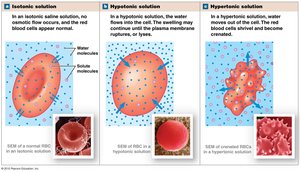
Tonicity describes the effect of a solution on cell volume and pressure, depending on the concentration of impermeable solutes.
Hypotonic Solution: Lower solute concentration outside the cell; water enters, cell swells and may burst (lyse).
Hypertonic Solution: Higher solute concentration outside; cell loses water and shrivels (crenate).
Isotonic Solution: Equal solute concentration; no net water movement, cell remains normal.
Primary Active Transport
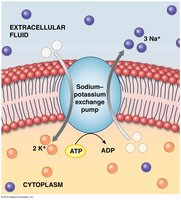
Primary active transport uses ATP to move solutes across the membrane against their concentration gradient. The sodium-potassium pump is a key example, maintaining cellular ion balance and enabling nerve and muscle function.
Sodium-Potassium Pump: Moves 3 Na+ out and 2 K+ in per ATP molecule.
Counter Transport: Simultaneous movement of two substances in opposite directions.
Equation for sodium-potassium pump:
Secondary Active Transport
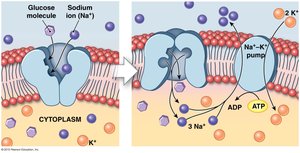
Secondary active transport relies on the concentration gradient established by primary active transport. For example, the sodium-potassium pump creates a gradient that drives glucose transport via a symport protein.
Na-Glucose Cotransport: Glucose enters the cell with Na+ as Na+ moves down its gradient.
Facilitated Diffusion: Glucose transport is facilitated by a symport protein.
Carrier Mediated Transport
Carrier mediated transport involves membrane proteins that specifically bind and transport ions or organic substrates. It includes facilitated diffusion, primary active transport, and secondary active transport.
Specificity: Each transport protein binds a specific substrate.
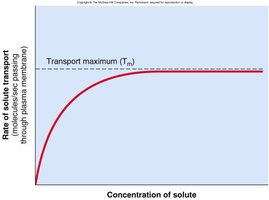
Saturation Limits: The rate of transport depends on the number of available proteins, not substrate concentration.
Transport Maximum (Tm): The maximum rate at which a substance can be transported.
Type | Energy Requirement | Direction |
|---|---|---|
Facilitated Diffusion | No | Down gradient |
Primary Active Transport | Yes (ATP) | Against gradient |
Secondary Active Transport | Indirect (uses gradient) | Against gradient |
Vesicular Transport
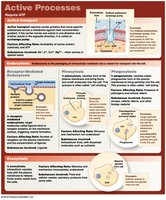
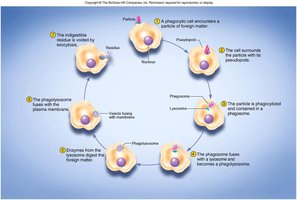
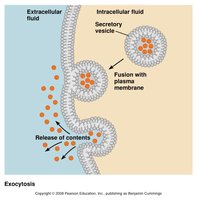
Vesicular transport moves large particles or fluids into or out of the cell using vesicles. It is a form of active transport requiring ATP.
Endocytosis: Transport into the cell. Includes:
Phagocytosis: "Cell-eating"; uptake of large particles.
Pinocytosis: "Cell-drinking"; uptake of fluid droplets.
Exocytosis: Transport out of the cell; vesicles fuse with the membrane to release contents.
Summary Table: Types of Cell Transport
Transport Type | Energy Required | Example | Direction |
|---|---|---|---|
Simple Diffusion | No | O2, CO2 | Down gradient |
Facilitated Diffusion | No | Glucose, ions | Down gradient |
Osmosis | No | Water | Down gradient |
Primary Active Transport | Yes | Na/K pump | Against gradient |
Secondary Active Transport | Indirect | Na/glucose cotransport | Against gradient |
Vesicular Transport | Yes | Endocytosis, exocytosis | Variable |
Key Questions for Review
Describe the plasma membrane and its protein functions.
Explain why the cell membrane is selectively permeable.
List and describe the types of passive and active transport.
Compare simple and facilitated diffusion.
Identify factors affecting diffusion rates.
Describe osmosis and the role of aquaporins.
Explain osmotic pressure and tonicity (hypotonic, hypertonic, isotonic).
Describe primary and secondary active transport, including the Na/K pump and Na/glucose cotransport.
Explain carrier mediated transport and transport maximum.
Describe vesicular transport, including endocytosis (phagocytosis, pinocytosis) and exocytosis.
Additional info: Academic context and expanded explanations were added to ensure completeness and clarity for college-level study.
