 Back
Cells: The Living Units – Comprehensive Study Notes
Study Guide - Smart Notes
 Tailored notes based on your materials, expanded with key definitions, examples, and context.
Chapter 3: Cells – The Living Units
3.1 Cells are the Smallest Unit of Life
Cells are the fundamental building blocks of all living organisms. Understanding their structure and function is essential for studying anatomy and physiology.
Cell Theory: All living things are composed of cells; cells are the basic unit of structure and function; all cells arise from pre-existing cells.
Major Regions of a Generalized Cell:
Plasma Membrane: Selectively permeable barrier.
Cytoplasm: Intracellular fluid containing organelles.
Nucleus: Controls cellular activities.
Extracellular Materials: Include extracellular fluid (interstitial fluid, plasma, cerebrospinal fluid), cellular secretions, and the extracellular matrix.
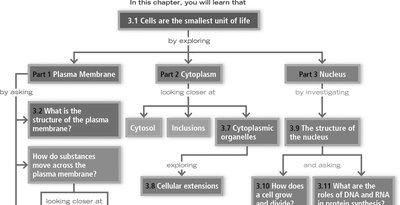
Part 1: Plasma Membrane
3.2 Structure and Function of the Plasma Membrane
The plasma membrane is a dynamic structure that separates the cell from its environment and regulates the movement of substances in and out.
Chemical Composition: Phospholipid bilayer with embedded proteins, glycolipids, and cholesterol.
Membrane Proteins:
Integral Proteins: Span the membrane; function as channels or carriers.
Peripheral Proteins: Attached to membrane surface; function as enzymes or in cell shape.
Glycocalyx: Carbohydrate-rich area for cell recognition.
Cell Junctions:
Tight Junctions: Prevent passage between cells.
Desmosomes: Anchor cells together, resist tearing.
Gap Junctions: Allow communication via small molecules.
3.3 Passive Membrane Transport
Passive transport involves the movement of substances across the membrane without energy input, driven by concentration gradients.
Simple Diffusion: Small or lipid-soluble molecules move directly through the membrane.
Facilitated Diffusion: Larger or charged molecules move via protein carriers or channels.
Osmosis: Diffusion of water through a selectively permeable membrane.
Tonicity:
Isotonic: No net water movement.
Hypertonic: Water leaves the cell; cell shrinks.
Hypotonic: Water enters the cell; cell swells.
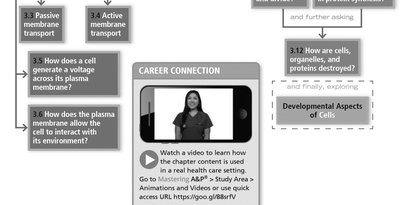
3.4 Active Membrane Transport
Active transport requires energy (ATP) to move substances against their concentration gradients or to transport large particles.
Primary Active Transport: Direct use of ATP (e.g., Na+-K+ pump).
Secondary Active Transport: Uses energy from ionic gradients created by primary transport.
Vesicular Transport:
Endocytosis: Bringing substances into the cell (phagocytosis, pinocytosis, receptor-mediated).
Exocytosis: Expelling substances from the cell.
3.5 Membrane Potential
The membrane potential is the voltage difference across the plasma membrane, essential for nerve and muscle function.
Resting Membrane Potential: Mainly determined by K+ gradients; typically -70 mV in neurons.
Maintained by: Selective permeability and active transport (Na+-K+ pump).
3.6 Cell Adhesion Molecules and Membrane Receptors
Cells interact with their environment through adhesion molecules and receptors.
Cell Adhesion Molecules (CAMs): Mediate cell attachment, migration, and immune responses.
Membrane Receptors: Involved in contact and chemical signaling (e.g., G protein-coupled receptors).
Part 2: Cytoplasm
3.7 Cytoplasmic Organelles
The cytoplasm contains organelles that perform specialized functions necessary for cell survival.
Mitochondria: Site of ATP production via aerobic respiration.
Ribosomes: Sites of protein synthesis; free or bound to rough ER.
Endoplasmic Reticulum (ER):
Rough ER: Protein synthesis and modification.
Smooth ER: Lipid metabolism, detoxification.
Golgi Apparatus: Modifies, sorts, and packages proteins and lipids.
Lysosomes: Digestive enzymes for breakdown of waste.
Peroxisomes: Detoxify harmful substances.
Cytoskeleton: Microtubules, microfilaments, intermediate filaments for structure and movement.
Centrosome and Centrioles: Organize microtubules, form spindle fibers during cell division.
3.8 Cellular Extensions: Cilia and Microvilli
Cellular extensions increase surface area or aid in movement.
Cilia: Motile, move substances across cell surfaces.
Flagella: Propel the cell itself (e.g., sperm).
Microvilli: Increase surface area for absorption.
Part 3: Nucleus
3.9 Structure and Function of the Nucleus
The nucleus is the control center of the cell, containing genetic material and directing cellular activities.
Nuclear Envelope: Double membrane with pores for molecular transport.
Nucleolus: Site of ribosome subunit assembly.
Chromatin: DNA-protein complex; condenses into chromosomes during cell division.
3.10 The Cell Cycle and DNA Replication
The cell cycle includes interphase (growth, DNA replication) and mitotic phase (division).
Interphase: G1 (growth), S (DNA synthesis), G2 (preparation for division).
Mitosis: Prophase, metaphase, anaphase, telophase.
Cytokinesis: Division of cytoplasm.
DNA Replication: DNA uncoils, strands separate, complementary nucleotides added.
3.11 Protein Synthesis: From DNA to Protein
Protein synthesis involves transcription (DNA to mRNA) and translation (mRNA to protein).
Gene: Segment of DNA coding for a polypeptide.
Transcription: DNA sequence copied to mRNA in the nucleus.
Translation: mRNA decoded by ribosomes to assemble amino acids into proteins.
RNA Types: mRNA (messenger), tRNA (transfer), rRNA (ribosomal).
Genetic Code: Triplets (DNA), codons (mRNA), anticodons (tRNA).
3.12 Cell Destruction: Autophagy, Proteasomes, and Apoptosis
Cells have mechanisms for removing damaged components and for programmed cell death.
Autophagy: Degradation of organelles and proteins via lysosomes.
Proteasomes: Degrade ubiquitin-tagged proteins.
Apoptosis: Programmed cell death; essential for development and homeostasis.
Developmental Aspects of Cells
Cell differentiation, division, and aging are regulated by genetic and environmental factors.
Cell Differentiation: Cells become specialized in structure and function.
Cell Aging Theories: Wear and tear, mitochondrial, immune, and genetic theories (telomere shortening).
Additional info: These notes synthesize and expand upon the provided outline, integrating textbook-level explanations and definitions for clarity and exam preparation.
