 Back
Cells: The Living Units – Structure and Function of Human Cells
Study Guide - Smart Notes
 Tailored notes based on your materials, expanded with key definitions, examples, and context.
Cells: The Living Units
Introduction to Cells
Cells are the fundamental structural and functional units of all living organisms. The human body contains trillions of cells, each specialized for particular functions. Understanding cell structure and function is essential for comprehending how the body operates at the microscopic level.
Cell Theory: All living things are composed of cells; the cell is the smallest unit of life; all cells arise from pre-existing cells.
Cell Diversity: Over 250 types of human cells exist, differing in size, shape, and internal components, which determine their specific functions.
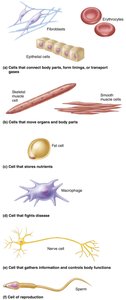
Generalized Cell Structure
Despite their diversity, all human cells share three basic structural components:
Plasma Membrane: The flexible outer boundary that separates the cell from its environment.
Cytoplasm: The intracellular fluid containing organelles.
Nucleus: The control center containing DNA.
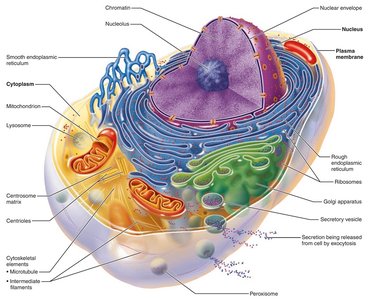
The Plasma Membrane
Structure and Composition
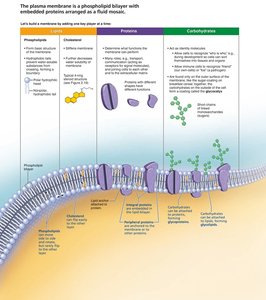
The plasma membrane is a dynamic, selectively permeable barrier that separates the intracellular fluid (ICF) from the extracellular fluid (ECF). It is described by the fluid mosaic model, which depicts a bilayer of phospholipids with embedded proteins and carbohydrates.
Phospholipid Bilayer: Composed mainly of phospholipids with hydrophilic heads facing outward and hydrophobic tails facing inward.
Cholesterol: Interspersed within the bilayer, increasing membrane stability and fluidity.
Proteins: Integral and peripheral proteins serve various functions such as transport, signaling, and cell recognition.
Carbohydrates: Form the glycocalyx, which is involved in cell recognition and protection.

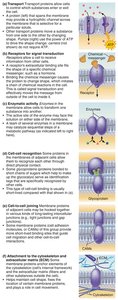
Membrane Proteins and Their Functions
Membrane proteins are crucial for communication, transport, and maintaining the cell's structure. They are classified as:
Integral Proteins: Span the membrane and function as channels, carriers, receptors, or enzymes.
Peripheral Proteins: Loosely attached to the membrane, functioning as enzymes, motor proteins, or in cell-to-cell connections.
Function | Description |
|---|---|
Transport | Move substances across the membrane (channels, pumps) |
Receptors | Bind chemical messengers and initiate cellular responses |
Enzymatic Activity | Catalyze reactions at the membrane surface |
Cell Recognition | Glycoproteins serve as identification tags |
Cell Joining | Form junctions between adjacent cells |
Attachment | Anchor cytoskeleton and extracellular matrix |
The Glycocalyx
The glycocalyx is a carbohydrate-rich area on the cell surface, formed by glycoproteins and glycolipids. It serves as a biological marker for cell recognition and is important for immune responses.
Intercellular Junctions
Types of Cell Junctions
Cells are connected by specialized junctions that allow communication and adhesion:
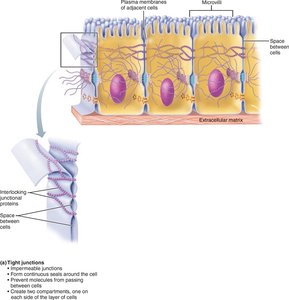
Tight Junctions: Create impermeable barriers by fusing adjacent cell membranes, preventing passage of substances between cells.
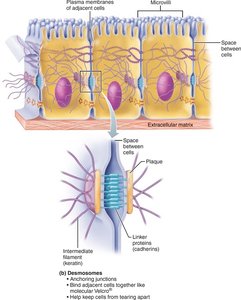
Desmosomes: Anchoring junctions that mechanically bind cells together, providing strength and stability.
Gap Junctions: Allow direct communication between cells through connexons, enabling the passage of ions and small molecules.
Junction Type | Main Function |
|---|---|
Tight Junction | Impermeable seal between cells |
Desmosome | Mechanical attachment, resists tearing |
Gap Junction | Communication, passage of ions/small molecules |
Membrane Transport
Passive Transport
Passive transport does not require energy and relies on the movement of molecules down their concentration gradients. Types include:
Simple Diffusion: Movement of nonpolar and lipid-soluble substances directly through the membrane (e.g., O2, CO2).
Facilitated Diffusion: Movement of polar molecules via carrier or channel proteins (e.g., glucose, ions).
Osmosis: Diffusion of water through a selectively permeable membrane, either directly or via aquaporins.
Osmolarity is the total concentration of solute particles in a solution, influencing water movement.
Tonicity describes a solution's ability to change cell shape by altering water volume:
Isotonic: No net water movement; cell shape unchanged.
Hypertonic: Water leaves cell; cell shrinks (crenation).
Hypotonic: Water enters cell; cell swells or bursts (lysis).
Active Transport
Active transport requires energy (ATP) to move substances against their concentration gradients. Types include:
Primary Active Transport: Direct use of ATP, e.g., sodium-potassium pump ( per ATP).
Secondary Active Transport: Indirect use of ATP; uses ion gradients established by primary active transport to drive movement of other substances (symporters and antiporters).

Vesicular Transport
Vesicular transport moves large particles or volumes via vesicles and requires energy:
Endocytosis: Import into cell (phagocytosis, pinocytosis, receptor-mediated endocytosis).
Exocytosis: Export from cell (e.g., secretion of hormones, neurotransmitters).
Membrane Potential
Resting Membrane Potential (RMP)
All cells maintain a voltage difference across their plasma membrane, typically -50 to -90 mV, with the inside negative relative to the outside. This is crucial for nerve and muscle function.
Key Ion: Potassium (K+) is the primary determinant of RMP due to its permeability and concentration gradient.
Sodium-Potassium Pump: Maintains the gradient by pumping 3 Na+ out and 2 K+ in per ATP used.
Equation for RMP (Nernst Equation):
Additional info: R = gas constant, T = temperature, z = ion charge, F = Faraday's constant.
Cytoplasm and Organelles
Cytoplasm
The cytoplasm is the cellular material between the plasma membrane and the nucleus, consisting of cytosol (fluid), inclusions (stored nutrients), and organelles (functional structures).
Major Organelles and Their Functions
Mitochondria: Site of ATP production via aerobic respiration; contains its own DNA and ribosomes.
Ribosomes: Sites of protein synthesis; can be free or membrane-bound.
Endoplasmic Reticulum (ER): Rough ER synthesizes proteins; smooth ER synthesizes lipids, detoxifies chemicals, and stores calcium.
Golgi Apparatus: Modifies, sorts, and packages proteins and lipids for secretion or use within the cell.
Lysosomes: Contain digestive enzymes for breaking down waste and cellular debris.
Peroxisomes: Detoxify harmful substances and break down fatty acids.
Cytoskeleton: Network of microfilaments, intermediate filaments, and microtubules that provide structural support and facilitate movement.
Centrosome and Centrioles: Organize microtubules and are essential for cell division.
Cellular Extensions
Cilia, Flagella, and Microvilli
Cilia: Motile extensions that move substances across the cell surface (e.g., respiratory tract).
Flagella: Longer extensions for cell movement (e.g., sperm cell).
Microvilli: Increase surface area for absorption (e.g., intestinal cells).
Nucleus
Structure and Function
The nucleus is the largest organelle, containing the genetic material (DNA) necessary for controlling cellular activities and protein synthesis. Most cells have a single nucleus, but some are multinucleate or anucleate.
