 Back
BackCells: The Living Units – Structure and Function of the Plasma Membrane
Study Guide - Smart Notes
 Tailored notes based on your materials, expanded with key definitions, examples, and context.
Cells: The Living Units
Introduction to Cell Theory
Cells are the fundamental structural and functional units of life. The activities of an organism depend on the individual and collective activities of its cells. The structure of each cell is closely related to its function, and all cells arise from preexisting cells, ensuring the continuity of life.
Cell Theory: All living things are composed of cells; cells are the basic units of structure and function in living organisms.
Cell Diversity: There are over 250 different types of human cells, varying in size, shape, and function.
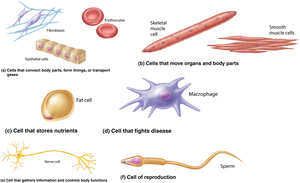
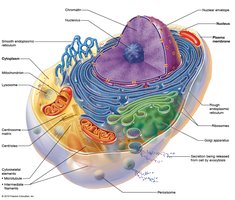
Generalized Cell Structure
Despite their diversity, all human cells share three basic components:
Plasma membrane: The flexible outer boundary that separates the cell from its environment.
Cytoplasm: The intracellular fluid containing organelles.
Nucleus: The control center containing DNA.
Extracellular Materials
Types of Extracellular Materials
Substances found outside cells are classified as:
Extracellular fluids: Includes interstitial fluid, blood plasma, and cerebrospinal fluid.
Cellular secretions: Such as saliva and mucus.
Extracellular matrix: A network that acts as a glue to hold cells together.
Plasma Membrane Structure and Function
Overview of the Plasma Membrane
The plasma membrane acts as an active barrier, separating intracellular fluid (ICF) from extracellular fluid (ECF). It controls what enters and leaves the cell and is also known as the "cell membrane." The membrane is described by the fluid mosaic model, indicating its dynamic and complex structure.
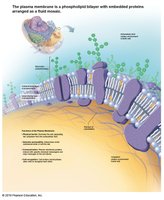
Membrane Lipids
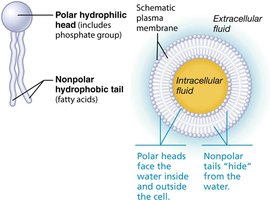
The lipid bilayer forms the basic structure of the plasma membrane:
Phospholipids (75%): Have hydrophilic (water-loving) heads and hydrophobic (water-fearing) tails, forming a bilayer.
Glycolipids (5%): Lipids with attached sugar groups on the outer membrane surface.
Cholesterol (20%): Stabilizes the membrane.
Membrane Proteins
Membrane proteins are essential for communication and various cellular functions. They make up about half the mass of the plasma membrane and are classified as:
Integral proteins: Firmly inserted into the membrane, often spanning the bilayer (transmembrane). They function as transporters, receptors, or enzymes.
Peripheral proteins: Loosely attached to integral proteins, functioning as enzymes, motor proteins, or in cell-to-cell connections.
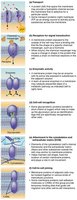
Functions of Membrane Proteins
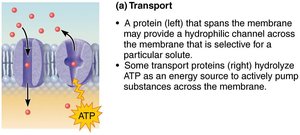
Transport: Move substances across the membrane.
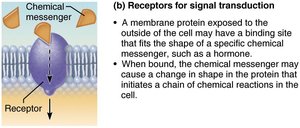
Receptors for signal transduction: Bind chemical messengers and initiate cellular responses.
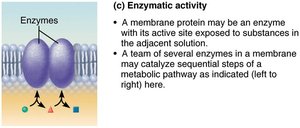
Enzymatic activity: Catalyze metabolic reactions.
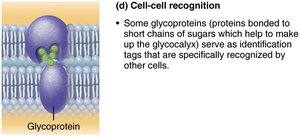
Cell-cell recognition: Serve as identification tags for cell recognition.
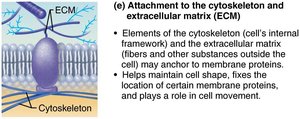
Attachment to cytoskeleton and extracellular matrix: Maintain cell shape and stabilize membrane location.
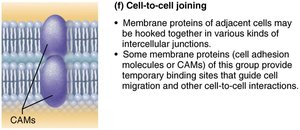
Cell-to-cell joining: Form intercellular junctions for tissue integrity.
Glycocalyx
The glycocalyx is a carbohydrate-rich area on the cell surface, formed by glycoproteins and glycolipids. It serves as a biological marker for cell recognition and helps the immune system distinguish self from nonself.
Cell Junctions
Types of Cell Junctions
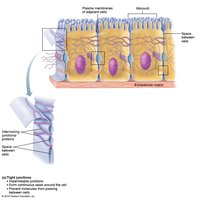
Most cells are bound together to form tissues and organs. The main types of cell junctions are:
Tight junctions: Form impermeable barriers to prevent passage of substances between cells.
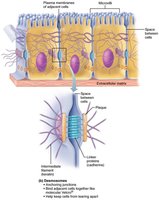
Desmosomes: Provide anchoring strength, allowing cells to resist mechanical stress.
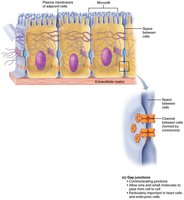
Gap junctions: Allow communication and passage of ions and small molecules between cells.
Membrane Transport
Selective Permeability
The plasma membrane is selectively permeable, allowing only certain molecules to cross. Substances move across the membrane by:
Passive transport: No energy required.
Active transport: Requires energy (ATP).
Passive Membrane Transport
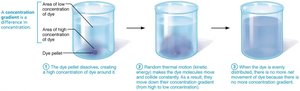
Passive transport involves the movement of molecules down their concentration gradient. The main types are:
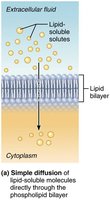
Simple diffusion: Nonpolar and lipid-soluble substances diffuse directly through the lipid bilayer.
Facilitated diffusion: Polar and larger molecules move via protein carriers or channels.
Osmosis: Diffusion of water across a selectively permeable membrane.
Factors Affecting Diffusion Speed
Concentration gradient: Greater differences increase diffusion rate.
Molecular size: Smaller molecules diffuse faster.
Temperature: Higher temperatures increase diffusion rate.
Simple Diffusion
Simple diffusion allows nonpolar, lipid-soluble molecules (e.g., oxygen, carbon dioxide, steroid hormones) to pass directly through the membrane.
Facilitated Diffusion
Facilitated diffusion is used by molecules that cannot cross the lipid bilayer directly. It occurs via:
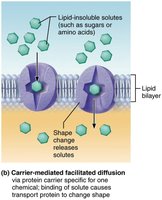
Carrier-mediated: Specific molecules bind to protein carriers that change shape to transport them.
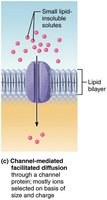
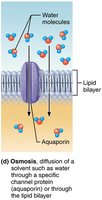
Channel-mediated: Ions and water move through protein channels (aquaporins for water).
Osmosis
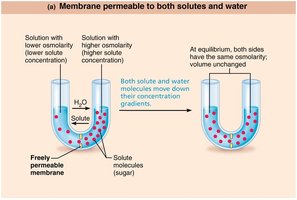
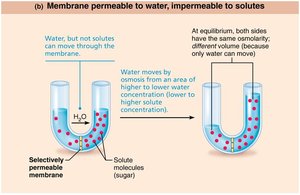
Osmosis is the movement of water across a selectively permeable membrane. Water moves from areas of low solute concentration (high water) to high solute concentration (low water) until equilibrium is reached.
Osmolarity and Tonicity
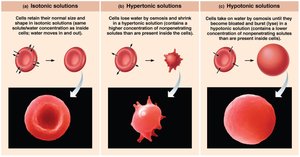
Osmolarity measures the total concentration of solute particles. Water moves to balance osmolarity across membranes. Tonicity describes a solution's ability to change cell shape by altering water volume inside the cell:
Isotonic: Same osmolarity as the cell; no net water movement.
Hypertonic: Higher osmolarity than the cell; water leaves the cell, causing it to shrink (crenation).
Hypotonic: Lower osmolarity than the cell; water enters the cell, causing it to swell and possibly burst (lysis).
Equations
Osmolarity calculation:
For example, 1 M NaCl dissociates into Na+ and Cl−, so its osmolarity is 2 Osm/L.
