 Back
Cellular Level of Organization: Structure and Function of Cells and Organelles
Study Guide - Smart Notes
 Tailored notes based on your materials, expanded with key definitions, examples, and context.
Introduction to Cells
Cell Theory and Cellular Differentiation
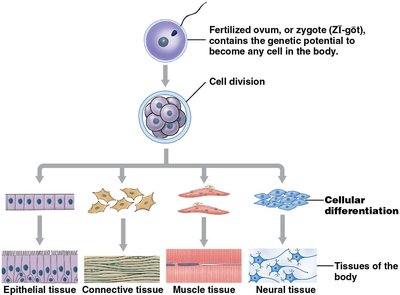
The cell theory is a foundational concept in biology, stating that all living organisms are composed of cells, cells are the basic units of structure and function in living things, and all cells arise from pre-existing cells. Cellular differentiation is the process by which a less specialized cell becomes a more specialized cell type, allowing for the formation of various tissues in the body.
Cell Theory: All living things are made of cells; cells are the basic unit of life; all cells come from pre-existing cells.
Cellular Differentiation: The process by which cells become specialized to perform specific functions.
Example: A fertilized ovum divides and differentiates into epithelial, connective, muscle, and neural tissues.
Cell Structure and Organelles
Body Fluid Distribution and Cell Components
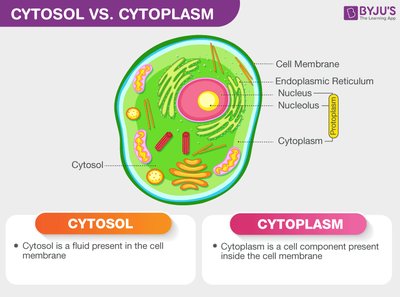
Cells are surrounded by extracellular fluid and contain intracellular fluid (cytosol). The plasma membrane separates these compartments, while the cytoplasm includes both cytosol and organelles.
Extracellular Fluid: Fluid outside the cell, including interstitial fluid.
Intracellular Fluid (Cytosol): Fluid within the cell, containing dissolved substances.
Cytoplasm: Includes cytosol and organelles.
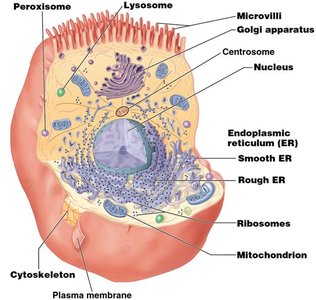
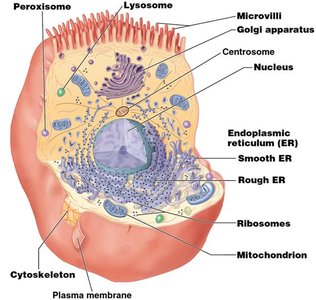
Overview of Major Organelles
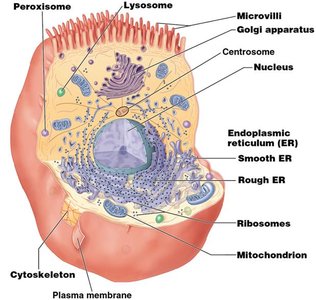
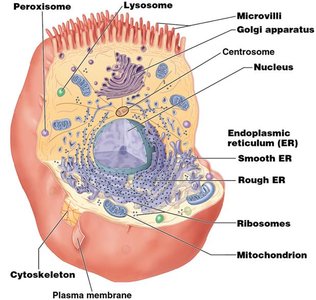
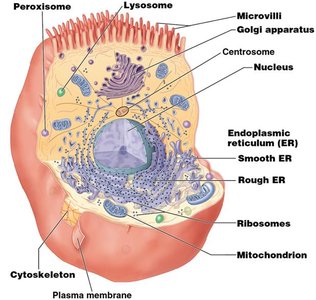
Cells contain various organelles, each with specific structures and functions essential for cellular activities.
Peroxisome: Vesicles containing enzymes that break down hydrogen peroxide and detoxify harmful substances.
Lysosome: Vesicles containing digestive enzymes for breaking down waste and cellular debris.
Microvilli: Membrane extensions that increase surface area for absorption.
Golgi Apparatus: Stacks of membranes that modify, package, and transport proteins and lipids.
Nucleus: Contains genetic material (DNA), nucleoplasm, and nucleolus; surrounded by a nuclear envelope.
Endoplasmic Reticulum (ER): Network of membranes; smooth ER synthesizes lipids, rough ER synthesizes proteins (with ribosomes attached).
Ribosomes: Sites of protein synthesis, composed of RNA and proteins.
Mitochondrion: Double-membraned organelle responsible for ATP production through cellular respiration.
Cytoskeleton: Protein filaments and tubules providing structural support and facilitating movement.
Peroxisomes
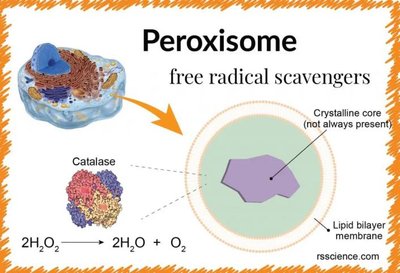
Peroxisomes are small, membrane-bound organelles that contain enzymes for breaking down fatty acids and neutralizing toxic compounds such as hydrogen peroxide.
Function: Detoxification and breakdown of hydrogen peroxide via catalase.
Equation:
Lysosomes
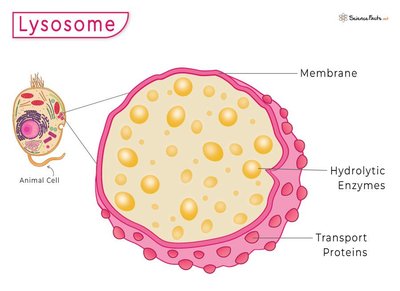
Lysosomes are vesicles filled with hydrolytic enzymes that digest macromolecules, old organelles, and pathogens.
Structure: Membrane-bound vesicle containing digestive enzymes.
Function: Intracellular digestion and recycling of cellular components.
Microvilli
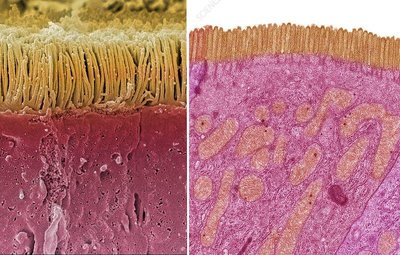
Microvilli are microscopic projections of the plasma membrane that increase the cell's surface area, enhancing absorption and secretion functions.
Structure: Membrane extensions supported by microfilaments.
Function: Increase surface area for absorption, especially in epithelial cells of the intestine.
Golgi Apparatus
The Golgi apparatus is a series of flattened membranous sacs responsible for modifying, sorting, and packaging proteins and lipids for secretion or delivery to other organelles.
Structure: Stacks of cisternae (membranous sacs).
Function: Processes and packages macromolecules synthesized by the cell.
Nucleus and Nucleolus
The nucleus is the control center of the cell, containing DNA and the nucleolus, which is involved in ribosome synthesis. The nuclear envelope surrounds the nucleus and contains nuclear pores for molecular transport.
Nucleoplasm: Fluid matrix inside the nucleus.
Nuclear Envelope: Double membrane with pores.
Nucleolus: Site of ribosomal RNA synthesis and ribosome assembly.
Endoplasmic Reticulum (ER)
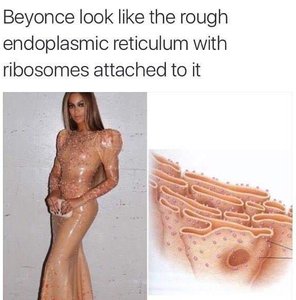
The ER is a network of membranes within the cytoplasm. The rough ER is studded with ribosomes and synthesizes proteins, while the smooth ER is involved in lipid synthesis and detoxification.
Rough ER: Protein synthesis and modification.
Smooth ER: Lipid synthesis, carbohydrate metabolism, and detoxification.
Ribosomes
Ribosomes are molecular machines composed of RNA and proteins, responsible for translating genetic information into proteins.
Structure: Two subunits (large and small) made of rRNA and proteins.
Function: Protein synthesis (translation).
Mitochondria
Mitochondria are double-membraned organelles known as the "powerhouses" of the cell, generating ATP through aerobic respiration. The inner membrane contains enzymes for the electron transport chain.
Structure: Outer and inner membranes; inner membrane forms cristae.
Function: ATP production via oxidative phosphorylation.
Equation:
Cytoskeleton
The cytoskeleton is a network of protein filaments and tubules that provides structural support, maintains cell shape, and facilitates intracellular transport and cell division.
Components: Microfilaments, intermediate filaments, microtubules, and centrosome.
Function: Structural framework, movement, and organization of organelles.
The Plasma Membrane
Structure and Function
The plasma membrane is a selectively permeable barrier that separates the cell from its environment, regulates the movement of substances, and facilitates communication and adhesion.
Phospholipid Bilayer: Two layers of amphipathic phospholipids with hydrophilic heads and hydrophobic tails.
Proteins: Integral, transmembrane, and peripheral proteins serve as receptors, carriers, and channels.
Glycocalyx: Carbohydrate-rich area on the cell surface involved in cell recognition and protection.
Cholesterol: Stabilizes membrane fluidity.
Membrane Proteins and Functions
Membrane proteins perform various functions, including transport, signal transduction, and cell recognition.
Receptor Proteins: Bind signaling molecules and initiate cellular responses.
Carrier Proteins: Transport specific substances across the membrane.
Channels: Allow passage of water and small ions.
Mitochondria: Powerhouses of the Cell
ATP Production and Cellular Respiration
Mitochondria are essential for energy production in cells. They require oxygen to produce ATP and release carbon dioxide as a byproduct. Cells with high energy demands contain numerous mitochondria.
Oxygen Requirement: Oxygen is necessary for aerobic respiration in mitochondria.
ATP Production: Most cellular ATP is generated in mitochondria.
Implication: Cells with many mitochondria (e.g., muscle cells) have high energy requirements.
Summary Table: Major Cell Organelles and Their Functions
Organelle | Structure | Function |
|---|---|---|
Peroxisome | Membrane-bound vesicle | Breakdown of hydrogen peroxide, detoxification |
Lysosome | Membrane-bound vesicle with enzymes | Digestion of macromolecules and waste |
Golgi Apparatus | Stack of membranous sacs | Modification, packaging, and transport of proteins/lipids |
Nucleus | Double membrane, nucleoplasm, nucleolus | Genetic information storage, ribosome synthesis |
Endoplasmic Reticulum | Network of membranes (smooth/rough) | Protein and lipid synthesis, detoxification |
Ribosome | RNA and protein complex | Protein synthesis |
Mitochondrion | Double membrane, cristae | ATP production |
Cytoskeleton | Protein filaments/tubules | Structural support, movement |
