 Back
Cellular Respiration and ATP Generation: Mechanisms and Pathways
Study Guide - Smart Notes
 Tailored notes based on your materials, expanded with key definitions, examples, and context.
Cellular Respiration and ATP Generation
Introduction to Cellular Respiration
Cellular respiration is the process by which cells extract energy from nutrients, primarily glucose, to produce adenosine triphosphate (ATP), the universal energy currency of the cell. The food we consume provides the energy required for biological work, which includes active processes, synthesis of structural and functional molecules, and storage as fat or glycogen for later use.
ATP (Adenosine Triphosphate): The main energy carrier in cells, produced through phosphorylation reactions.
Phosphorylation: The addition of a phosphate group to a molecule, storing energy in the bond attaching the third phosphate group to ADP to form ATP.
Fate of Glucose: Glucose can be oxidized for immediate energy, converted to glycogen or fat for storage, or used to synthesize other molecules.
Overview of Cellular Respiration
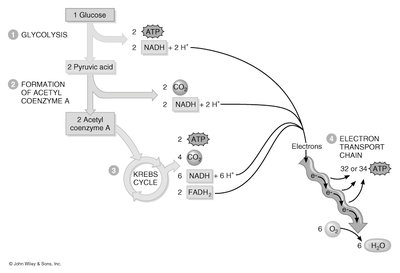
Cellular respiration consists of four main stages, each contributing to the complete oxidation of glucose and the generation of ATP. These stages occur in different cellular compartments and involve a series of enzyme-catalyzed reactions.
Glycolysis: Occurs in the cytoplasm; breaks down glucose into pyruvic acid.
Formation of Acetyl Coenzyme A: Converts pyruvic acid into acetyl CoA in the mitochondria.
Krebs Cycle (Citric Acid Cycle): Occurs in the mitochondrial matrix; oxidizes acetyl CoA to produce NADH, FADH2, and ATP.
Electron Transport Chain (ETC): Located on the inner mitochondrial membrane; uses electrons from NADH and FADH2 to generate a large amount of ATP.
Glycolysis
Process and Products of Glycolysis
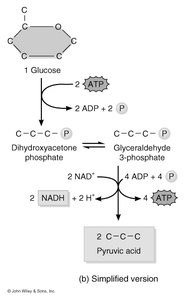
Glycolysis is the initial step in cellular respiration, involving the breakdown of one molecule of glucose (a six-carbon compound) into two molecules of pyruvic acid (each with three carbons). This process occurs in the cytosol and does not require oxygen.
Steps: Glycolysis consists of 10 enzyme-catalyzed reactions.
ATP Yield: Two ATP molecules are consumed, and four are produced, resulting in a net gain of two ATP per glucose molecule.
NADH Production: Two molecules of NAD+ are reduced to NADH, capturing high-energy electrons.
Fate of Pyruvic Acid
The fate of pyruvic acid depends on the availability of oxygen:
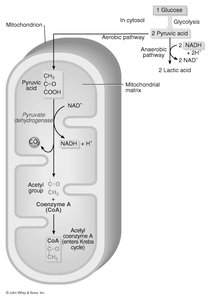
Aerobic Pathway: In the presence of oxygen, pyruvic acid is transported into the mitochondria and converted to acetyl CoA, which enters the Krebs cycle.
Anaerobic Pathway: When oxygen is scarce, pyruvic acid is reduced to lactic acid, which diffuses into the blood and is transported to the liver.
Formation of Acetyl Coenzyme A
Conversion of Pyruvic Acid
Pyruvic acid enters the mitochondria, where it is converted into acetyl CoA in a process known as the transitional step. This reaction links glycolysis to the Krebs cycle.
Decarboxylation: One carbon is removed from pyruvic acid as CO2.
Formation of Acetyl Group: The remaining two-carbon fragment is attached to coenzyme A, forming acetyl CoA.
NADH Production: One molecule of NADH is produced per pyruvic acid.
Coenzyme A: Derived from pantothenic acid (vitamin B5).
Krebs Cycle (Citric Acid Cycle)
Biochemical Pathway and Products
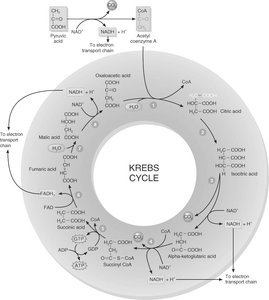
The Krebs cycle is a series of biochemical reactions that occur in the mitochondrial matrix. It completes the oxidation of glucose derivatives, generating high-energy electron carriers and ATP.
Inputs: Two molecules of acetyl CoA (from one glucose) enter the cycle per glucose molecule.
Outputs (per two acetyl CoA):
6 NADH
2 FADH2
2 ATP
4 CO2
Energy Storage: Most of the energy is temporarily stored in NADH and FADH2.
Electron Transport Chain (ETC) and Chemiosmosis
Mechanism of ATP Generation
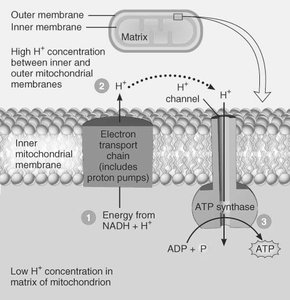
The electron transport chain is a series of protein complexes located in the inner mitochondrial membrane. Electrons from NADH and FADH2 are transferred through these complexes, releasing energy used to pump protons (H+) across the membrane, creating an electrochemical gradient.
Oxygen as Final Electron Acceptor: Molecular oxygen (O2) accepts electrons at the end of the chain, forming water (H2O).
ATP Synthase: Protons flow back into the mitochondrial matrix through ATP synthase, driving the synthesis of ATP from ADP and inorganic phosphate (Pi).
ATP Yield: The majority of ATP (32 or 34 molecules per glucose) is generated during this stage.
Summary of Aerobic Cellular Respiration
Overall Equation and ATP Yield
The complete oxidation of one molecule of glucose during aerobic respiration can be summarized by the following equation:
ATP Distribution:
2 ATP from glycolysis
2 ATP from the Krebs cycle
32 or 34 ATP from the electron transport chain
Key Point: The majority of ATP is produced during the electron transport chain, highlighting the importance of oxygen in efficient energy production.
