 Back
BackCellular Respiration: Mechanisms of Energy Production in Cells
Study Guide - Smart Notes
 Tailored notes based on your materials, expanded with key definitions, examples, and context.
Cellular Respiration
Overview of Cellular Respiration
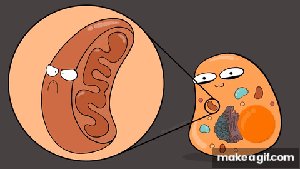
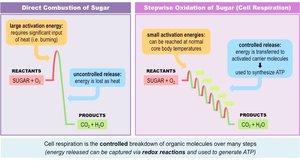
Cellular respiration is the process by which cells extract energy from glucose and other organic molecules to produce adenosine triphosphate (ATP), the main energy currency of the cell. This process primarily occurs in the mitochondria and involves a series of enzyme-catalyzed reactions that gradually release energy in a controlled manner.
General Equation:
Reactants: Glucose and oxygen
Products: Carbon dioxide, water, and energy (ATP)
Location: Mitochondria (except glycolysis, which occurs in the cytoplasm)
Main Steps of Cellular Respiration
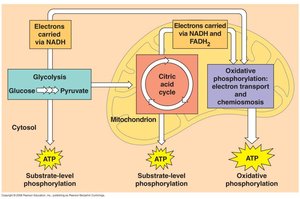
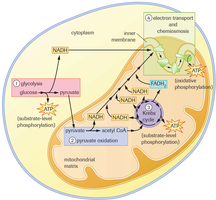
Cellular respiration consists of three main stages, each with distinct roles in energy extraction and ATP synthesis:
Glycolysis: Occurs in the cytoplasm; breaks glucose into two pyruvate molecules and produces a small amount of ATP.
Citric Acid (Krebs) Cycle: Occurs in the mitochondrial matrix; completes the breakdown of glucose, releases CO2, and loads electron carriers.
Electron Transport Chain (ETC): Occurs in the inner mitochondrial membrane; uses oxygen and produces the majority of ATP.
Key Chemical Reactions in Cellular Respiration
Redox Reactions
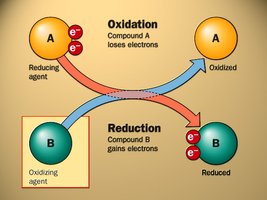
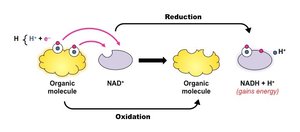
Redox (reduction-oxidation) reactions are fundamental to cellular respiration. They involve the transfer of electrons between molecules, allowing cells to capture and utilize energy efficiently.
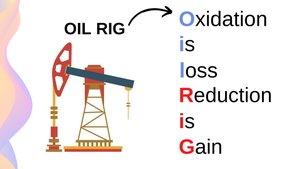
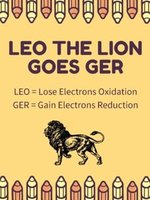
Oxidation: Loss of electrons (LEO: Lose Electrons Oxidation)
Reduction: Gain of electrons (GER: Gain Electrons Reduction)
Redox reactions are always coupled; one molecule is oxidized while another is reduced.
Isomerization
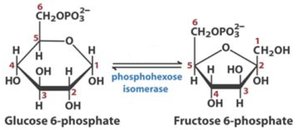
Isomerization is the rearrangement of a molecule's atoms to form a different isomer, often catalyzed by isomerase enzymes. This process is crucial in glycolysis, where glucose is converted into a form that can be split into two equal parts.
Example: Conversion of glucose-6-phosphate to fructose-6-phosphate
Decarboxylation
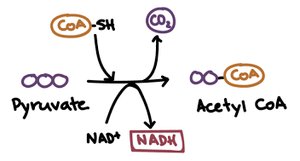
Decarboxylation is the removal of a carbon atom from a molecule in the form of carbon dioxide (CO2). This reaction is essential in the citric acid cycle and the link reaction between glycolysis and the Krebs cycle.
Example: Conversion of pyruvate to acetyl-CoA, releasing CO2
Phosphorylation and Dephosphorylation
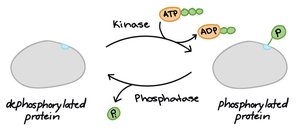
Phosphorylation is the addition of a phosphate group to a molecule, often transferring energy. Dephosphorylation is the removal of a phosphate group, releasing energy for cellular work.
Phosphorylation: Catalyzed by kinases; energizes molecules for subsequent reactions.
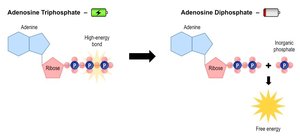
Dephosphorylation: Catalyzed by phosphatases; releases energy stored in ATP.
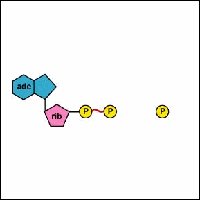
ATP Synthesis:
ATP Hydrolysis:
Adenosine Triphosphate (ATP) and Related Molecules
ATP, ADP, and AMP
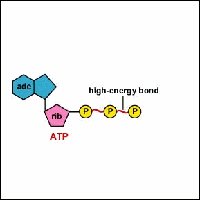
ATP (adenosine triphosphate) is the primary energy carrier in cells. It contains two high-energy phosphate bonds. ADP (adenosine diphosphate) has one high-energy bond, and AMP (adenosine monophosphate) has none and is mainly found in nucleic acids.
ATP: Two high-energy phosphate bonds; energy currency of the cell.
ADP: One high-energy phosphate bond; can be converted to ATP.
AMP: No high-energy bonds; not used for energy transfer in this context.
Types of ATP Production
ATP can be produced by two main mechanisms during cellular respiration:
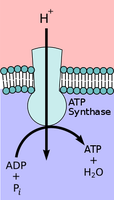
Substrate-level phosphorylation: Direct transfer of a phosphate group from a substrate to ADP, catalyzed by a kinase.
Oxidative phosphorylation: Indirect addition of phosphate to ADP using energy from electrons transferred through the electron transport chain.
Electron Carriers in Cellular Respiration
Role of Electron Carriers
During cellular respiration, energy is temporarily stored in electron carriers before being used to generate ATP. These carriers transport high-energy electrons to the electron transport chain.
NAD+ / NADH: Nicotinamide adenine dinucleotide; most common electron carrier.
FAD / FADH2: Flavin adenine dinucleotide; less common and less energetic than NADH.
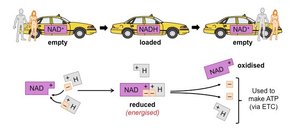
NAD+ / NADH
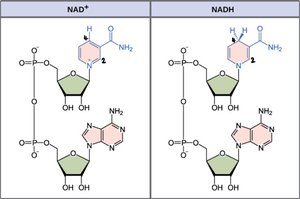
NAD+ is the oxidized form, and NADH is the reduced form. NADH carries electrons to the electron transport chain, where its energy is used to produce ATP.
Oxidized: NAD+
Reduced: NADH (sometimes written as NADH + H+)
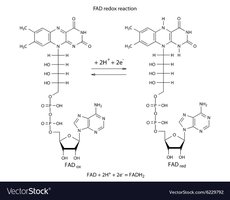
FAD / FADH2
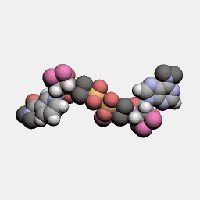
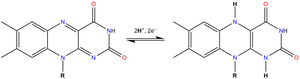
FAD is another electron carrier, less common and less energetic than NADH. It is reduced to FADH2 during the Krebs cycle and donates electrons to the electron transport chain.
Oxidized: FAD
Reduced: FADH2
Summary Table: Key Steps and Molecules in Cellular Respiration
Step | Location | Main Events | ATP Produced | Electron Carriers Loaded |
|---|---|---|---|---|
Glycolysis | Cytoplasm | Glucose split into 2 pyruvate | Small amount (2 ATP) | NADH |
Krebs Cycle | Mitochondrial matrix | CO2 released, electron carriers loaded | Small amount (2 ATP) | NADH, FADH2 |
Electron Transport Chain | Inner mitochondrial membrane | O2 used, most ATP produced | ~34 ATP | Uses NADH, FADH2 |
Summary of Cellular Respiration Steps
Glycolysis: Occurs in the cytoplasm, breaks glucose into two pyruvate molecules, produces a small amount of ATP.
Krebs Cycle: Occurs in the mitochondria, releases CO2, loads electron carriers (NADH, FADH2).
Electron Transport Chain: Occurs in the inner mitochondrial membrane, uses oxygen, produces the majority of ATP.
Additional info: Anaerobic respiration (without oxygen) will be discussed separately. The above notes focus on aerobic respiration, which is the primary pathway for energy production in most eukaryotic cells.
