 Back
Cellular Transport and Membrane Potential: Study Notes for ANP College Students
Study Guide - Smart Notes
 Tailored notes based on your materials, expanded with key definitions, examples, and context.
Cells: The Living Units
Active Membrane Transport
Active membrane transport is a fundamental process by which cells move substances across their plasma membranes against concentration gradients. This process is essential for maintaining cellular homeostasis and involves two main mechanisms: active transport and vesicular transport. Both require energy, typically in the form of ATP, to move solutes that are too large, not lipid soluble, or unable to move down their concentration gradient.
Active Transport: Utilizes carrier proteins (solute pumps) to move substances against their concentration gradient. Includes antiporters (move substances in opposite directions) and symporters (move substances in the same direction).
Vesicular Transport: Involves the movement of large particles, macromolecules, and fluids in membranous sacs called vesicles.
Types of Active Transport
Active transport is classified into two types based on the source of energy:
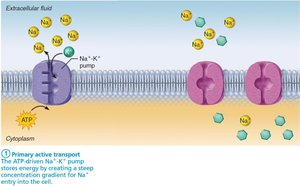
Primary Active Transport: Energy is supplied directly by ATP hydrolysis. The transport protein changes shape, allowing solutes (such as ions) to be pumped across the membrane. Examples include calcium, hydrogen (proton), and sodium-potassium (Na+-K+) pumps.
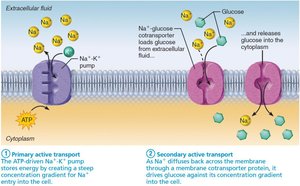
Secondary Active Transport: Energy is obtained indirectly from ionic gradients created by primary active transport. The gradient drives the transport of other solutes, often via symporters.
Sodium-Potassium Pump (Na+-K+ ATPase)
The Na+-K+ pump is a well-studied example of primary active transport. It maintains electrochemical gradients essential for muscle and nerve function by pumping Na+ out of the cell and K+ into the cell against their concentration gradients.
Leakage channels allow Na+ to enter and K+ to exit the cell down their gradients.
The pump works as an antiporter, maintaining the cell's electrochemical balance.
Secondary Active Transport
Secondary active transport relies on the concentration gradient established by primary active transport. For example, the low Na+ concentration inside the cell, maintained by the Na+-K+ pump, drives Na+ to enter the cell, often dragging other molecules (such as glucose) with it via symporters.
Commonly transports sugars, amino acids, and ions.
Vesicular Transport
Vesicular transport is the movement of large particles and fluids across membranes in vesicles. It requires ATP and includes several processes:
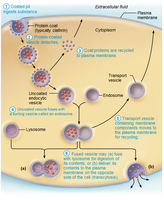
Endocytosis: Transport into the cell. Types include phagocytosis, pinocytosis, and receptor-mediated endocytosis.
Exocytosis: Transport out of the cell.
Transcytosis: Transport into, across, and out of the cell.
Vesicular trafficking: Transport within the cell.
Endocytosis
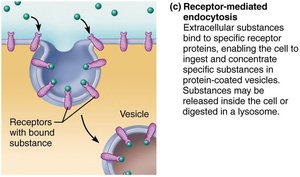
Endocytosis involves the formation of protein-coated vesicles, often requiring specific receptors. The process is highly selective, and substances must bind to their unique receptors. Once inside, vesicles may fuse with lysosomes or undergo transcytosis.
Phagocytosis
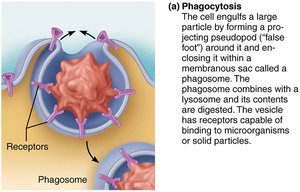
Phagocytosis, or "cell eating," is a type of endocytosis where membrane projections (pseudopods) surround solid particles, forming a phagosome. This process is used by macrophages and certain white blood cells.
Phagocytic cells move by amoeboid motion.
Pinocytosis
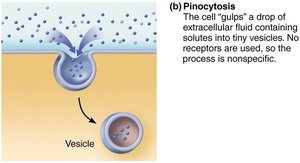
Pinocytosis, or "cell drinking," involves the infolding of the plasma membrane to bring extracellular fluid and dissolved solutes into the cell. It is nonspecific and is a main method for nutrient absorption in the small intestine.
Receptor-Mediated Endocytosis
This process allows cells to selectively take in specific molecules by internalizing receptors in clathrin-coated pits. Examples include uptake of enzymes, LDL, iron, and insulin.
Exocytosis
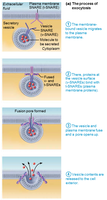
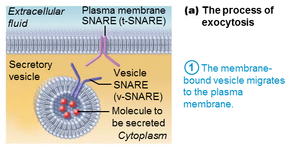
Exocytosis is the process by which cells eject materials. It is triggered by cell-surface signals or changes in membrane voltage. The substance is enclosed in a secretory vesicle, which docks with the plasma membrane via SNARE proteins, leading to the release of contents.
Substances exocytosed include hormones, neurotransmitters, mucus, and cellular wastes.
Membrane Potential
Resting Membrane Potential (RMP)
The resting membrane potential is the electrical potential energy produced by the separation of oppositely charged particles across the plasma membrane. It is measured as voltage, typically ranging from –50 to –100 mV, with the inside of the cell being more negative.
Voltage occurs only at the membrane surface; the rest of the cell and extracellular fluid are neutral.
Cells with a charge are said to be polarized.
Role of K+ in RMP
K+ diffuses out of the cell through leakage channels, making the cytoplasmic side more negative. The drive for K+ to leave is balanced by its drive to stay, establishing the RMP. Na+ can also affect RMP, but the membrane is more permeable to K+.
Most cells have an RMP around –90 mV.
Electrochemical gradient of K+ sets the RMP.
Active Transport Maintains Electrochemical Gradients
The Na+-K+ pump maintains RMP by continuously ejecting 3 Na+ out and bringing 2 K+ in. This steady state is essential for neuron and muscle cell function.
Cell-Environment Interactions
Glycocalyx and Cell Adhesion Molecules (CAMs)
Cells interact with their environment through the glycocalyx, cell adhesion molecules (CAMs), and plasma membrane receptors. CAMs are sticky glycoproteins that anchor cells, assist in movement, attract white blood cells, and transmit signals.
CAMs anchor cells to the extracellular matrix or each other.
They assist in cell movement and attract immune cells to injury sites.
They stimulate synthesis or degradation of membrane junctions.
Transmit signals for cell migration, proliferation, and specialization.
Plasma Membrane Receptors
Membrane receptor proteins serve as binding sites for chemical signals. Contact signaling allows cells to recognize each other, while chemical signaling involves ligands (neurotransmitters, hormones, paracrines) binding to receptors, causing changes in cellular activity.
Binding can trigger enzyme activation or open ion channels.
Same ligand can cause different responses in different cells.
Activated G protein–linked receptors indirectly cause cellular changes by activating G proteins, which affect ion channels, enzymes, or release second messengers like cyclic AMP or calcium.
G Proteins as Signal Relays
G proteins act as intermediaries between extracellular first messengers and intracellular second messengers, leading to cellular responses.
Type of Transport | Energy Source | Example |
|---|---|---|
Primary Active Transport | Directly from ATP | Na+-K+ pump |
Secondary Active Transport | Indirectly from ionic gradients | Na+-glucose cotransporter |
Vesicular Transport | ATP | Endocytosis, Exocytosis |
Additional info: The notes above expand on brief points from the slides, providing definitions, examples, and context for each transport mechanism and cell-environment interaction. The included images visually reinforce the explanations of active and vesicular transport processes.
