 Back
BackCentral Nervous System and Somatosensory System: Structure, Function, and Sensory Processing
Study Guide - Smart Notes
 Tailored notes based on your materials, expanded with key definitions, examples, and context.
The Central Nervous System (CNS)
Overview of the CNS
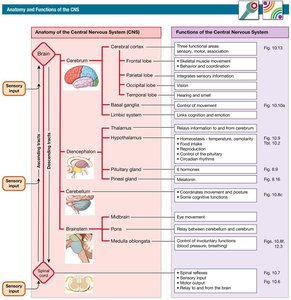
The central nervous system is the primary control center of the body, integrating sensory information and coordinating bodily functions. It consists of the brain and spinal cord, each with specialized regions responsible for distinct physiological roles.
Brain: Divided into cerebrum, diencephalon, cerebellum, and brainstem.
Spinal Cord: Conducts sensory and motor information between the body and brain.
Major Brain Regions and Their Functions
Cerebrum: Responsible for higher brain functions, including thought, voluntary movement, language, reasoning, and perception.
Diencephalon: Contains the thalamus (sensory relay) and hypothalamus (homeostasis, emotion).
Cerebellum: Coordinates movement and balance.
Brainstem: Controls basic life functions such as breathing, heart rate, and digestion.
Functional Areas of the Cerebral Cortex
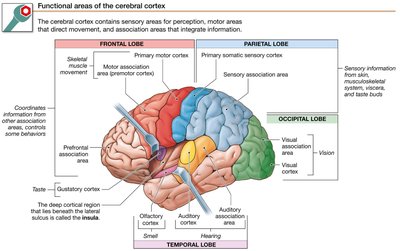
The cerebral cortex is divided into lobes, each with specialized sensory, motor, and association areas. These regions process and integrate information for perception, voluntary movement, and cognition.
Frontal Lobe: Voluntary movement, planning, reasoning, and problem-solving.
Parietal Lobe: Somatic sensation and spatial awareness.
Occipital Lobe: Visual processing.
Temporal Lobe: Auditory processing, memory, and language.
Clinical Cases: Phineas Gage
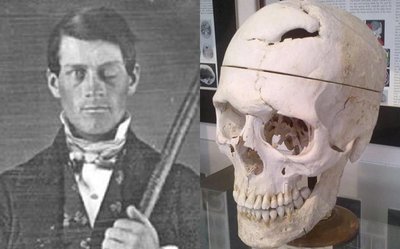
Phineas Gage is a famous case in neuroscience, illustrating the role of the frontal cortex in personality and behavior. After a traumatic brain injury, Gage exhibited profound changes in personality, highlighting the importance of the frontal lobe in executive functions and social behavior.

Language and the Brain
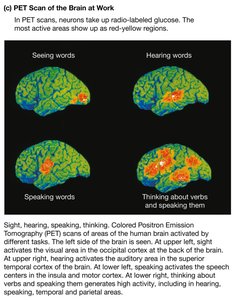
Language processing involves multiple brain regions, including Broca's area (speech production) and Wernicke's area (language comprehension). PET scans show that different language tasks activate distinct cortical areas.
Broca's Area: Located in the frontal lobe; involved in speech production.
Wernicke's Area: Located in the temporal lobe; involved in understanding language.
Cerebral Lateralization
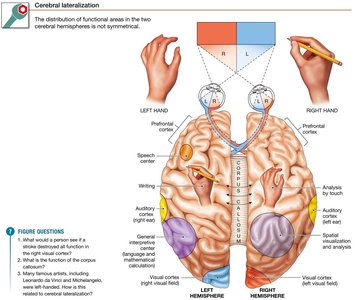
Cerebral lateralization refers to the functional differences between the left and right hemispheres of the brain. For example, language is typically processed in the left hemisphere, while spatial abilities are often localized to the right hemisphere.
Left Hemisphere: Language, logic, analytical tasks.
Right Hemisphere: Spatial abilities, face recognition, music.
The Somatosensory System
Overview of Sensory Pathways
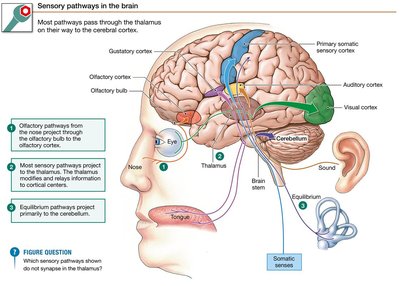
Sensory pathways transmit information from sensory receptors to the brain. Most sensory signals are relayed through the thalamus before reaching the appropriate cortical area.
Primary Sensory Cortex: Receives and processes sensory input from the body.
Thalamus: Acts as a relay station for sensory information.
Somatosensory Pathways
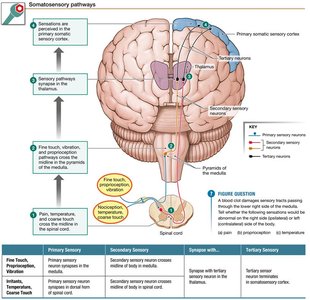
Somatosensory pathways carry information about touch, temperature, pain, and proprioception from the body to the brain. These pathways involve multiple neurons and synapses, with precise mapping to the somatosensory cortex.
Fine Touch and Proprioception: Ascend ipsilaterally and cross in the medulla.
Pain and Temperature: Cross at the level of the spinal cord.
Receptive Fields and Two-Point Discrimination
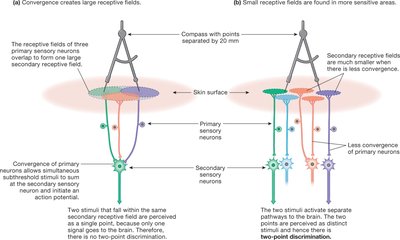
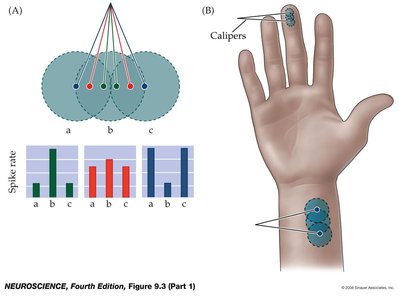
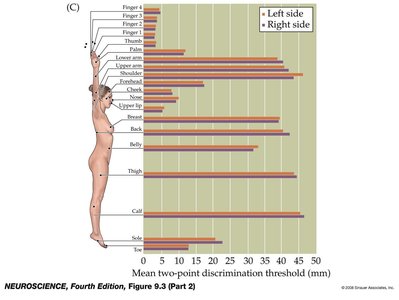
Receptive fields are areas of the body that, when stimulated, activate a particular sensory neuron. The size and density of receptive fields determine the ability to discriminate between two closely spaced stimuli (two-point discrimination).
Large Receptive Fields: Lower spatial resolution, less precise localization.
Small Receptive Fields: Higher spatial resolution, more precise localization.
Coding and Processing of Sensory Information
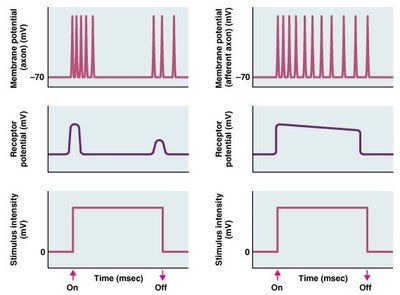
The nervous system encodes and processes sensory information based on modality, location, intensity, and duration.
Modality: Determined by which sensory neurons are activated (labeled line coding).
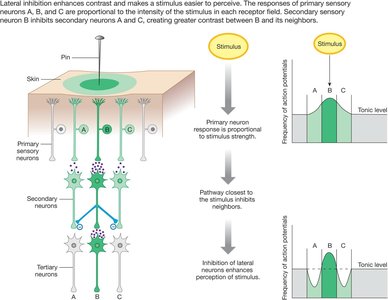
Location: Determined by the receptive field and lateral inhibition.
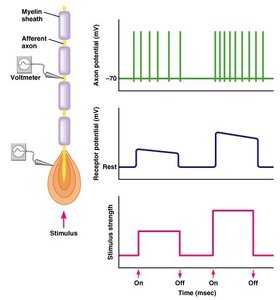
Intensity: Encoded by the number of receptors activated and the frequency of action potentials.
Duration: Encoded by the duration of action potentials; receptors may adapt (tonic vs. phasic).
The Somatosensory Cortex and Homunculus
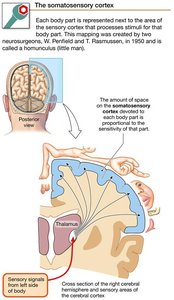
The somatosensory cortex contains a topographic map of the body, known as the sensory homunculus. The size of each body part on the map reflects the density of sensory receptors and the sensitivity of that region.

Touch Receptors and Sensory Receptors in the Skin
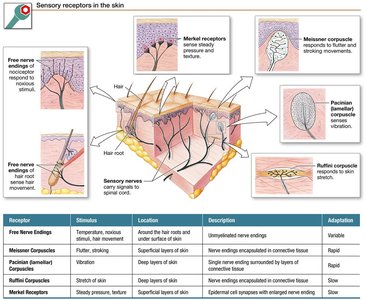
Touch receptors are specialized to detect various forms of mechanical stimuli, such as pressure, vibration, and stretch. They are distributed throughout the skin and deeper tissues.
Pacinian Corpuscles: Detect vibration and pressure.
Merkel Receptors: Detect steady pressure and texture.
Meissner's Corpuscles: Detect flutter and stroking movements.
Ruffini Corpuscles: Detect skin stretch.
Free Nerve Endings: Detect temperature, pain, and crude touch.
Somatosensory Nerve Fibers
Somatosensory nerve fibers differ in diameter, myelination, and conduction speed, which influence the type of sensation they carry.
Fiber Type | Diameter (µm) | Myelination | Conduction Speed (m/s) | Associated Sensation |
|---|---|---|---|---|
Aβ | 6–12 | Myelinated | 35–75 | Touch, pressure |
Aδ | 1–5 | Myelinated | 5–30 | Fast pain, cold, touch |
C | 0.2–1.5 | Unmyelinated | 0.5–2 | Slow pain, heat, itch |
Proprioception (Ia, II) | 13–20 | Myelinated | 80–120 | Proprioception |
Nociceptors and Pain Pathways
Nociceptors are specialized sensory neurons that detect noxious (potentially damaging) stimuli, initiating protective responses such as withdrawal reflexes and pain perception.
Fast Pain: Sharp, localized; transmitted by Aδ fibers.
Slow Pain: Dull, diffuse; transmitted by C fibers.
Itch: Mediated by C fibers, often triggered by histamine.
TRP Channels and Mechanotransduction
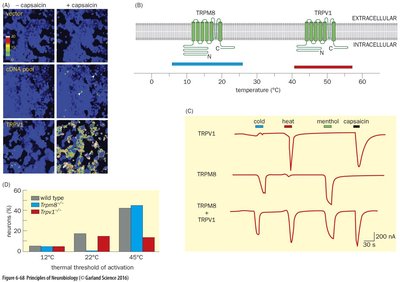
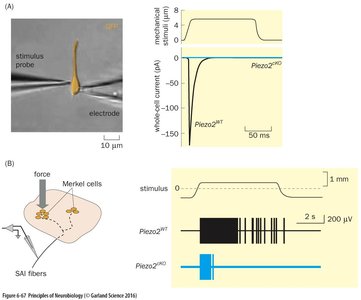
Transient receptor potential (TRP) channels are involved in sensing temperature, pain, and certain chemicals. Piezo channels are mechanotransduction receptors that detect mechanical stimuli such as touch and pressure.
TRPV1 Receptor and Capsaicin
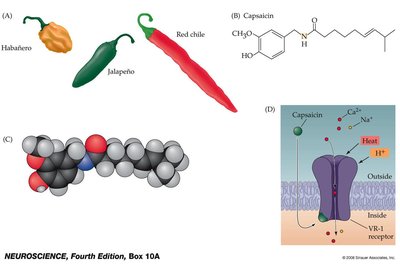
The TRPV1 receptor is activated by heat and capsaicin (the active component in chili peppers), linking the sensation of heat and pain. This receptor is a key target in pain research and pharmacology.
Summary Table: Sensory Receptors in the Skin
Receptor | Stimulus | Location | Description | Adaptation |
|---|---|---|---|---|
Free Nerve Endings | Temperature, noxious stimuli, hair movement | Around hair roots, under skin surface | Unmyelinated nerve endings | Variable |
Meissner Corpuscles | Flutter, stroking | Superficial layers of skin | Nerve ending encapsulated in connective tissue | Rapid |
Pacinian Corpuscles | Vibration | Deep layers of skin | Nerve ending encapsulated in layers of connective tissue | Rapid |
Ruffini Corpuscles | Stretch of skin | Deep layers of skin | Enlarged nerve endings | Slow |
Merkel Receptors | Steady pressure, texture | Superficial layers of skin | Epidermal cell synapsing with enlarged ending | Slow |
Key Concepts and Applications
Clinical Relevance: Understanding the CNS and somatosensory system is crucial for diagnosing and treating neurological disorders, pain syndromes, and sensory deficits.
Research Applications: Advances in sensory physiology have led to the discovery of novel receptors (e.g., TRP, Piezo) and therapeutic targets for pain and sensory dysfunction.
Additional info: The Nobel Prize in Physiology or Medicine 2021 was awarded for the discovery of receptors for temperature and touch, highlighting the importance of these sensory systems in human physiology.
