 Back
BackCentral Nervous System: Structure, Development, and Functional Organization
Study Guide - Smart Notes
 Tailored notes based on your materials, expanded with key definitions, examples, and context.
Central Nervous System Overview
Definition and Components
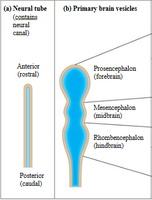
The central nervous system (CNS) is composed of the brain and spinal cord. It is responsible for integrating sensory information and coordinating bodily functions. Embryologically, the CNS develops from a structure called the neural tube.
Rostral: Toward the forehead (upper)
Caudal: Toward the spinal cord (lower)
Embryonic Development of the Brain
Neural Tube and Brain Vesicles
The brain and spinal cord originate from the neural tube. As development proceeds, the neural tube forms three primary brain vesicles:
Prosencephalon (forebrain)
Mesencephalon (midbrain)
Rhombencephalon (hindbrain)
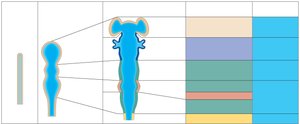
These vesicles further differentiate into secondary brain vesicles and eventually into the major adult brain structures:
Telencephalon → Cerebrum (cerebral hemispheres)
Diencephalon → Thalamus, hypothalamus, epithalamus, retina
Mesencephalon → Midbrain
Metencephalon → Pons and cerebellum
Myelencephalon → Medulla oblongata
Brain Regions and Organization
Major Brain Regions
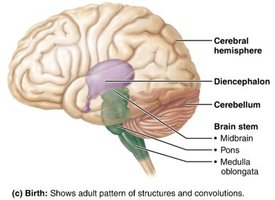
The adult brain is organized into four main regions:
Cerebral hemispheres
Diencephalon
Brain stem (midbrain, pons, medulla oblongata)
Cerebellum
Brainstem Structure
The brainstem consists of three main parts, often referred to as "bumps":
Midbrain
Pons (largest bump)
Medulla oblongata
The brainstem transitions into the spinal cord as it passes through the foramen magnum.
Gray Matter and White Matter in the CNS
Distribution Patterns
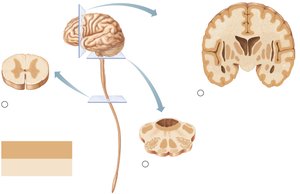
The CNS exhibits a characteristic pattern of gray matter (neuron cell bodies, nonmyelinated neurons) and white matter (myelinated and nonmyelinated axons):
In the spinal cord: Central cavity surrounded by gray matter, with white matter external to gray matter.
In the brainstem: Additional gray matter nuclei are scattered within white matter.
In the cerebrum and cerebellum: An outer cortex of gray matter is present, with islands of gray matter (nuclei) within white matter.
Cerebral Hemispheres
Surface Features and Lobes
The cerebral hemispheres form the superior part of the brain and account for about 83% of its mass. Key surface features include:
Gyri: Ridges or folds
Sulci: Shallow grooves
Fissures: Deep grooves
The hemispheres are divided into five lobes by various sulci:
Frontal lobe
Parietal lobe
Temporal lobe
Occipital lobe
Insula (not visible on the surface)
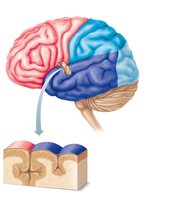
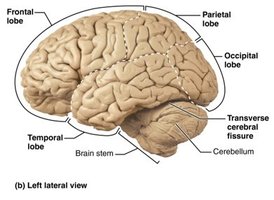
Major Fissures
Longitudinal fissure: Separates the left and right hemispheres
Transverse cerebral fissure: Separates the cerebrum from the cerebellum
Ventricles of the Brain
Structure and Function
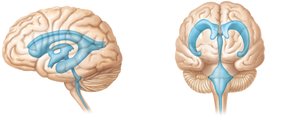
Ventricles are fluid-filled chambers within the brain that are continuous with each other and the central canal of the spinal cord. They are filled with cerebrospinal fluid (CSF) and lined by ependymal cells.
Paired lateral ventricles (deep in each hemisphere)
Third ventricle (in the diencephalon)
Fourth ventricle (in the hindbrain, continuous with the central canal)
Ventricles are connected by the interventricular foramen and cerebral aqueduct.
Cerebral Cortex
Functional Areas
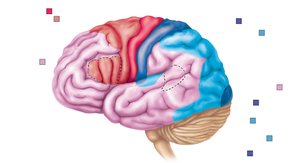
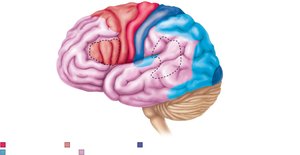
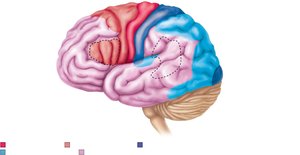
The cerebral cortex is the site of conscious mind functions, including awareness, sensory perception, voluntary motor initiation, communication, memory storage, and understanding. It contains three main types of functional areas:
Motor areas: Control voluntary movements (located in the frontal lobe)
Sensory areas: Conscious awareness of sensation (parietal, temporal, occipital lobes)
Association areas: Integrate diverse information
Motor Areas
Primary (somatic) motor cortex: Located in the precentral gyrus; initiates voluntary movement of skeletal muscle
Premotor cortex: Plans movements, controls learned and patterned motor skills
Broca’s area: Motor speech area, usually in the left hemisphere
Frontal eye field: Controls voluntary eye movements
Sensory Areas
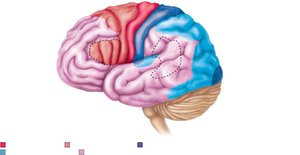
Primary somatosensory cortex: Located in the postcentral gyrus; receives sensory information from skin, muscles, and joints
Somatosensory association cortex: Integrates sensory input for understanding
Primary visual cortex: Receives visual information from the retinas (occipital lobe)
Visual association area: Interprets visual stimuli
Primary auditory cortex: Interprets information from the inner ear (temporal lobe)
Auditory association area: Stores memories of sounds and permits perception of sound stimulus
Lateralization of Cortical Functioning
Lateralization refers to the division of labor between the two hemispheres. The left hemisphere typically controls language, math, and logic, while the right hemisphere is associated with visual-spatial skills, intuition, emotion, and artistic abilities. Most people have left hemisphere dominance, which usually results in right-handedness.
Cerebral White Matter
Fiber Tracts
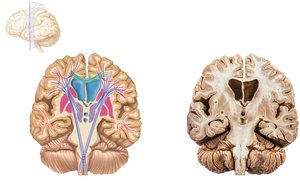
Cerebral white matter is responsible for communication within the brain and between the brain and spinal cord. It consists of myelinated fibers organized into three types:
Association fibers: Connect different parts of the same hemisphere
Commissural fibers: Connect gray matter of the two hemispheres (e.g., corpus callosum)
Projection fibers: Connect the cerebral cortex with lower brain regions or the spinal cord
Somatotopy and Body Maps
Homunculus Representation
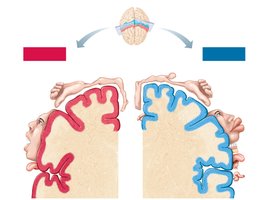
The primary motor cortex and primary somatosensory cortex contain spatial maps of the body, known as homunculi. These maps reflect the amount of cortex devoted to motor or sensory functions of different body regions.
Areas with fine motor control (e.g., hands, face) have larger cortical representation.
Areas with greater sensory input (e.g., lips, fingertips) are similarly enlarged in the sensory cortex.
Ascending and Descending Pathways
Major Spinal Tracts
Spinal tracts are organized into multi-neuron pathways with four key features:
Decussation: Most pathways cross from one side of the CNS to the other
Relay: Consist of chains of two or three neurons
Somatotopy: Spatial correspondence between CNS regions and body regions
Symmetry: Pathways are paired on both sides of the CNS
Ascending Pathways
Dorsal column–medial lemniscal pathways: Discriminative touch and vibration
Spinothalamic pathways: Pain, temperature, coarse touch, and pressure
Spinocerebellar tracts: Muscle or tendon stretch to the cerebellum for coordination
Meninges of the CNS
Protective Membranes
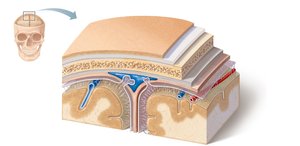
The meninges are three connective tissue membranes that surround the brain and spinal cord:
Dura mater: Strongest, outermost layer; forms dural septa to limit brain movement
Arachnoid mater: Middle layer with web-like extensions; contains CSF and blood vessels
Pia mater: Delicate, innermost layer; clings tightly to the brain surface
Spinal Cord Structure
Organization and Function
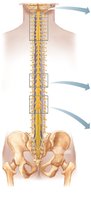
The spinal cord is enclosed within the vertebral column and begins at the foramen magnum. It provides two-way communication between the brain and body and mediates spinal reflexes.
Key anatomical features:
Cervical and lumbar enlargements: Regions where nerves serving the limbs arise
Conus medullaris: Tapered end of the spinal cord
Cauda equina: Collection of nerve roots at the inferior end
Filum terminale: Fibrous extension anchoring the spinal cord
