 Back
BackCentral Nervous System: Structure, Function, and Development
Study Guide - Smart Notes
 Tailored notes based on your materials, expanded with key definitions, examples, and context.
The Central Nervous System (CNS)
Overview of the CNS
The central nervous system (CNS) is composed of the brain and spinal cord. It is responsible for integrating sensory information and responding accordingly. The CNS is the site of higher functions such as thought, memory, emotion, and voluntary movement.
Cephalization: Evolutionary development of the anterior CNS, resulting in increased neuron numbers and complexity, especially in humans.
Main divisions: Brain and spinal cord.
Brain Development
Embryological Origins
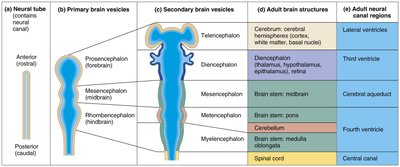
The brain and spinal cord originate from the neural tube during embryonic development. The anterior end of the neural tube expands and forms three primary brain vesicles, which further differentiate into five secondary vesicles, giving rise to the major brain regions.
Primary brain vesicles: Prosencephalon (forebrain), Mesencephalon (midbrain), Rhombencephalon (hindbrain).
Secondary brain vesicles: Telencephalon, Diencephalon, Mesencephalon, Metencephalon, Myelencephalon.
Adult brain structures: Cerebrum, diencephalon (thalamus, hypothalamus, epithalamus), brain stem (midbrain, pons, medulla oblongata), cerebellum.
Ventricles: The central cavity of the neural tube becomes the brain's ventricles, filled with cerebrospinal fluid (CSF).
Pattern of Gray and White Matter
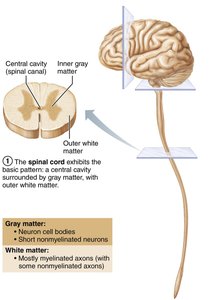
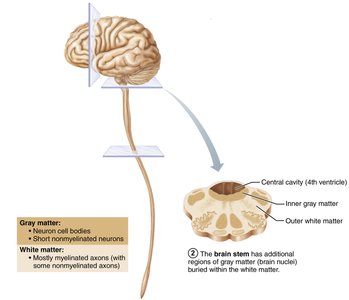
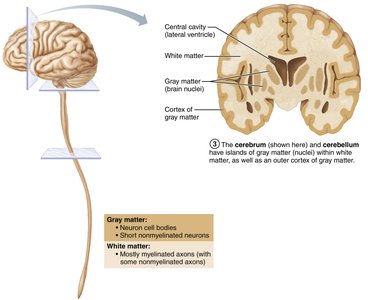
The CNS exhibits a basic pattern: a central cavity surrounded by gray matter, with white matter external to gray matter. This pattern changes as one ascends from the spinal cord to the brain stem and into the cerebrum and cerebellum.
Gray matter: Contains neuron cell bodies and nonmyelinated neurons.
White matter: Contains myelinated and nonmyelinated axons.
Cortex: The cerebrum and cerebellum have an outer layer of gray matter called the cortex.
Ventricles of the Brain
Structure and Function
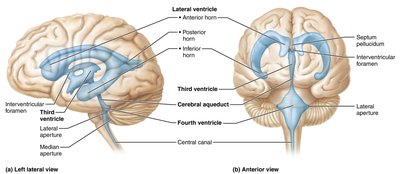
The brain contains four ventricles, which are interconnected, fluid-filled cavities lined by ependymal cells. They are filled with cerebrospinal fluid (CSF) and are continuous with the central canal of the spinal cord.
Lateral ventricles: Paired, C-shaped chambers in each hemisphere, separated by the septum pellucidum.
Third ventricle: Located in the diencephalon, connected to lateral ventricles via interventricular foramen.
Fourth ventricle: Located in the hindbrain, connected to the third ventricle via the cerebral aqueduct; continuous with the central canal of the spinal cord.
Openings: Lateral and median apertures connect the fourth ventricle to the subarachnoid space.
Cerebral Hemispheres
Surface Features and Lobes
The cerebral hemispheres form the superior part of the brain and account for about 83% of its mass. The surface is marked by gyri (ridges), sulci (shallow grooves), and fissures (deep grooves).
Major fissures: Longitudinal fissure (separates hemispheres), transverse cerebral fissure (separates cerebrum and cerebellum).
Lobes: Frontal, parietal, temporal, occipital, and insula (buried under other lobes).
Major sulci: Central sulcus (separates frontal and parietal lobes), parieto-occipital sulcus, lateral sulcus.
Regions: Cerebral cortex (gray matter), internal white matter, basal nuclei (deep gray matter).





Cerebral Cortex
Functional Areas
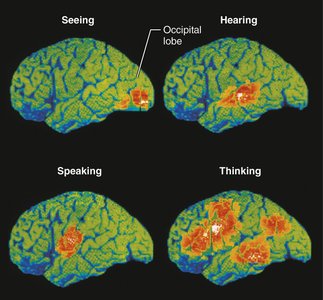
The cerebral cortex is the site of the conscious mind, responsible for awareness, sensory perception, voluntary motor initiation, communication, memory storage, and understanding. It is a thin layer (2–4 mm) of gray matter, making up 40% of brain mass.
Motor areas: Control voluntary movement (located in the frontal lobe).
Sensory areas: Conscious awareness of sensation (parietal, insular, temporal, occipital lobes).
Association areas: Integrate diverse information.
Contralateral control: Each hemisphere controls the opposite side of the body.
Lateralization: Specialization of function in one hemisphere.
Motor and Sensory Maps
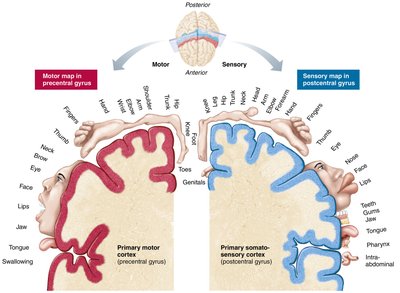
Specific regions of the cortex correspond to control of specific body parts, represented as homunculi (body maps) in the precentral (motor) and postcentral (sensory) gyri.
Cerebral White Matter and Basal Nuclei
Cerebral White Matter
White matter consists of myelinated fibers responsible for communication within the brain and between the brain and spinal cord. Fibers are classified as:
Association fibers: Connect different parts of the same hemisphere.
Commissural fibers: Connect gray matter of the two hemispheres.
Projection fibers: Connect the hemispheres with lower brain or spinal cord.
Basal Nuclei
Basal nuclei (ganglia) are deep gray matter structures involved in regulating movement, cognition, and emotion. They include the caudate nucleus, putamen, and globus pallidus. Disorders include Parkinson's and Huntington's diseases.
Diencephalon
Major Structures
The diencephalon consists of the thalamus, hypothalamus, and epithalamus, which enclose the third ventricle.
Thalamus: Relay station for sensory and motor signals to the cerebral cortex.
Hypothalamus: Main visceral control center, regulating homeostasis (autonomic nervous system, emotions, body temperature, hunger, thirst, sleep-wake cycles, endocrine function).
Epithalamus: Contains the pineal gland, which secretes melatonin to regulate sleep-wake cycles.
Brain Stem
Regions and Functions
The brain stem consists of the midbrain, pons, and medulla oblongata. It controls automatic behaviors necessary for survival and connects higher and lower neural centers.
Midbrain: Contains visual and auditory reflex centers, cranial nerve nuclei, and motor pathways.
Pons: Relays information between cerebrum and cerebellum, helps regulate breathing.
Medulla oblongata: Autonomic reflex center (cardiovascular, respiratory, vomiting, swallowing, etc.).
Cerebellum
Structure and Function
The cerebellum coordinates voluntary movements, balance, and posture. It processes input from the cerebral cortex, brain stem, and sensory receptors to fine-tune motor activity.
Arbor vitae: Distinctive tree-like pattern of white matter.
Peduncles: Fiber tracts connecting the cerebellum to the brain stem.
Functional Brain Systems
Limbic System and Reticular Formation
Limbic system: Mediates emotional responses and memory processing.
Reticular formation: Maintains cerebral cortical alertness (reticular activating system), filters stimuli, and regulates skeletal and visceral muscle activity.
Protection of the Brain
Meninges
The meninges are three connective tissue membranes that cover and protect the CNS, contain CSF, and form partitions in the skull.
Dura mater: Strongest, outermost layer; forms dural septa and venous sinuses.
Arachnoid mater: Middle layer with web-like extensions; contains CSF and blood vessels.
Pia mater: Delicate, innermost layer; clings tightly to the brain.
Cerebrospinal Fluid (CSF)
CSF is a clear fluid that cushions the brain, provides buoyancy, removes waste, and nourishes neural tissue. It is produced by the choroid plexus and circulates through the ventricles and subarachnoid space.
Blood Brain Barrier
The blood brain barrier protects the brain from harmful substances in the blood while allowing essential nutrients to pass through. It is formed by tight junctions between endothelial cells and is supported by astrocytes.
Spinal Cord
Structure and Function
The spinal cord provides two-way communication between the brain and body and serves as a major reflex center. It is protected by bone, meninges, and CSF.
Gross anatomy: Begins at the foramen magnum and ends at L1 or L2 vertebra.
Spinal nerves: 31 pairs attach to the cord by paired roots.
Cauda equina: Collection of nerve roots at the inferior end of the vertebral canal.
Cross-Sectional Anatomy
Gray matter: Butterfly-shaped core; contains dorsal (sensory), ventral (motor), and lateral (autonomic) horns.
White matter: Surrounds gray matter; contains ascending (sensory), descending (motor), and transverse (commissural) tracts.
Neuronal Pathways
Ascending (Sensory) Pathways
Dorsal column–medial lemniscal pathways: Discriminative touch and proprioception.
Spinothalamic pathways: Pain, temperature, coarse touch, and pressure.
Spinocerebellar tracts: Proprioceptive information to the cerebellum.
Descending (Motor) Pathways
Direct (pyramidal) pathways: Fast and fine (skilled) movements.
Indirect pathways: Regulate balance, posture, and coarse limb movements.
Clinical Considerations
Brain injuries: Concussion, contusion, hemorrhage, cerebral edema.
Cerebrovascular accidents (strokes): Ischemia, hemiplegia, TIA, treatment with tPA.
Degenerative disorders: Alzheimer's disease, Parkinson's disease, Huntington's disease.
Spinal cord trauma: Paresthesias, paralysis, transection, poliomyelitis, ALS.
Developmental Aspects
Neural tube formation: CNS develops from the neural tube in the embryo.
Neural crest cells: Form dorsal root ganglia and other structures.
Disorders: Cerebral palsy, anencephaly, spina bifida (linked to folic acid deficiency).
