 Back
Chapter 1: An Introduction to Anatomy and Physiology – Structured Study Notes
Study Guide - Smart Notes
 Tailored notes based on your materials, expanded with key definitions, examples, and context.
Introduction to Anatomy & Physiology
Overview of Anatomy and Physiology
Anatomy and physiology are foundational sciences in understanding the structure and function of the human body. Anatomy focuses on the physical structures, while physiology explores how these structures operate individually and together.
Anatomy: Describes the structures of the body, including what they are made of, their location, and associated structures.
Physiology: Studies the functions of anatomical structures, both individually and cooperatively.
Relationship: Anatomy and physiology are interdependent; structure determines function, and function influences structure.
Specialties: Each discipline has various specialties, such as gross anatomy, microscopic anatomy, cell physiology, and pathological physiology.
Clinical Application: Physicians use the scientific method to diagnose by evaluating signs (objective indicators like fever) and symptoms (subjective feelings like tiredness).

Levels of Organization in the Human Body
Hierarchical Structure of Life
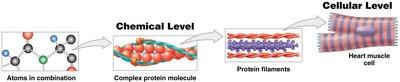
The human body is organized into several levels, from the simplest chemical components to the complex organism. Each level builds upon the previous, contributing to overall function and health.
Chemical Level: Atoms and molecules form the basis of all matter.
Cellular Level: Cells are the smallest living units, composed of molecules.
Tissue Level: Groups of similar cells working together to perform specific functions.
Organ Level: Organs consist of two or more tissues working together.
Organ System Level: Organ systems are groups of organs that interact to perform complex functions. Humans have 11 organ systems.
Organism Level: The complete living individual.
The Organ Systems of the Human Body
Major Organ Systems and Their Functions
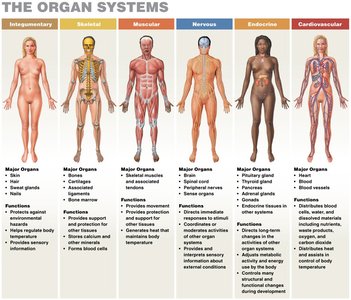
The human body contains 11 major organ systems, each with specific organs and functions essential for survival and health.
Integumentary System: Skin, hair, sweat glands, nails. Protects against environmental hazards, regulates temperature, provides sensory information.
Skeletal System: Bones, cartilages, ligaments, bone marrow. Provides support, protection, stores minerals, forms blood cells.
Muscular System: Skeletal muscles, tendons. Enables movement, provides support, generates heat.
Nervous System: Brain, spinal cord, nerves, sense organs. Directs responses to stimuli, coordinates other systems, interprets sensory information.
Endocrine System: Glands (pituitary, thyroid, adrenal), pancreas, gonads. Directs long-term changes, adjusts metabolism, controls development.
Cardiovascular System: Heart, blood, blood vessels. Distributes blood, nutrients, waste, oxygen, carbon dioxide, heat.
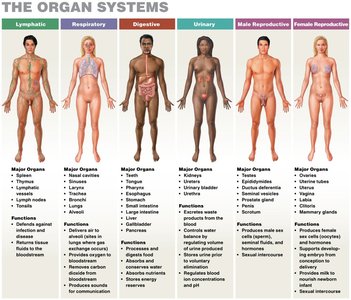
Lymphatic System: Spleen, thymus, lymphatic vessels, nodes, tonsils. Defends against infection, returns fluids to bloodstream.
Respiratory System: Nasal cavities, sinuses, larynx, trachea, bronchi, lungs, alveoli. Delivers air, provides oxygen, removes carbon dioxide, produces sounds.
Digestive System: Teeth, tongue, pharynx, esophagus, stomach, intestines, liver, gallbladder, pancreas. Processes food, absorbs water and nutrients, stores energy.
Urinary System: Kidneys, ureters, bladder, urethra. Excretes waste, regulates water and ions, stores urine.
Male Reproductive System: Testes, ducts, glands, penis, scrotum. Produces sperm, fluids, hormones, enables intercourse.
Female Reproductive System: Ovaries, tubes, uterus, vagina, labia, clitoris, mammary glands. Produces oocytes, hormones, supports embryo, provides milk, enables intercourse.

Medical and Anatomical Terminology
Origins and Usage of Medical Terms
Medical terminology provides precise language for describing the body in health and disease. Most commemorative names (eponyms) have been replaced by standardized terms, such as those in Terminologia Anatomica.
Surface Anatomy: Locating structures on or near the body surface.
Anatomical Landmarks: Standard positions include anatomical position (standing, palms forward), supine (lying face up), and prone (lying face down).
Directional References and Sectional Planes
Directional terms and sectional planes are used to describe locations and divisions within the body, aiding in anatomical study and medical imaging.
Directional Terms: Superior, inferior, anterior, posterior, medial, lateral, proximal, distal.
Sectional Anatomy: Slices through the body to visualize internal structures, important in MRI, PET, and CT scans.
Sectional Planes:
Frontal (Coronal) Plane: Divides body into anterior and posterior portions.
Sagittal Plane: Divides body into left and right portions; midsagittal is exactly in the middle, parasagittal is offset.
Transverse Plane: Divides body into superior and inferior portions (cross section).


Homeostasis
Concept and Regulation of Homeostasis
Homeostasis is the process by which the body maintains a stable internal environment, despite external and internal changes. It is essential for health and survival.
Homeostatic Regulation: Includes autoregulation (automatic response in a cell, tissue, or organ) and extrinsic regulation (controlled by nervous and endocrine systems).
Regulatory Mechanism: Involves a receptor (detects stimulus), control center (processes information), and effector (carries out instructions).
Set Point: The desired value for a physiological variable.

Negative and Positive Feedback
Feedback Mechanisms in Homeostasis
Feedback mechanisms are crucial for maintaining homeostasis. Negative feedback restores balance, while positive feedback amplifies changes to complete specific processes.
Negative Feedback: The effector's response negates the original stimulus, returning the body to homeostasis. Example: regulation of body temperature.
Positive Feedback: The response amplifies the original change, moving the body away from homeostasis to quickly complete a process. Example: blood clotting.
Systems Integration: All physiological systems work together to maintain dynamic equilibrium; failure leads to disease.


Summary Table: The Organ Systems
Comparison of Major Organ Systems
The following tables summarize the major organs and functions of each organ system.
Organ System | Major Organs | Functions |
|---|---|---|
Integumentary | Skin, hair, sweat glands, nails | Protection, temperature regulation, sensory information |
Skeletal | Bones, cartilages, ligaments, bone marrow | Support, protection, mineral storage, blood cell formation |
Muscular | Skeletal muscles, tendons | Movement, support, heat generation |
Nervous | Brain, spinal cord, nerves, sense organs | Immediate responses, coordination, sensory interpretation |
Endocrine | Pituitary, thyroid, adrenal glands, pancreas, gonads | Long-term changes, metabolism, development |
Cardiovascular | Heart, blood, blood vessels | Distribution of blood, nutrients, waste, heat |
Organ System | Major Organs | Functions |
|---|---|---|
Lymphatic | Spleen, thymus, lymphatic vessels, nodes, tonsils | Defense, fluid return |
Respiratory | Nasal cavities, sinuses, larynx, trachea, bronchi, lungs, alveoli | Air delivery, gas exchange, sound production |
Digestive | Teeth, tongue, pharynx, esophagus, stomach, intestines, liver, gallbladder, pancreas | Food processing, water and nutrient absorption, energy storage |
Urinary | Kidneys, ureters, bladder, urethra | Waste excretion, water and ion regulation, urine storage |
Male Reproductive | Testes, ducts, glands, penis, scrotum | Sperm production, fluids, hormones, intercourse |
Female Reproductive | Ovaries, tubes, uterus, vagina, labia, clitoris, mammary glands | Oocyte production, hormones, embryo support, milk, intercourse |
Key Equations and Concepts
Scientific Method in Diagnosis
Physicians use the scientific method to reach a diagnosis:
Form a hypothesis
Test the hypothesis by collecting and analyzing data
Homeostatic Regulatory Mechanism
The homeostatic regulatory mechanism can be summarized as:
Receptor → Control Center → Effector
Limits fluctuations of internal conditions to keep them close to a set point.
Feedback Mechanisms
Negative feedback equation:
Positive feedback equation:
Summary
This chapter provides a foundational overview of anatomy and physiology, levels of organization, organ systems, medical terminology, anatomical directions, and the principles of homeostasis and feedback mechanisms. Mastery of these concepts is essential for further study in human biology and health sciences.
