 Back
Chapter 1: An Introduction to Anatomy & Physiology – Study Notes
Study Guide - Smart Notes
 Tailored notes based on your materials, expanded with key definitions, examples, and context.
Section 1: Introduction to Anatomy & Physiology
Overview of Anatomy and Physiology
Anatomy and physiology are foundational sciences in understanding the structure and function of the human body. Anatomy focuses on the physical structures, while physiology explores how these structures operate to sustain life.
Anatomy: The study of body structures and their physical relationships.
Physiology: The study of how body parts function and carry out life-sustaining activities.
Example: Studying the heart's chambers (anatomy) and understanding how they pump blood (physiology).
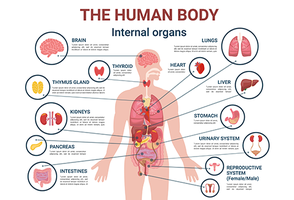
Section 2: Characteristics of Life
Common Characteristics and Processes in Living Organisms
All living things share several essential characteristics that distinguish them from non-living matter.
Cellular Composition: All organisms are composed of one or more cells.
Complex Structural Arrangement: Living things have organized structures at multiple levels.
Responsiveness: Ability to detect and respond to stimuli from the environment.
Homeostasis: Maintenance of a stable internal environment.
Growth and Development: Increase in size and progression through life stages.
Reproduction: Production of offspring to continue the species.
Metabolism: All chemical reactions in the body, including:
Anabolism: Building up complex molecules from simpler ones.
Catabolism: Breaking down complex molecules into simpler ones.
Section 3: Levels of Organization
Hierarchical Organization in the Human Body
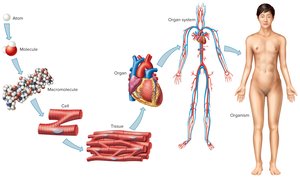
The human body is organized into a hierarchy of structural levels, each building upon the previous one.
Subatomic Particles → Atoms → Molecules → Macromolecules → Organelles → Cells → Tissues → Organs → Organ Systems → Organism
Example: Muscle tissue is made of muscle cells, which contain organelles, which are composed of macromolecules, and so on.
Cells: The Smallest Units of Life
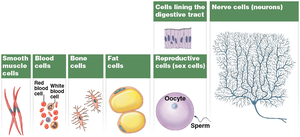
Cells are the basic structural and functional units of life. Their structure is closely related to their function.
Smooth muscle cells: Contract to produce movement.
Red blood cells: Transport oxygen.
Bone cells: Maintain bone structure.
Fat cells: Store energy.
Cells lining digestive tract: Absorb nutrients.
Reproductive cells: Involved in sexual reproduction.
Nerve cells: Transmit electrical impulses.
Organ Systems of the Human Body
The human body contains 11 major organ systems, each with specific functions and organs. These systems interact to maintain homeostasis and overall health.
Organ System | Main Functions |
|---|---|
Integumentary | Protection, temperature regulation, sensation |
Skeletal | Support, movement, protection, blood cell production |
Muscular | Movement, posture, heat production |
Nervous | Control, coordination, response to stimuli |
Endocrine | Hormone production, regulation of metabolism |
Cardiovascular | Transport of nutrients, gases, wastes |
Lymphatic | Immunity, fluid balance |
Respiratory | Gas exchange (O2 and CO2) |
Digestive | Breakdown and absorption of nutrients |
Urinary | Waste elimination, water balance |
Reproductive | Production of offspring |
Section 4: Homeostasis
Homeostatic Regulation
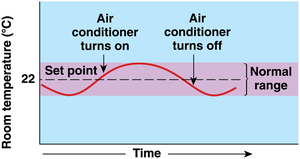
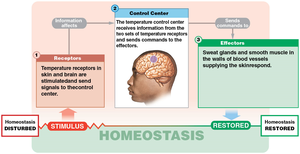
Homeostasis is the maintenance of a stable internal environment despite external changes. The body uses homeostatic regulation to preserve optimal conditions for survival.
Receptor (sensor): Detects changes in the environment.
Control Center (integration center): Processes information and determines response.
Effector: Carries out the response to restore balance.
Negative Feedback
Negative feedback is the most common mechanism for maintaining homeostasis. It works by reversing a change to keep a variable within a normal range.
Example: Body temperature regulation—if temperature rises, mechanisms lower it; if it falls, mechanisms raise it.
Positive Feedback
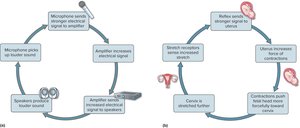
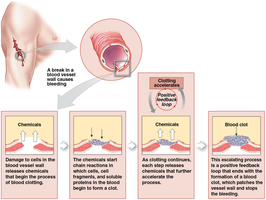
Positive feedback amplifies a change instead of reversing it. It is less common but important in processes like blood clotting and childbirth.
Example: During labor, contractions intensify until delivery.
Section 5: Anatomical Terms and Body Organization
History and Use of Anatomical Terms
Anatomical terminology is based on Latin and Greek roots, providing a universal language for describing body structures and locations. Landmarks and orientation terms help map the body for study and communication.
Superficial and Regional Anatomy
Superficial anatomy refers to external features, while regional anatomy divides the body into specific areas for study. The anatomical position is the standard reference: standing upright, facing forward, arms at sides, palms forward, feet together.
Four abdominopelvic quadrants: Right Upper, Left Upper, Right Lower, Left Lower
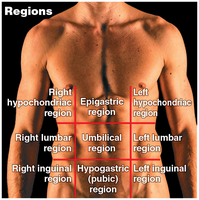
Nine abdominopelvic regions: Right/Left hypochondriac, epigastric, right/left lumbar, umbilical, right/left inguinal, hypogastric
Directional Terms and Sectional Planes
Directional terms describe the positions of structures relative to each other. Sectional planes are used to visualize internal structures.
Anterior (ventral): Front of the body
Posterior (dorsal): Back of the body
Superior: Above
Inferior: Below
Medial: Toward the midline
Lateral: Away from the midline
Proximal: Closer to the point of attachment
Distal: Farther from the point of attachment
Superficial: Toward the surface
Deep: Away from the surface
Sectional Planes:
Frontal (coronal) plane: Divides body into anterior and posterior parts
Sagittal plane: Divides body into right and left parts (midsagittal is exactly in the middle)
Transverse (horizontal) plane: Divides body into superior and inferior parts
Major Body Cavities and Membranes
The body is divided into major cavities that house organs. These cavities are lined by serous membranes, which secrete fluid to reduce friction.
Thoracic cavity: Contains heart and lungs; divided by the mediastinum.
Abdominopelvic cavity: Contains digestive, urinary, and reproductive organs; subdivided into abdominal and pelvic cavities.
Serous membranes: Double-layered membranes (visceral and parietal layers) lining body cavities and covering organs.
Examples: Pleura (lungs), pericardium (heart), peritoneum (abdominal organs).
Additional info: Understanding anatomical terminology and body organization is essential for effective communication in health sciences and for interpreting medical imaging and procedures.
