 Back
Chapter 1: Foundations – An Introduction to Anatomy
Study Guide - Smart Notes
 Tailored notes based on your materials, expanded with key definitions, examples, and context.
Introduction to Anatomy
Overview of Anatomy
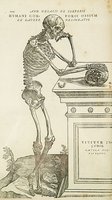
Anatomy is the branch of biology concerned with the study of the structure of organisms and their parts. The term originates from the Ancient Greek word anatomḗ, meaning 'dissection.' The field has a rich history, with significant contributions from figures such as Herophilus, Galen, and Andreas Vesalius, whose work De Humani Corporis Fabrica revolutionized anatomical study.
Importance of Studying Anatomy
Professional Careers: Essential for medical doctors, nurses, physical therapists, physician’s assistants, dentists, and many other health-related professions.
Scientific Knowledge: Provides foundational understanding for fields such as evolutionary biology, embryology, zoology, and anthropology.
Personal Health: Informs personal health decisions and understanding of the human body.
Research: Critical for advancements in biochemistry, medical science, and forensic investigations.
When Things Go Wrong: Disease
Infectious Diseases: Caused by bacteria, viruses, fungi, parasites, and prions.
Deficiency Diseases: Result from lack of essential nutrients (e.g., scurvy, goiter).
Hereditary Diseases: Genetic disorders such as cystic fibrosis, sickle cell anemia, Tay-Sachs disease, Von Willebrand disease, and hemophilia.
Physiological Diseases: Disorders of body function, including diabetes, cancer, and asthma.
Relationship Between Anatomy and Physiology
Definitions and Interdependence
Anatomy: Study of external and internal structures, naming parts, and understanding how they fit together.
Physiology: Study of how the body functions, including homeostatic mechanisms that maintain internal stability.
Principle: Anatomy dictates physiology—specific anatomical structures have specific physiological functions.
Levels of Biological Organization
Hierarchy of Structural Organization
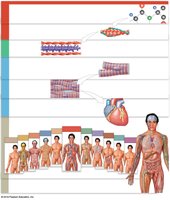
The human body is organized into a hierarchy of increasing complexity:
Chemical/Molecular Level: Atoms combine to form molecules.
Cellular Level: Molecules form organelles, which make up cells.
Tissue Level: Groups of similar cells form tissues.
Organ Level: Different tissues combine to form organs.
Organ System Level: Organs work together in organ systems.
Organism Level: All organ systems function together to sustain life.
Types of Anatomy
Microscopic vs. Gross Anatomy
Microscopic Anatomy: Study of structures too small to be seen with the naked eye.
Cytology: Study of cells.
Histology: Study of tissues.
Gross (Macroscopic) Anatomy: Study of structures visible to the naked eye.
Surface Anatomy: Superficial anatomical markings and their relation to deeper structures.
Clinical Anatomy: Anatomical changes during illness.
Surgical Anatomy: Anatomical landmarks important for surgical procedures.
Developmental and Comparative Anatomy
Developmental Anatomy: Study of structural changes from conception to adulthood.
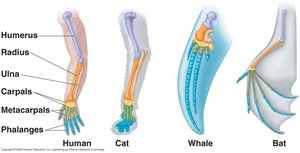
Comparative Anatomy: Examines similarities and differences in anatomy across species, highlighting evolutionary relationships.
Organ Systems of the Human Body
Overview of Major Organ Systems
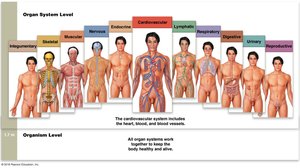
The human body consists of eleven major organ systems, each with primary and secondary homeostatic functions:
System | Primary Function(s) | Secondary Function(s) |
|---|---|---|
Integumentary | Protection, thermoregulation, sensory | Vitamin D synthesis |
Skeletal | Support, protection, blood cell formation | Mineral storage, immunity |
Muscular | Movement, support, heat production | Storage of amino acids |
Nervous | Immediate response, coordination | Hormone regulation |
Endocrine | Long-term regulation | Reproduction |
Cardiovascular | Transport of gases, nutrients | pH balance, immune function |
Lymphatic | Immunity, water balance | Nutrient absorption |
Respiratory | Gas exchange, pH balance | Water balance |
Digestive | Digestion, absorption | Waste removal, immune function |
Urinary | Waste elimination, water/pH balance | Endocrine function |
Reproductive | Reproduction | Secondary sex characteristics |
The Language of Anatomy
Anatomical Position and Directional Terms
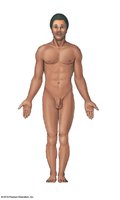
The anatomical position is the standard reference for anatomical terminology: standing upright, feet flat, arms at sides, and palms facing forward. All directional terms are based on this position.
Supine: Lying face up
Prone: Lying face down
Left/Right: Always refers to the specimen's left/right
Body Planes and Sections
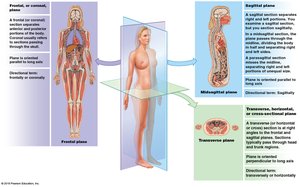
Sagittal Plane: Divides the body into left and right portions.
Frontal (Coronal) Plane: Divides the body into anterior and posterior portions.
Transverse (Horizontal) Plane: Divides the body into superior and inferior portions.
Abdominopelvic Regions and Quadrants
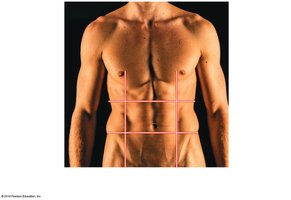
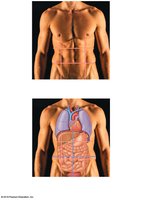
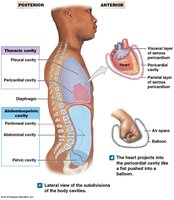
The abdominopelvic cavity is divided into regions and quadrants for precise anatomical localization. These divisions help relate superficial landmarks to underlying organs.
Body Cavities and Serous Membranes
Major body cavities include the thoracic, abdominal, and pelvic cavities. Serous membranes line these cavities and provide lubrication to reduce friction between organs.
Pleura: Surrounds the lungs (visceral and parietal layers).
Pericardium: Surrounds the heart.
Peritoneum: Surrounds abdominal organs.
Summary Table: Key Anatomical Terms
Term | Definition |
|---|---|
Anterior (ventral) | Toward the front of the body |
Posterior (dorsal) | Toward the back of the body |
Superior (cranial) | Toward the head |
Inferior (caudal) | Toward the feet |
Medial | Toward the midline |
Lateral | Away from the midline |
Proximal | Closer to the point of attachment |
Distal | Farther from the point of attachment |
Superficial | Near the surface |
Deep | Away from the surface |
Conclusion
Understanding the foundational concepts of anatomy, including its history, terminology, and organizational structure, is essential for further study in health sciences and related fields. Mastery of anatomical language and the relationships between structure and function provides the groundwork for all subsequent topics in anatomy and physiology.
